Article · RB01
Why RacketBridge Exists
Most adults organize friendship, exercise and recreation separately. RacketBridge is designed to put them back into the same recurring game—and to remove the practical obstacles that keep interested people from becoming regular players.
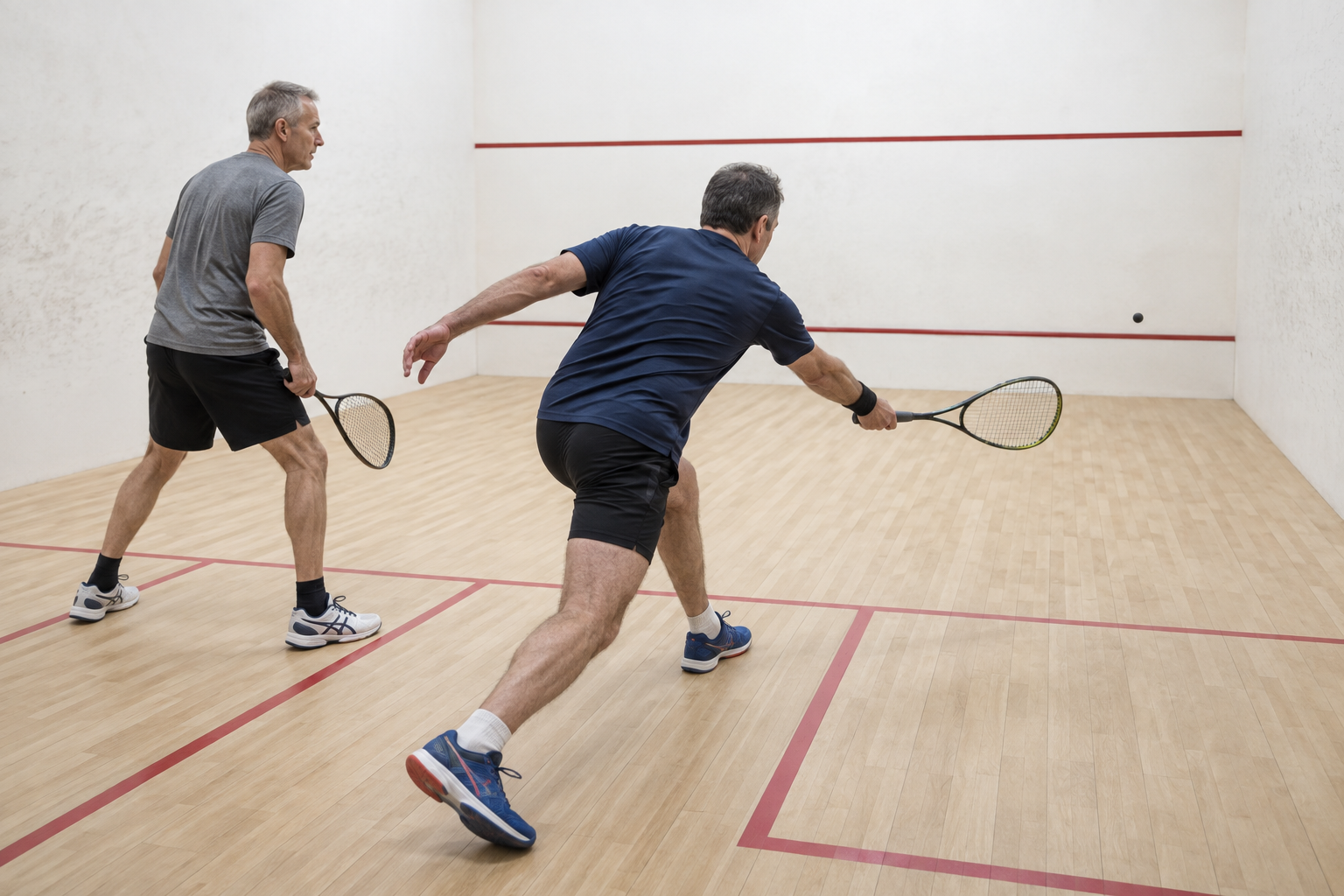
Three points
- A racket game can deliver three returns on the same hour. Players maintain relationships, practice usable movement and enjoy an uncertain contest instead of scheduling friendship, fitness and recreation separately.
- Interest becomes participation only when someone solves the practical details. A player needs a suitable partner or group, the right level and purpose, a workable time and place, and a clear second invitation.
- RacketBridge will be judged by repeat play. The service must help beginners begin, existing friends keep playing and players cross into related sports without making promises that attendance or enjoyment cannot support.
Many adults maintain three calendars without naming them. One holds work and family obligations. A second holds exercise: the gym, a studio class, a run completed largely through self-discipline. A third holds friendship and recreation, fitted into whatever time remains.
The arrangement is inefficient. A person may spend an hour exercising alone, then search for another evening to see a friend, then postpone both because neither feels urgent enough. The problem is not a shortage of good intentions. It is that each intention competes separately for scarce time.
A racket game changes the economics of that hour. A friend or partner expects the player to arrive. The ball creates a physical task. The score, rally or practice condition supplies uncertainty. Improvement remains visible: one more return, a better recovery, a longer rally, a calmer decision under pressure. Exercise occurs inside an activity with a social and practical purpose.
RacketBridge exists to make that hour easier to arrange—and easier to repeat.
Three returns on one appointment
“Friends, functional fitness and fun” describes three different forms of value. Treating them as interchangeable weakens the idea.
Friends means regular human contact. Existing friends need an easy way to protect a game in the calendar. New players need introductions that do not leave them standing outside an established group. A useful service must help people state whether they want a competitive match, cooperative practice, instruction, a social session or simply a reliable weekly game.
Functional fitness means capacity that serves real activity. The World Health Organization defines functional ability broadly: the ability to be mobile, build and maintain relationships and do what one has reason to value. On a racket court, that idea becomes concrete. Players observe, accelerate, stop, balance, reach, rotate, strike and recover because the rally demands it. Court play does not replace progressive strength work, mobility training or medical care. It gives physical capacity an immediate use.
Fun does not mean effortless entertainment. A close rally can be demanding. Practice can expose a weakness. Fun comes from willing participation: an absorbing problem, visible progress, good company and enough uncertainty to make the next point matter.
| If the hour is organized around… | It usually supplies | It may still lack |
|---|---|---|
| Individual exercise | Planned physical work and measurable load | A partner, play and a reason beyond exercise to return |
| A social meeting | Conversation, familiarity and emotional connection | Purposeful movement and skill development |
| Unstructured recreation | Novelty and enjoyment | Continuity, appropriate challenge and a next appointment |
| A well-matched racket game | Shared time, movement, skill and play | Strength or mobility work beyond the sport and careful load progression |
The final row is not automatically superior. A poor match, unsafe progression or unwelcoming group can erase the advantage. The opportunity lies in designing the conditions under which a game becomes worth repeating.
The real problem appears before the first serve
Jerusalem already has courts, clubs, coaches and players. Yet facilities alone do not create participation. A prospective player still faces a chain of unanswered questions.
Does this session welcome a complete beginner? Can one person register without bringing a partner? Is equipment available? Will the group play socially or keep formal score? Does “intermediate” describe technical ability, competitive results or simply confidence? Can a player in his sixties ask for a moderate pace without being treated as unambitious? What happens after the first lesson?
These are small questions individually. Together they form the gap between curiosity and play. Conventional directories often stop after listing a venue. Messaging groups work well for people already inside a community. Rankings describe competitive performance but say little about preferred pace, schedule, social expectations or the purpose of a session.
RacketBridge is intended to connect the whole decision. A useful invitation should identify the sport, place, time, level, format, intensity, equipment, cost and next step. A useful player profile should distinguish ability from intent. “I am a strong player” and “I want a hard match” are not the same statement.
Matching requires more than a rating
Ratings matter when two people want a conventional competitive match. They matter less when the objective is a first lesson, a cooperative rally, a return after injury or a conditioned game between unequal players.
Consider two competent squash players with similar results. One wants ninety minutes of demanding match play. The other wants forty minutes of controlled length hitting before work. Their ratings match; their sessions do not. Now consider an experienced table-tennis player and a squash beginner. Their sport-specific levels differ completely, yet they may be ideal partners for a hosted “Table Tennis Players Try Squash” session because both value observation, placement and learning.
RacketBridge should therefore match several dimensions at once:
| Matching question | Why it changes the experience | Useful answer |
|---|---|---|
| What do you want today? | Match play, instruction and cooperative practice require different partners | “Controlled practice followed by one game” |
| How hard do you want to work? | Similar ability can hide different fitness and recovery needs | “Moderate pace with breaks” |
| How do you describe your level? | Rankings exclude beginners and may not travel across sports | Rating plus a plain-language description |
| When and where can you play? | A theoretically good match has no value if it never occurs | Specific time windows and realistic travel area |
| How social should the session be? | Some players want conversation; others want focused training | A stated preference without judgment |
| What should happen next? | A first visit does not create a habit by itself | Another suitable session offered before departure |
Competition without the verdict
Some adults avoid competition because they hear a judgment inside the score: I won, you lost; I am better, you are worse. That interpretation makes ordinary club play unnecessarily narrow.
Conditioned games offer another form of contest. The players agree that one may score only after a deep shot, that neither may hit hard, or that the stronger player will direct play toward the other player’s best side. The restriction creates a tactical problem. It can also let players with different abilities share a meaningful game.
The score remains real inside the agreed condition. What changes is what the score measures. It may measure patience, depth, recovery or the ability to construct a rally. The stronger player does not pretend to be weaker; both players accept a format that gives each a reason to concentrate.
This approach reflects a larger RacketBridge principle: good participation begins with the session people want, not with a single hierarchy applied to every encounter.
One sport expands the network
Most players discover their first racket sport through circumstance. A parent owns a table. A friend books a tennis court. A school offers badminton. A nearby club opens a squash program. That first opportunity often becomes an identity: “I am a tennis player.”
The identity need not become a border. A table-tennis player brings habits of early observation, compact preparation and spin awareness to squash, then learns that the larger shared court demands very different movement and safety. A tennis player understands rally construction but must reinterpret space when walls return the ball. A squash player trying badminton recognizes recovery and disguise while meeting overhead technique and a shuttle that decelerates sharply.
Transfer is selective. Strokes do not copy neatly. Skill in one sport does not create an equivalent level in another. The useful bridge is a better first question: Which parts of my experience help, which must change, and who can give me a suitable first session?
Cross-sport activity also enlarges the social network available to every club. A table-tennis opening can introduce people to squash. A tennis community can supply participants for a badminton evening. Clubs gain prospective members without asking anyone to abandon the sport they already enjoy.
What RacketBridge must actually do
A persuasive idea is not yet a useful service. RacketBridge must convert its three promises into observable behavior.
| Promise | Service responsibility | Early evidence worth measuring |
|---|---|---|
| Friends | Make introductions, protect contact preferences and simplify repeat invitations | Second visits, voluntary repeat pairings and returning groups |
| Functional fitness | Let players state pace and purpose; support gradual participation | Attendance patterns, session completion and participant-reported suitability |
| Fun | Offer formats that reward rallies, learning and fair challenge | Return intention, repeat bookings and reasons given for returning |
| Cross-sport discovery | Explain transferable skills and provide hosted beginner entry points | First sessions completed and second-sport return visits |
| Club growth | Show who a session welcomes and what happens after arrival | Newcomer conversion, retention and fuller appropriate sessions |
These measures need interpretation. A second visit does not prove better health. A longer rally does not prove friendship. Self-reported enjoyment does not guarantee continued participation. The pilot must test whether the service reduces practical friction and produces games people voluntarily repeat.
Jerusalem is the proving ground
Jerusalem offers the right scale for an early test. Its racket communities overlap geographically but often remain separate socially and digitally. New squash facilities and the anticipated table-tennis center create timely reasons to invite established players into new spaces. The city also presents real constraints: travel time, language, religious schedules, age, gender norms, playing level and the difficulty of entering a group without a partner.
The first objective is therefore modest and demanding: help a person move from “I might try that” to a suitable first session, then make the second session easier than the first.
If RacketBridge succeeds, it will not be because an application persuaded people to spend more time looking at a screen. It will be because the screen led to a court, the court led to another person and both players found a reason to meet again.