Article · FF01
Fitness for Real Life
Functional fitness is the capacity to perform valued activities—to move, stop, balance, reach, rotate and recover—yet recreational racket play develops only part of that capacity and works best beside progressive strength, mobility and aerobic training.
Three points
- Function begins with a task a person values. Strength, endurance, mobility and balance matter because they support play, travel, stairs, family life and independence.
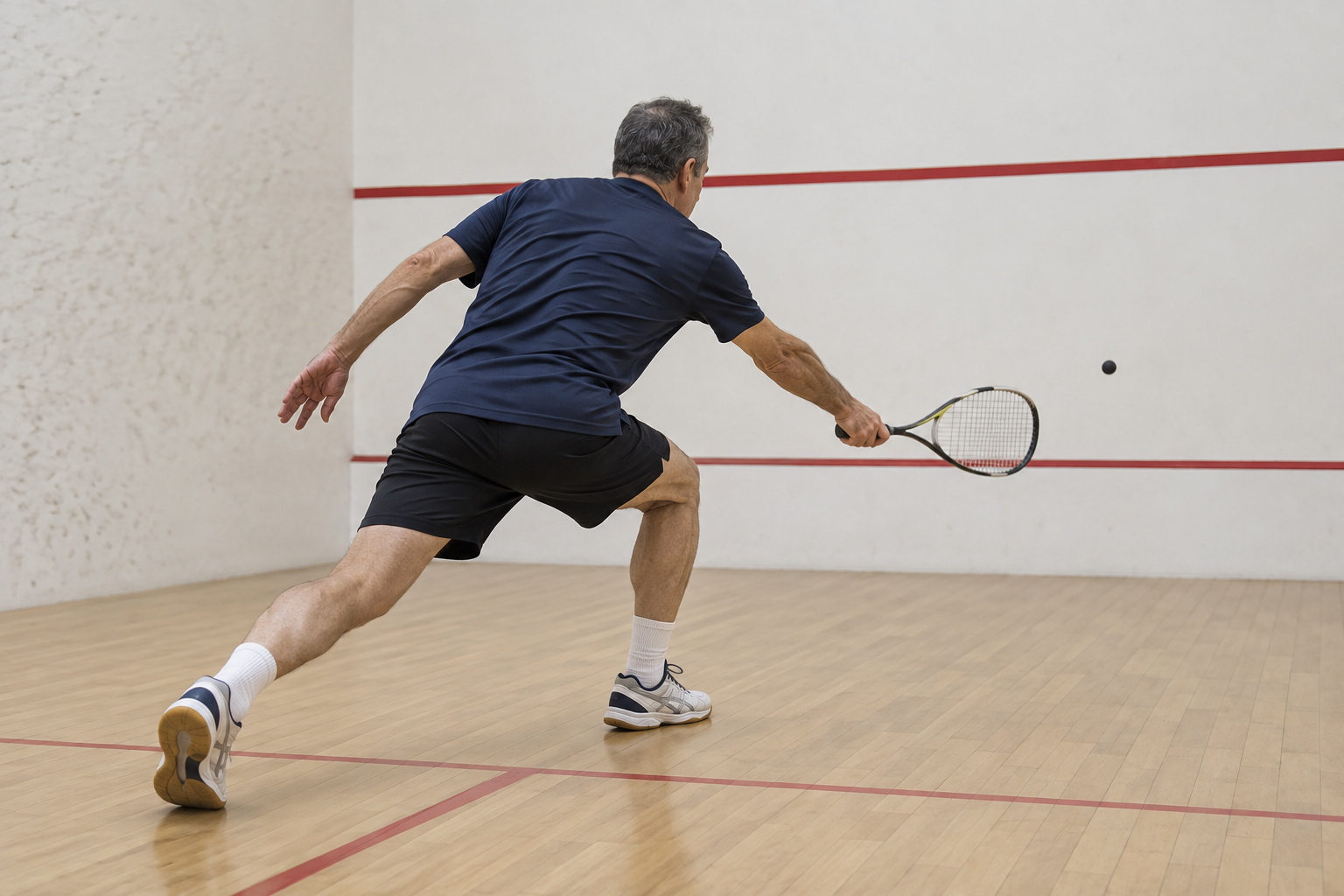
- RB Sports develop an unusually rich movement sequence: perceive, decide, start, brake, strike and recover. The sequence changes by sport, so fitness transfers as a foundation rather than a finished technique.
- Court time leaves gaps. A durable recreational player combines enjoyable play with progressive strength, aerobic activity, balance, mobility and enough recovery for age, health and playing history.
Fitness advertising favors visible numbers: weight lifted, distance covered, calories burned and minutes in a heart-rate zone. Each number can answer a useful question. None answers the question that matters most to a recreational player: What does this training help me do, and can I still do it well next year?
RacketBridge uses functional fitness as a practical editorial term for the physical capacity to perform valued activities. It includes strength, endurance, mobility, balance, coordination, acceleration and controlled braking. It is not a diagnosis, a branded workout or a claim that every movement must resemble a forehand.
Function belongs to a person and a purpose
The same exercise has different value for different people. A heavy squat may serve a trained athlete. Rising smoothly from a chair may be the more relevant strength test for an older beginner. A long run develops endurance, but it does not teach a squash player to stop before the front wall or a table-tennis player to stay balanced through a rapid change of direction.
The World Health Organization takes an even broader view. It defines functional ability through what people can be and do, including moving, maintaining relationships, meeting basic needs and contributing to society. A person’s physical capacity interacts with the environment. Stairs, court access, transport, a suitable partner and a welcoming club all affect whether capacity becomes participation.
That distinction matters to RacketBridge. The goal is not an abstract state called “fitness.” The goal is enough usable capacity—and enough social opportunity—to keep doing something worthwhile.
A rally is a chain, not one exercise
Every rally joins six tasks. The player reads an opponent or incoming ball, selects a response, initiates movement, controls arrival, strikes and recovers. Fatigue does not merely slow the legs; it can reduce balance, timing and judgment at each link.
This makes racket play an open-skill activity. The player moves in response to changing information rather than following a fully predictable path. A stationary bicycle can build aerobic capacity efficiently. It does not require the rider to interpret a serve, adjust foot position and control a racket face before the next ball arrives. Racket play adds perception and decision to exertion.
The useful demands are concrete:
| Capacity | What it does on court | What it supports in daily life | What court play may fail to develop |
|---|---|---|---|
| Lower-body strength | Pushes the body out of a split step or lunge | Stairs, rising, lifting and carrying | Progressive force through a full, controlled range |
| Braking strength | Absorbs force before a wall, net or change of direction | Stopping after a trip or sudden step | Slow, deliberate practice of deceleration mechanics |
| Balance | Holds posture while reaching or changing direction | Turning, dressing and moving on uneven ground | Stable single-leg work without rally pressure |
| Mobility | Permits a useful ankle, hip, trunk and shoulder position | Reaching, bending and comfortable movement | Individual restrictions that require targeted work |
| Aerobic capacity | Supports repeated rallies and recovery between points | Walking, hills, errands and sustained activity | A predictable weekly dose when rallies are short or rests are long |
| Coordination | Connects eyes, feet, trunk, arm and racket | Responding to an unexpected object or obstacle | Balanced work on the non-dominant side |
| Reaction and decision | Converts visual information into timely action | Navigating changing surroundings | Calm rehearsal of a new movement pattern |
| Trunk control | Transfers force while the limbs move | Carrying, reaching and changing direction | Progressive strength in multiple planes |
The final column prevents a common mistake. Playing a sport uses a capacity; it does not always develop that capacity through a complete or progressive range.
Each sport expresses the foundation differently
Transfer between RB Sports is real but incomplete. A tennis player brings tracking skill and rotational coordination to squash. The player still must learn shorter approach steps, shared-court awareness and braking near the front corners. A squash player brings anticipation and repeated movement to table tennis, but a large lunge becomes wasteful when the next ball arrives almost immediately.
| Sport | Typical recreational movement problem | Useful functional emphasis | Common error when crossing over |
|---|---|---|---|
| Squash | Reach a corner, control the lunge and recover in shared space | Braking, leg strength, hip and ankle control | Running through the shot or turning toward an opponent |
| Tennis | Cover a larger court and organize strokes at wider distances | Lateral acceleration, trunk control and shoulder capacity | Arriving late and using the arm to rescue poor spacing |
| Table tennis | Make repeated small adjustments under severe time pressure | Low-posture endurance, balance and rapid foot repositioning | Taking movements that are too large to recover from |
| Badminton | Move forward and backward, jump, land and strike overhead | Calf capacity, landing control and shoulder mobility | Reaching overhead without preparing the trunk and shoulder |
| Padel | Move with a partner, defend rebounds and transition together | Braking, communication and repeated low-to-high movement | Following the ball while losing team position |
These are tendencies, not measurements of every match. Level, age, surface, rally style and session format change the demand.
Braking deserves equal status with speed
Recreational players often train to reach the ball and neglect the cost of stopping. Yet the body must absorb momentum before it can strike in balance or change direction. Weak braking appears as extra steps, a collapsing knee, an uncontrolled lunge or a collision risk.
A sensible progression starts below match speed. Learn to step and stop under control. Add a directional choice. Add a racket and predictable feed. Only then add the speed and uncertainty of open play. The objective is not a textbook pose. It is a position the player can control and leave safely.
This progression also exposes why professional movement is a poor template when copied at full depth or speed. Professionals support extreme court positions with years of strength, mobility, technique and workload preparation. The recreational player needs the principle—efficient arrival and recovery—at a range the body can own.
Court play belongs inside a complete week
WHO guidance gives adults a useful public-health baseline: 150–300 minutes of moderate aerobic activity, or 75–150 minutes of vigorous activity, across the week, plus muscle-strengthening work involving major muscle groups on at least two days. For older adults, the guidance also recommends multicomponent activity emphasizing functional balance and strength on at least three days.
A racket session may contribute to aerobic minutes, but a booking is not a standardized dose. Twenty minutes of continuous squash and a relaxed doubles session do not impose the same load. Watches also estimate rather than directly measure energy expenditure. Record the session honestly: duration, effort, recovery and how the body responded the next day.
A balanced recreational week might contain two court sessions, two short whole-body strength sessions, easy walking or cycling, and brief balance or mobility work. The exact arrangement depends on age, medical status, injury history and recovery. Increase one major variable at a time—frequency, duration, intensity or technical complexity—rather than increasing all four because one session felt good.
Measure capacity without turning it into a diagnosis
Useful observations are repeatable and tied to a task:
- Can you stop after a lateral step without a corrective hop?
- Can you rise from a chair smoothly and under control?
- Does a familiar flight of stairs require less recovery?
- Can you reach the sport position your technique requires without pain?
- Does your movement remain organized late in a session?
These observations show change; they do not identify disease or certify safety. Pain that persists, dizziness, unusual breathlessness or symptoms that change participation deserve qualified medical attention. A coach can improve movement and session design. A physician, physical therapist or appropriately qualified exercise professional addresses questions beyond coaching.
The strongest case for RB Sports is therefore measured. They combine movement, attention and human connection in a form many people want to repeat. They contribute to functional fitness when the game suits the player, and they become more durable when complementary training fills the gaps the game leaves.