Article · CG01
Competition Without Fear
A recreational score should sharpen attention without becoming a verdict on ability or belonging. Conditioned games give unequal players a shared contest by stating what the score measures, changing one purposeful rule and treating the result as information for the next game.
Three points
- Many adults fear what losing appears to reveal: inadequate skill, poor movement or failure to justify a stronger player's time. The answer is not to remove every score but to define its meaning before play.
- A conditioned game changes one purposeful feature—scoring, target, pace, court area or opening sequence—while preserving an opponent, uncertainty and real decisions. The condition gives players different but compatible challenges.
- The format succeeds when both players understand the agreement, remain safe and want another session. A close score alone proves little; clarity, respect, useful decisions and return intention matter more.
Competition gives sport much of its energy. A score focuses attention, makes choices consequential and gives a rally a place in a larger story. It can also keep adults away from a court they might otherwise enjoy.
The fear is rarely arithmetic. A beginner worries that six lost points prove he does not belong. A returning player worries that awkward movement will be visible. A stronger player fears an unproductive hour; a developing player fears becoming an obligation. In doubles, a player may worry more about disappointing a partner than losing to the other side.
Removing the score can lower pressure, but it also removes some of the attention and uncertainty that make play compelling. RacketBridge proposes a different response: keep a meaningful contest, state exactly what it measures and design the task so each participant has a credible reason to care.
This is a proposed recreational format, not a clinically tested treatment for anxiety. Coaching research supports representative practice problems and deliberate changes to task constraints. It does not establish that the specific RacketBridge formats below reduce fear, improve retention or prevent injury. Those claims require pilot testing.
Four formats make four different promises
Players need to know what kind of session they are entering. Confusion creates more discomfort than competition itself.
| Format | What stays open | What the result means | Appropriate use |
|---|---|---|---|
| Cooperative rally | Players work together to continue an exchange | Duration or quality of cooperation | Warm-up, introduction or control practice |
| Closed drill | Feed, movement or response is largely prescribed | Accuracy or consistency in a repeated task | Isolate a technique or movement pattern |
| Conditioned game | An opponent and score remain, but one or two features change | Performance under the stated condition | Develop decisions or create a useful unequal-level contest |
| Regulation match | Official rules apply and choices remain open | Result under the sport’s ordinary competitive rules | Test overall match performance |
A friendly session can include all four formats. The participants should know when one ends and another begins. A conditioned score does not update a conventional rating unless the rating system explicitly says that it does.
The opening question is therefore not simply, “Who won?” It is, “What did we agree this game would test?”
A condition changes the problem, not the person’s status
Equal ratings are one way to create an interesting game. They are not the only way. Players of different standards can accept conditions that give each person a demanding and useful task.
The stronger player might score only after hitting an agreed target. The developing player might receive a larger scoring area. Both might begin each point with three cooperative contacts before open play. These changes preserve decisions and uncertainty while changing how a point can be constructed or won.
A good condition has six properties:
- Purposeful: it develops a skill, creates rallies or balances a known difference.
- Observable: both players can tell whether the condition was met.
- Limited: one principal change remains easy to remember during play.
- Representative: the game still contains information and decisions that matter in the sport.
- Respectful: neither player becomes a prop in someone else’s practice.
- Reversible: either person can pause or discard a condition that fails.
The condition should never change quietly because the score becomes inconvenient. That turns a learning agreement into arbitrary control.
Different sports offer different levers
The best condition changes the behavior that produces the desired challenge. It does not merely award random points.
| RB Sport | Session purpose | Example condition | What each player must solve |
|---|---|---|---|
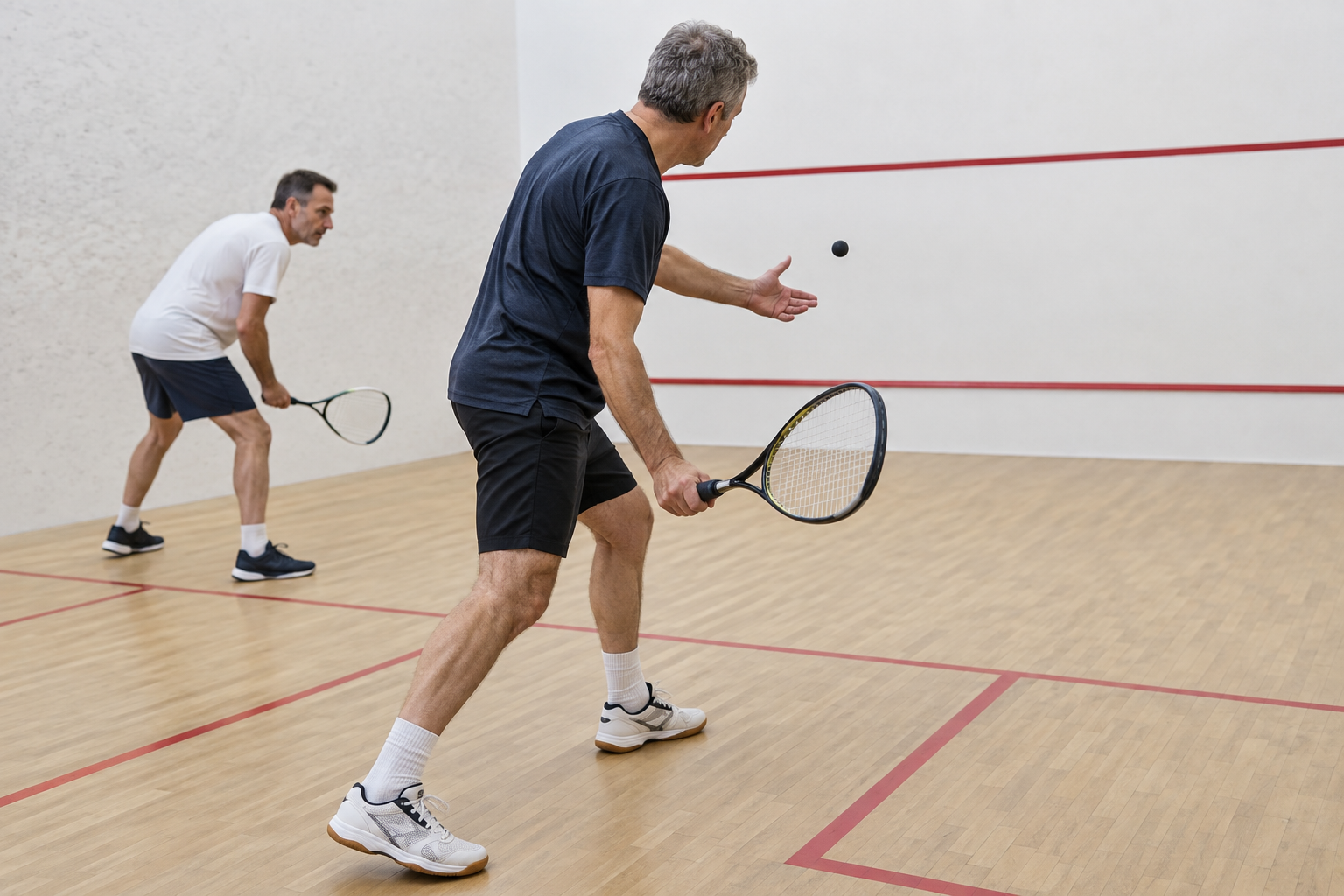
| Squash | Create length and recovery | Stronger player scores only after a ball reaches an agreed rear-court target; both use controlled pace | Precision and patience for one player; retrieval and recovery for the other |
| Tennis | Build a rally before attacking | The point becomes open after three cooperative cross-court balls | Spacing and control first, then recognition of the attacking chance |
| Table tennis | Improve serve return | Server uses one declared serve type for a short game; receiver earns a bonus for a return to a target zone | Disguise and placement for one; reading and first-ball control for the other |
| Badminton | Develop movement before a winner | A winning shot counts only after both front and rear court have been used in the rally | Construction, recovery and change of depth |
| Padel | Improve team movement | A point counts only if partners cross the service line together before the winning phase | Communication and coordinated transition |
These examples need adaptation by a coach or experienced host. A target that is demanding for one pair may be trivial or impossible for another. In squash, every condition remains subordinate to swing safety, access to the ball and interference rules. No training objective justifies striking near an opponent or turning blindly toward a ball behind the body.
Read the score narrowly
A conditioned score belongs to the condition. It does not prove that one player has become stronger overall or that the other has lost status. A 7–5 result may show that the design created an absorbing challenge. It may also show that one condition was too easy and another impossibly hard. The score needs context.
This interpretation matters for ladders. A conventional ladder orders results under common rules. A conditioned ladder recognizes a different achievement: completing varied challenges with different people. Combining the two into one unexplained ranking would mislead participants.
Competition becomes friendlier when the result helps design the next game. Partners can tighten a target, reverse roles, change the opening sequence or return to ordinary rules. Losing becomes useful information when the agreement protects its limited meaning.
Replace hidden judgment with an explicit agreement
Before play, each partner completes one sentence: “Today I want to practice ___, so for the next ___ minutes we will change ___.” The final blank gives the condition an end point. A short block makes experimentation easier and prevents a poor rule from consuming the session.
| Concern | Weak response | Better design response |
|---|---|---|
| “The score will prove I do not belong” | Avoid all scoring indefinitely | State the narrow task the score measures and keep the first game short |
| “The stronger player will be bored” | Ask the player to “take it easy” | Give the player a precise target or restricted route to score |
| “I am being patronized” | Hide the handicap | Explain the asymmetric challenges and let both players accept them |
| “I will disappoint my partner” | Offer vague reassurance | Give each partner a visible role and a shared process target |
| “The rule is unfair” | Debate after every point | Define an observable condition and a method for disputed calls before play |
| “Losing ends the invitation” | Wait to see how everyone feels | Review the format and propose the next session before leaving |
Competition still supplies pressure and consequence. The difference is that the players decide what the score measures.
Know when a condition has failed
A close score does not rescue a bad experience. Stop or change the format when players spend more time remembering rules than reading the ball, when the restriction produces unnatural or unsafe movement, when one player feels displayed rather than challenged, or when the selected task rarely occurs.
The stronger player should not receive every restriction. Reversing roles can reveal whether the exercise offers value to both participants. Nor should the developing player receive automatic advantages forever. As skill changes, the condition should change.
Three questions after a short block are enough for an immediate review:
- Did the condition create the intended decisions?
- Did both players have a credible chance to succeed at their own task?
- Should we retain, adjust or discard it?
The answers matter more than defending the original plan.
Test the RacketBridge claim
RacketBridge should not infer success from enthusiasm alone. After a pilot session, both players can privately rate four statements: the purpose was clear; the challenge suited me; the agreement felt respectful; I want another session with this person. The host should also record completion, early stops, disputed rules, safety incidents and whether a second game was booked.
Compare those responses with ordinary social matches involving similar level differences. The useful questions are behavioral: Do more people complete the session? Do they book again? Do the conditions create the intended rally patterns? Does either participant consistently feel patronized or overmatched?
Research on practice design explains why a purposeful constraint may produce useful decisions. It does not answer the RacketBridge social question in advance. Only actual participants can show whether competition without fear becomes a repeatable community format.