Article · PM06
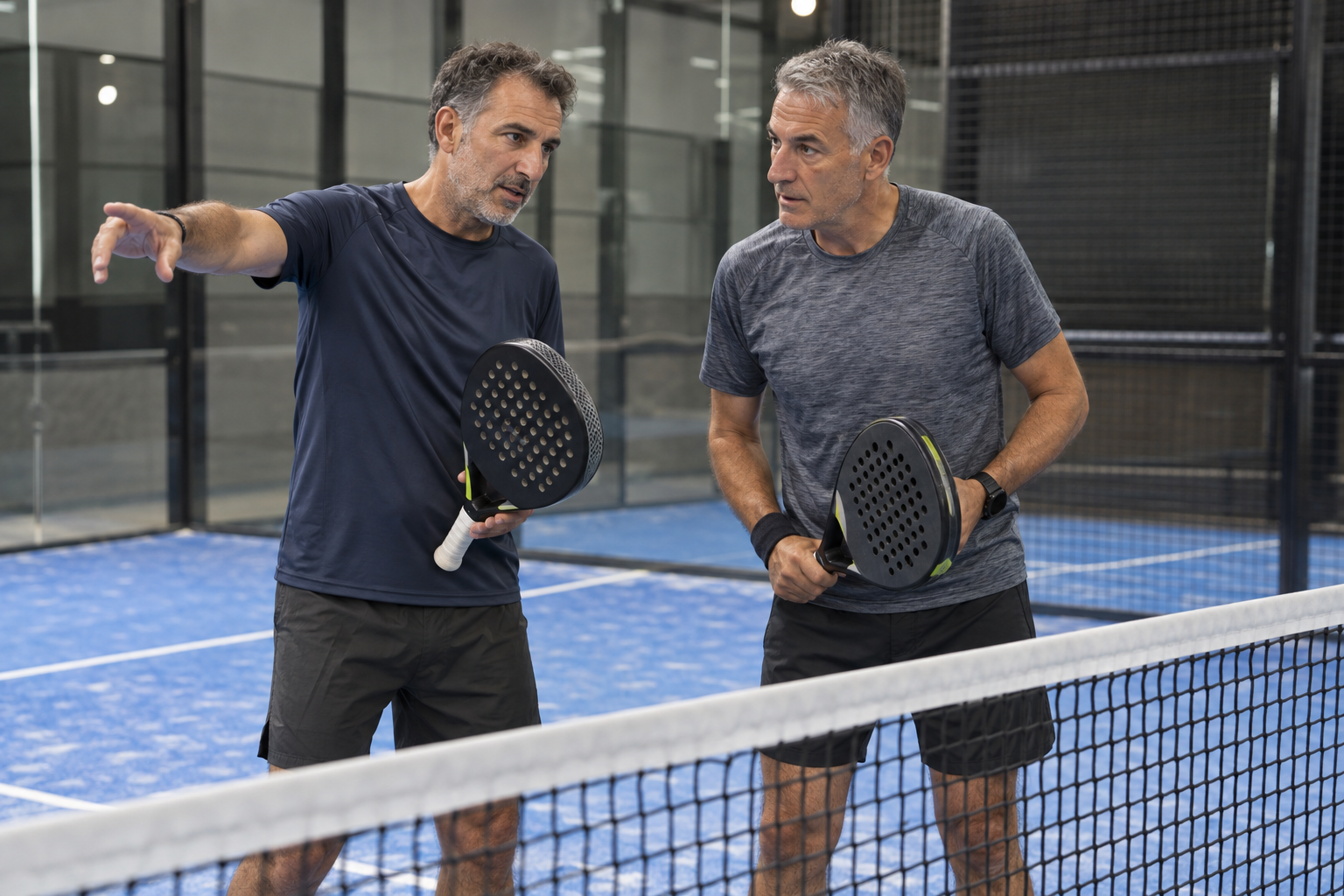
Padel Progress Belongs to the Pair
Professional padel highlights speed and aggressive overheads, but the transferable achievement is two players who move, communicate and solve the next ball together
Three points
- **Professional padel is a partnership system.** Position, spacing and coordinated movement create many of the spectacular shots viewers remember.
- **Recreational progress starts with shared decisions.** Partners need simple rules for the middle, net movement, lobs and wall rebounds before they need greater pace.
- **Equipment should support control and confidence.** Borrowing a manageable racket reveals more than copying the shape or balance used by a favorite professional.
Padel’s most shareable moments feature overhead winners, balls leaving the court and rapid exchanges at net. Watch only the striker and the professional game looks like a collection of difficult shots. Watch the pair and another structure appears.
Partners maintain useful spacing, move forward and back together, protect the middle, communicate early and preserve the next position after an overhead. The winner belongs to a sequence the pair created.
Copy the relationship between players
Recreational partners often lose points before either person strikes poorly. One advances while the other stays deep. Both leave the middle for the other. A player hits a difficult winner because no one called time for the back-wall rebound.
| Professional action | Underlying principle | Recreational version |
|---|---|---|
| Coordinated advance | Maintain a common court shape | Call “up” and move as a pair |
| Middle coverage | Remove uncertainty in valuable space | Agree who takes forehand and overhead balls |
| Wall defense | Use the rebound to create time | Learn one predictable back-wall feed |
| Aggressive overhead | Preserve or finish net advantage | Direct a controlled overhead and recover |
| Compact volley | Take time without losing position | Short swing to a large target |
| Tactical signaling | Share intention before pressure | Use plain calls both partners understand |
Measure pair behavior
The final score says little about why a new pair struggled. During a short practice game, record observable partnership events.
| Pair measure | Count as success | What a low count suggests |
|---|---|---|
| Coordinated movement | Both arrive at net or retreat together | Calls or recognition occur late |
| Middle decision | One player calls and takes the ball cleanly | Responsibility remains unclear |
| Wall judgment | Pair lets a playable ball rebound by agreement | Players rush or distrust the wall |
| Recovery after overhead | Striker and partner restore spacing | Attack breaks the pair’s shape |
| Constructed attack | Pair earns an easier ball before forcing pace | Highlight hunting begins too early |
| Supportive reset | Partners communicate after confusion | Errors become personal rather than tactical |
Build the wall into the lesson
Beginners need time to discover which balls should pass and rebound. Start with predictable feeds and no score. One player calls “wall,” lets the ball travel and returns it to a large target while the partner maintains spacing. Add direction choice, then a cooperative rally, then pressure.
The same staged approach suits overheads. Begin grounded and controlled. Add movement and recovery. Increase pace only when the pair’s position survives the shot.
Select equipment for the present game
Padel rackets vary in mass, balance and shape. Beginner guidance commonly favors control and manageable handling and encourages borrowing or renting before purchase. The best trial includes defensive contact, volleys and overheads late in the session.
| Trial question | Useful evidence | Misleading shortcut |
|---|---|---|
| Can I position the racket on fast volleys? | Repeated controlled contacts | One hard winner |
| Does the racket stay comfortable? | Normal play after thirty minutes | First-swing impression |
| Can I defend after the wall? | Maneuverable preparation | Professional endorsement |
| Can I control an overhead? | Direction plus balanced recovery | Maximum rebound alone |
The recreational pair should study professional padel closely, with attention shifted away from the highlight. Copy the spacing, communication, patience and recovery. Those habits create more rallies, better decisions and more fun with the person sharing the court.