Article · CS06
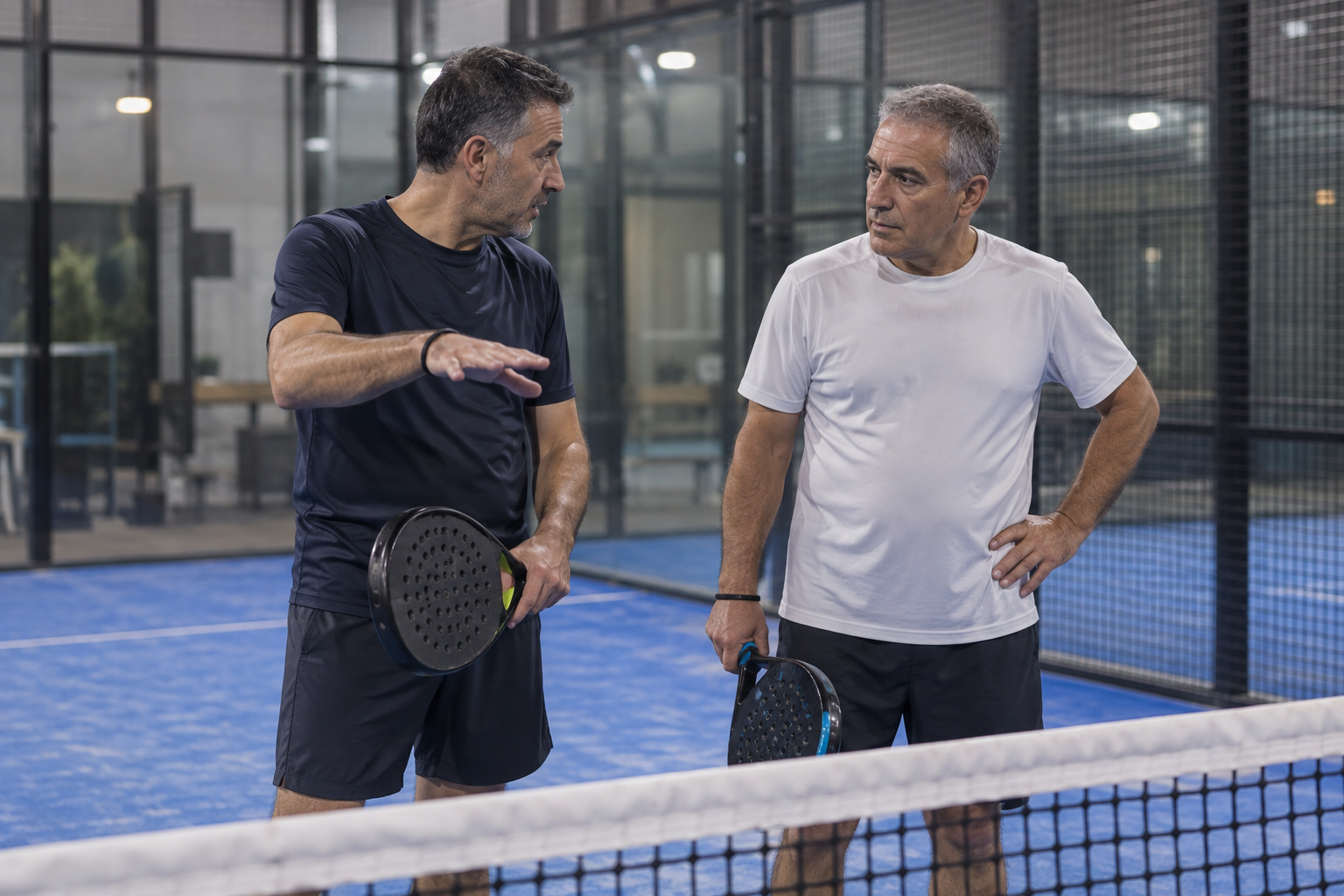
Squash Players Meet a Partner and a Net
Squash experience helps players read walls and recover after pressure, while padel reorganizes those skills around a net, a teammate and coordinated doubles position
Three points
- **Wall experience provides a useful head start.** Squash players understand that a rebound can create time instead of ending the point.
- **Padel geometry belongs to a pair.** Two partners must advance, retreat and protect the middle together.
- **Patience transfers better than the squash swing.** Compact volleys, controlled overheads and communication should precede power.
A squash player enters padel already willing to let a ball travel toward glass. That comfort removes one beginner fear. It can also create false confidence: padel places a net between teams, a partner alongside each player and a different racket in the hand.
| Squash resource | Padel value | New requirement |
|---|---|---|
| Read the back wall | Let selected balls rebound | Coordinate with a partner |
| Recover after pressure | Expect another shot | Move as a pair toward or away from net |
| Use height and depth | Create time | Clear the net with purposeful trajectory |
| Compact reaction under pressure | Support volleys | Shorten swing with solid paddle |
| Occupy central access | Understand high-value space | Share the middle explicitly |
Replace individual recovery with pair shape
| Situation | Pair rule | Observable success |
|---|---|---|
| Advancing | Call and move together | Similar depth at net |
| Defending lob | Both retreat unless clearly assigned | No split formation |
| Middle ball | Predetermine forehand or call responsibility | One decisive player |
| Back-wall ball | Call “wall” early | Partner preserves space |
| Overhead | Striker recovers while partner covers | Shape survives attack |
A first exchange
| Block | Task | Purpose |
|---|---|---|
| Wall | Predictable back-glass feeds | Transfer rebound confidence |
| Net | Compact cooperative volleys | Control racket length and angle |
| Pair | Synchronized advance and retreat | Establish shared geometry |
| Middle | Call every central ball | Remove hesitation |
| Game | Score only after coordinated net position | Reward partnership before winners |
Professional padel highlights spectacular finishes. The squash player’s best entry route uses the quieter expertise beneath them: patience with rebounds, recovery after pressure and curiosity about how position creates the next ball.
Rebuild the instinct for the middle
Squash trains one player to recover toward central access after striking. In padel, moving independently toward the middle can close a partner’s space or leave the line exposed. The pair needs a shared reference: maintain workable lateral spacing, move on a common forward-back line and call balls that enter the uncertain area between them.
Run a shadow exercise before hitting. The feeder points toward net, back glass or one sideline. Both partners move and stop while checking their relative depth and middle coverage. Add a slow ball only after the pair can preserve shape without watching each other continuously.
Let the glass create time
A squash player is comfortable with rebounds but may read padel glass as if every wall angle behaves like a squash court. The net, floor bounce, glass sequence and solid paddle change the contact. Start with one predictable back-glass feed and a large crosscourt target. Add side-glass combinations later.
The lesson should reward correct non-action as well as contact. Letting a ball pass, calling it early and arriving behind the rebound may show more padel understanding than volleying it from a poor position. The second session can add a conditioned point in which the pair earns a bonus for a called, controlled wall defense followed by coordinated recovery.