Article · CG03
Play to Their Strength
Match tactics attack weakness, but a strong practice partnership often directs play toward the developing player's reliable shot, giving that player meaningful repetitions and the stronger player a demanding test of accuracy, patience and construction.
Three points
- Unequal players can pursue different but compatible goals in the same rally. One practices control and construction while the other practices recognition, movement and a trusted response.
- Playing to a strength is not charity when the stronger player's target remains exacting and the agreement is explicit. Hidden handicaps and careless feeds communicate condescension.
- Roles should change as the session develops. A conditioned block, role reversal and short open game reveal what the rule improved and what ordinary play still exposes.
Competitive tactics are direct: identify a weakness and make the opponent use it. That principle belongs in a match whose purpose is to win.
Practice changes the economic logic of the rally. The valuable outcome is not the cheapest point. It is a sequence both players want to repeat because each receives useful work.
Difference can become an asset
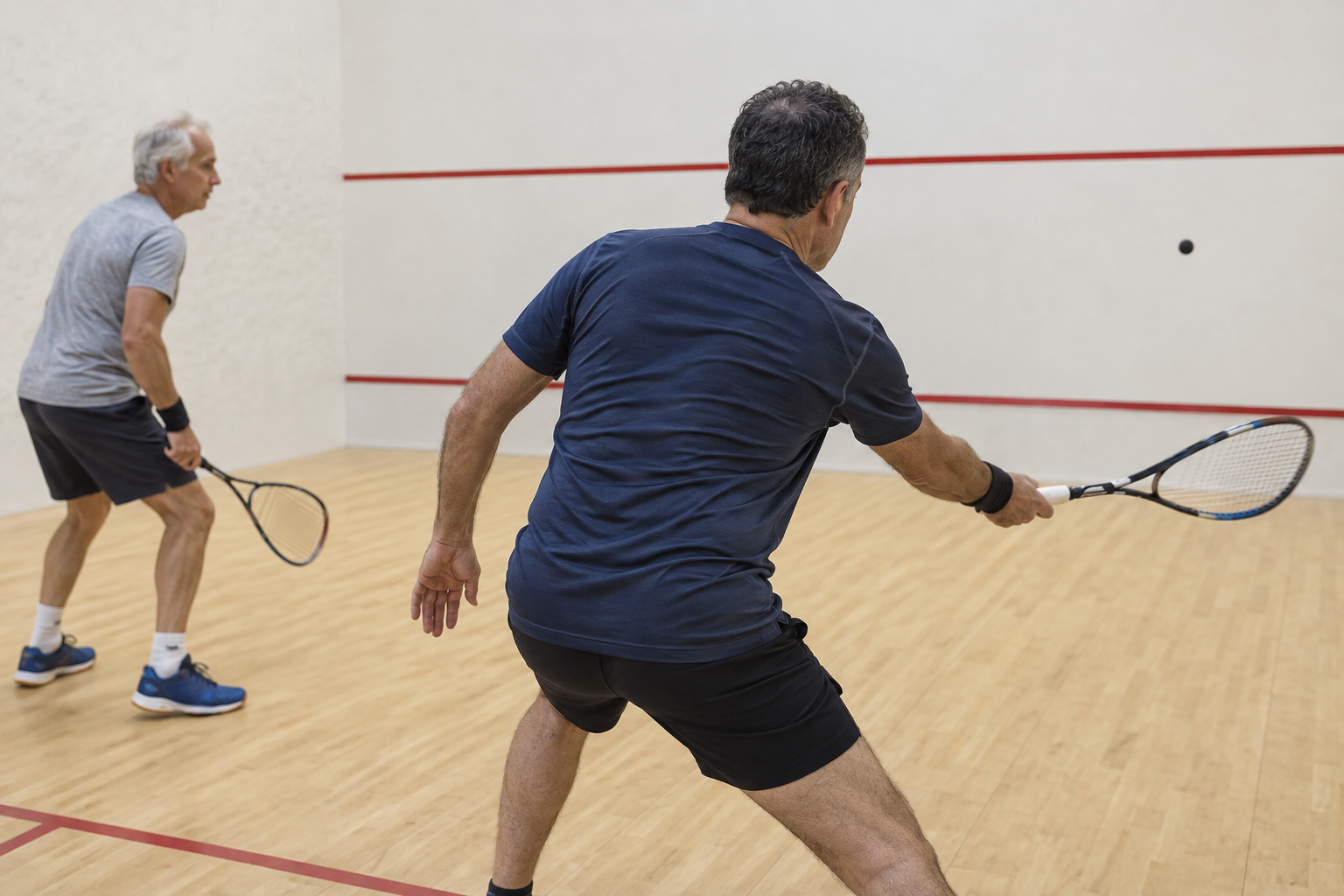
An advanced squash player may direct most balls toward an amateur’s dependable forehand. The amateur receives enough playable balls to move, recover and make decisions. The advanced player loses easy access to the weaker backhand and must hit a smaller target with patience.
The arrangement works because their goals differ without conflicting.
| Player | Ordinary mismatch | Conditioned purpose | Credible challenge |
|---|---|---|---|
| Stronger | Wins quickly by exposing weakness | Direct play toward the reliable side | Accuracy, disguise and construction within a narrow route |
| Developing | Defends the weakest shot repeatedly | Organize around a trusted response | Recover, vary placement and recognize the rare opening |
| Both | Rally quality collapses | Sustain a representative exchange | Make decisions under pressure and preserve safety |
The developing player is not promised victory. He receives a rally in which present skill can operate.
Make the stronger task genuinely difficult
“Play nicely” is not a training instruction. The stronger player may become inattentive, then alternate between careless errors and abrupt winners. The partner experiences both as dismissal.
Precision creates a better bargain. The stronger player can be required to reach a deep target before attacking, use a declared sequence, keep pace below an agreed threshold or recover to a stricter position. The target should be difficult enough to require full attention without producing unsafe or unnatural movement.
| RB Sport | Stronger player’s condition | Developing player’s task | Shared value |
|---|---|---|---|
| Squash | Attack only after two controlled deep balls to the forehand side | Hold length and recover around the T | Patience, spacing and longer movement sequences |
| Tennis | Continue cross-court until a short ball appears | Maintain height and depth from a trusted wing | Construction before changing direction |
| Table tennis | Serve one declared spin and place returns to the reliable side | Read the serve and control the third-ball exchange | Repeated first-three-ball decisions |
| Badminton | Build through the rear court before using a drop | Recover behind the shuttle and defend depth | Movement pattern and change of pace |
| Padel | Direct first attack toward the stronger defender | Defend with height and move forward with the partner | Team transition rather than isolated winners |
These are starting points, not universal recipes. Playing level, handedness, safety and the actual skill goal change the agreement.
Consent protects dignity
A hidden handicap tells the developing player that the stronger player controls the meaning of the session. An explicit condition makes both participants authors.
Before play, state four things:
- the skill each player wants to practice;
- the route each player has to score;
- how long the condition will last;
- how either player may stop or revise it.
The stronger player should not describe the exercise as “giving the other player a chance.” The condition gives both people a task. Nor should every restriction fall on the stronger player. Some formats give the developing player a placement target, minimum rally requirement or recovery goal.
Use strength as a platform, not a hiding place
Repeatedly using a reliable forehand can build movement, confidence and tactical understanding. It can also allow the weaker side to remain untouched forever. The session needs progression.
| Phase | Format | Purpose |
|---|---|---|
| Establish | Cooperative exchange toward the reliable side | Create rhythm and identify a usable pace |
| Challenge | Score under the asymmetric condition | Add decisions and consequence |
| Reverse | Change target or exchange player conditions | Test whether each task remains meaningful |
| Open | Play briefly under ordinary rules | Observe what transfers and what breaks down |
| Review | Compare the four phases | Select the next condition rather than declare a general winner |
The open phase prevents the conditioned result from becoming a false ranking. It also reveals when the reliable shot can serve as a base from which the player begins addressing a weakness.
Evaluate the partnership, not only the score
Count information that reflects the purpose: rallies reaching the target sequence, balanced recoveries, successful changes of direction, interruptions and second-session interest. Ask both players privately whether the challenge felt clear, difficult and respectful.
A close score can coexist with boredom. A one-sided score can accompany excellent learning. The best sign is a pair that can explain what each person practiced and propose a useful revision.
RacketBridge can match these partnerships through richer profiles. Rating remains relevant, but so do a player’s reliable patterns, training aims, preferred pace, willingness to use conditions and ability to host a respectful session. Difference then becomes material for good play rather than an automatic reason to decline it.