Article · PM05
Earn the Jump Before the Smash
Badminton professionals support explosive overheads with positioning, strength and landing skill; recreational players should copy the preparation and recovery before copying maximum height or speed
Three points
- **The highlight is the final link in a long chain.** Early movement, balanced preparation, coordinated contact, landing and recovery make an explosive shot usable.
- **Professional range requires professional capacity.** Recreational players should scale jump height and lunge depth to strength, mobility and control.
- **Equipment cannot rescue a late or unstable action.** Racket and string choices should support clean repetition at the player's present swing speed.
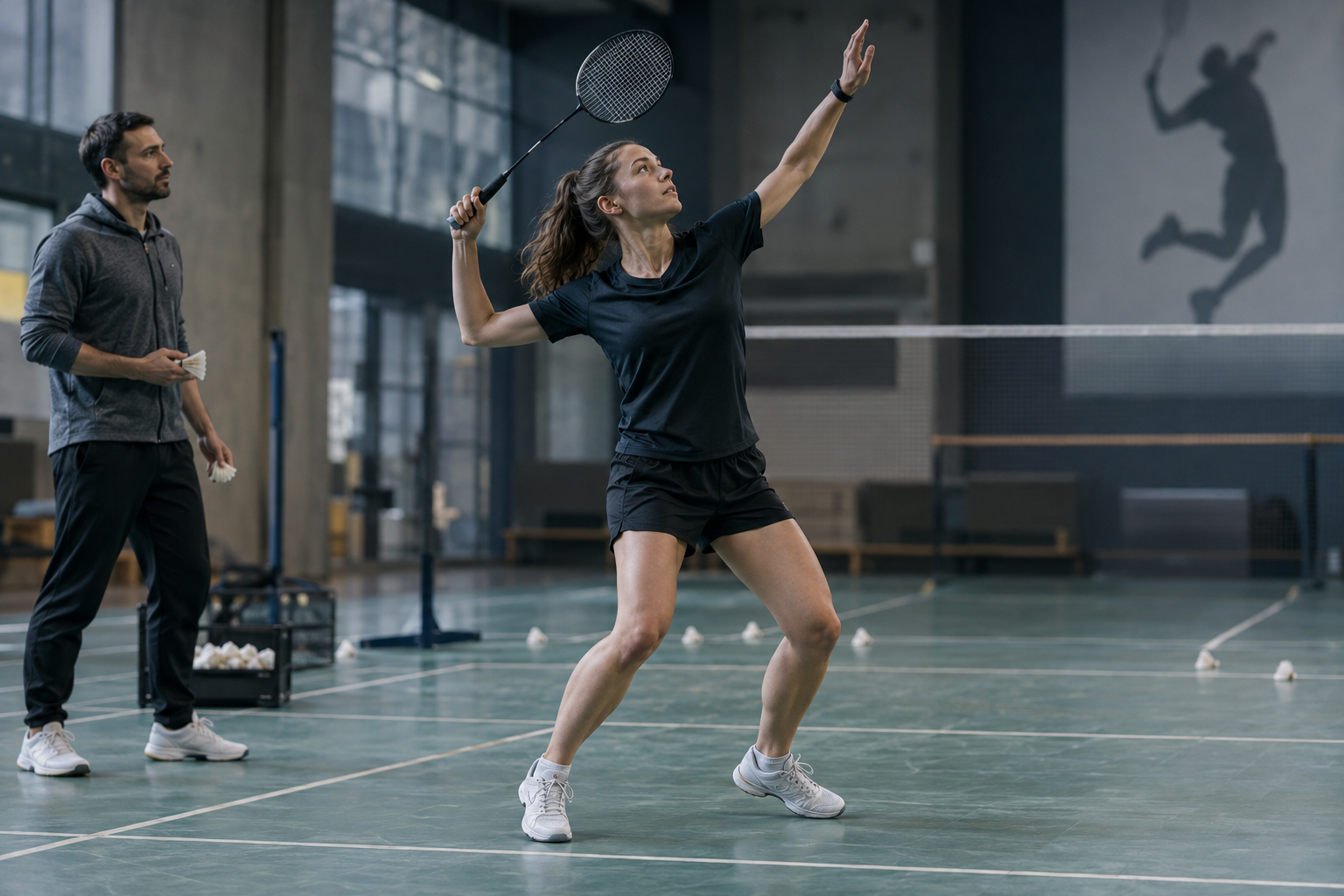
The jump smash concentrates badminton’s appeal into one image: height, speed and decisive contact. The professional lands already organizing the next movement. The recreational imitator often copies the airborne strike and discovers the missing parts on the way down.
The lesson from professional play is not “jump higher.” It is that every attacking shot begins before the racket accelerates and ends after the player recovers.
Copy the sequence
The player must move behind the shuttle, turn, load, contact in front, control the landing and regain a base. A late player who jumps harder often reaches a worse contact point. A deep lunge without braking strength may extend range while removing the ability to return.
| Professional feature | Principle worth copying | Recreational progression |
|---|---|---|
| Timed split step | Begin moving from opponent information | Small repeatable split tied to contact |
| Early overhead preparation | Organize before the shuttle drops | Shadow turn, then controlled feed |
| Jump smash | Use position and whole-body sequence | Grounded overhead, small jump, then greater height |
| Deep front-court lunge | Reach while preserving the next action | Limit depth until knee, trunk and return remain controlled |
| Fast recovery | Expect another shot | Land, balance and regain base before adding speed |
| High repetition volume | Build robust skilled exposure | Add repetitions gradually with quality stops |
Score four actions, not one impact
A useful overhead test awards one point each for early position, clean contact, quiet balanced landing and readiness for the next shuttle. Maximum score: four. Shuttle speed receives no separate point until the sequence remains stable.
| Stage | Playing condition | Advance when |
|---|---|---|
| Grounded contact | Predictable high feed | Player contacts in front and recovers |
| Grounded movement | One repositioning step | Preparation remains early |
| Small jump | Submaximal effort | Landing stays quiet and aligned |
| Direction choice | Two large targets | Accuracy survives the jump |
| Next-ball sequence | Smash followed by simple reply | Player recovers before the reply |
| Conditioned rally | Attack only from balanced position | Player declines poor attacking opportunities |
Match training to recreational life
Badminton injury reviews describe demands from repeated lunges, jumps, direction changes and overhead strokes, with evidence drawn heavily from competitive populations. They do not supply one universal prevention routine or predict an individual’s injury.
The practical plan develops lower-body strength, single-leg control, calf capacity, trunk organization and shoulder tolerance progressively. It also respects the player’s total week. A hard badminton evening added to tennis, running and an unfamiliar gym program still adds load even though the activities have different names.
| Warning in practice | Immediate adjustment | Longer question |
|---|---|---|
| Landing becomes loud or unstable | Reduce jump height | Is strength or fatigue limiting control? |
| Front knee collapses inward | Shorten the lunge and slow the feed | Does movement technique need coaching? |
| Contact moves behind the head | Stop forcing pace | Is positioning late? |
| Shoulder tightens through repetitions | Reduce volume and effort | Does persistent pain need assessment? |
| Recovery disappears after attack | Restore next-ball task | Is the player training a shot or a complete rally? |
Professional badminton provides an excellent model of preparation, efficiency and recovery. Recreational players should copy those less spectacular behaviors first. The explosive shot becomes valuable when it leaves a capable player ready to continue.