Article · IN05
Land Before You Recover
Badminton's lunges, jumps and abrupt direction changes reward speed only when recreational players retain control through the landing and the next movement
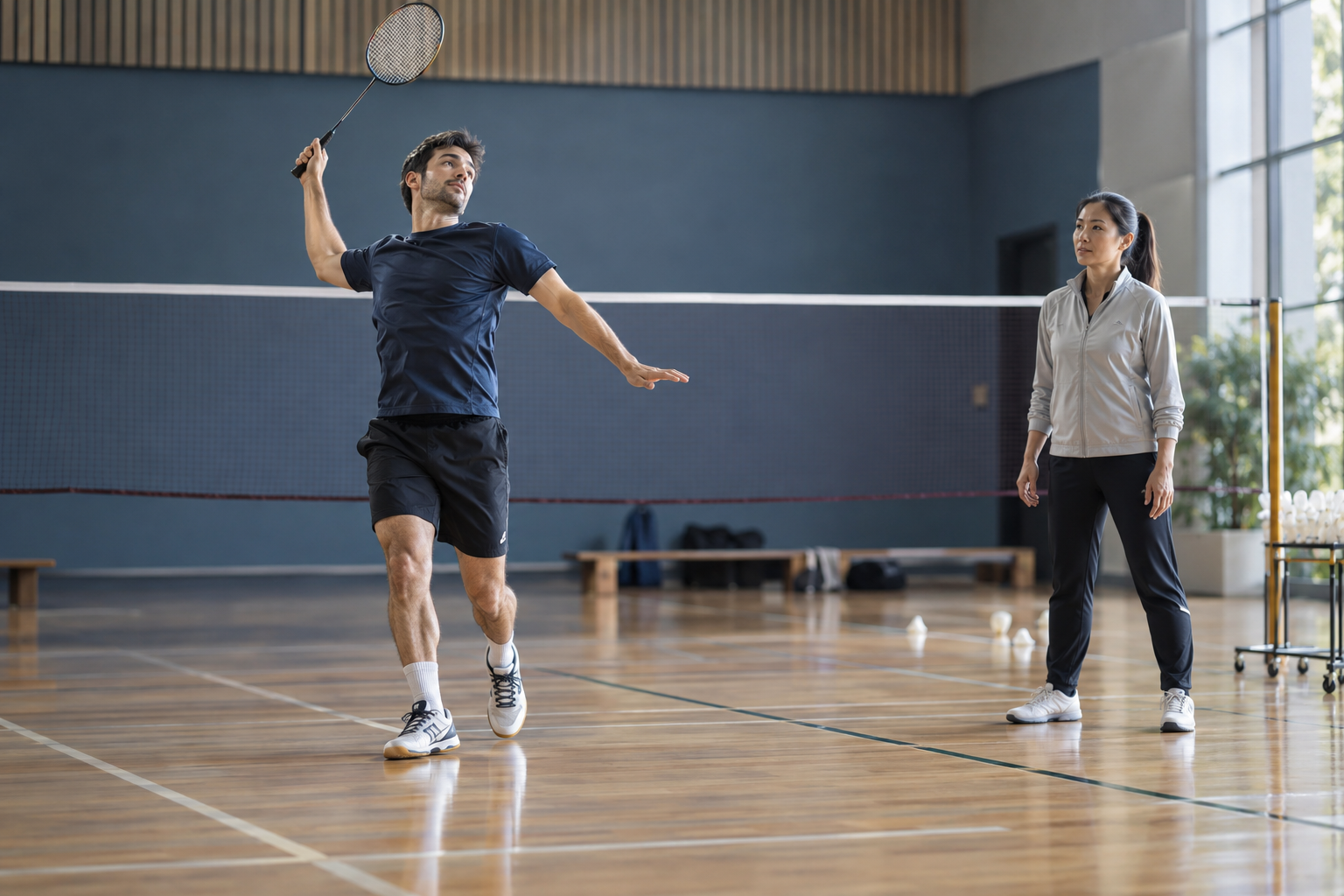
Three points
- **Lower-limb demand often concentrates at braking and landing.** Range without control can leave the player unable to recover.
- **Overhead repetition creates a separate load.** Jump count, smash volume and total court time should remain visible.
- **Progression needs observable standards.** Quiet landing, aligned knee, stable trunk and next-step readiness matter more than maximum depth.
Badminton injury research draws heavily from competitive players and uses varied definitions. It identifies repeated lunges, jumps, direction changes and overhead actions as important demands, not a personal forecast.
| Demand | Quality signal | Adjustment when lost |
|---|---|---|
| Front lunge | Foot, knee and trunk organize over a controlled base | Shorten reach and slow feed |
| Jump landing | Quiet contact and retained balance | Reduce height or remove jump |
| Direction change | Player brakes before pushing away | Increase preparation time |
| Overhead series | Contact stays in front | Reduce repetition or pace |
| Long rally | Base returns before next shot | Add rest or condition the court area |
Count concentrated actions
| Load | Simple record | Why separate it |
|---|---|---|
| Court minutes | Total active time | Captures general exposure |
| High-effort jumps | Approximate count | Short sessions may still contain many |
| Deep lunges | Planned practice blocks | Range creates concentrated demand |
| Overheads | High-effort contacts | Upper-limb load differs from footwork |
| Weekly sessions | Frequency | Determines recovery opportunity |
Use a movement gate
| Gate | Advance when |
|---|---|
| Grounded overhead | Preparation and recovery remain stable |
| Small jump | Landing stays quiet and balanced |
| Target choice | Accuracy survives modest height |
| Next-ball feed | Player recovers before reacting |
| Conditioned rally | Player attacks only from a stable position |
Increasing pain, swelling, weakness or altered movement warrants stopping and qualified assessment. A coach can scale court area, feed, speed and repetition; the coach cannot diagnose the structure causing symptoms.
Separate preparation from promises
A warm-up raises readiness for the planned session; it cannot guarantee that an injury will not occur. Progress from general movement to controlled lunges and overheads, then to the speed expected in play. The sequence should reveal whether normal movement feels available before competition removes control over direction and timing.
Strength work can prepare the qualities badminton repeatedly uses: calf capacity, controlled knee and hip flexion, single-leg balance, trunk control and tolerance for overhead action. The program should progress from the player’s present level and total weekly load. A recreational player combining badminton with running, tennis and gym work must count all of those demands rather than treating each sport as a separate body.
Treat symptoms as information
Immediate inability to bear weight, marked swelling, deformity or acute loss of function requires prompt assessment. Gradually increasing pain, night pain, weakness or symptoms that change normal technique also deserve qualified attention. Continuing to alter the stroke around pain can turn a clear signal into a confusing movement problem.
For ordinary fatigue, reduce range, pace or repetitions and check the following day. For concerning or persistent symptoms, seek a clinician rather than a more advanced warm-up.
Return through conditions, not bravery
After time away, begin with a smaller court area, predictable feeds and grounded overheads. Add one demand at a time: movement distance, uncertainty, jump height, rally length or weekly frequency. A conditioned game can keep the contest real while limiting the demand—for example, no jump smashes, or a point begins only after three controlled exchanges.
The condition should have a stated purpose and an end point. If landing and recovery remain stable, the next session can widen the task. If movement deteriorates, repeat or reduce it. This approach does not turn a coach into a clinician; it gives the player and coach visible evidence about current sporting capacity.