Article · PM01
The Pro Is Not the Plan
Professional players offer valuable lessons in preparation, purpose and discipline. Their visible equipment, movement and training choices belong to a performance system that recreational players should understand before they copy it.
Three points
- **Copy principles before appearances.** Early preparation, recovery, tactical purpose and planned practice help players at every level; a professional's exact racket, ball, stance depth or training volume may solve a problem the recreational player does not have.
- **Judge equipment by the rally it produces.** The useful choice improves repeatable contact, control, comfort and learning on the court actually used—not status, price or professional endorsement.
- **Use the recreational player's freedom.** An amateur can select a bouncier ball, a more forgiving racket, a shorter session, broader conditioning or a conditioned game because long-term participation matters more than conformity to elite practice.
Professional sport is an irresistible showroom. The camera isolates the racket. Commentators discuss string tension, blade construction and training routines. Slow motion turns a stroke into a sequence that appears available for inspection and imitation.
What the screen omits is the system around the visible choice. A professional athlete brings years of technical repetition, sport-specific strength, practiced recovery, medical and coaching support, individualized equipment testing and a schedule built around performance. The racket in the athlete’s hand is the final decision in a long chain.
The recreational player often sees only the final link. He buys the same class of equipment, copies the deepest movement or repeats the hardest drill, then assumes difficulty proves seriousness. In many cases it proves only that the solution arrived before the problem.
Professional players remain excellent teachers when we ask the right question: What principle does this behavior express, and what version serves the player I am now?
The surface and the system
An elite player prepares early because time is valuable. That principle travels well. The exact preparation may not. A tour-level table-tennis player can control a fast blade and highly responsive rubber through refined timing and touch. A developing player may receive less usable feedback because small contact errors produce large changes in the ball.
A squash professional moves deeply into the front corner because strength, mobility, anticipation and braking capacity support the position. A recreational player who imitates the final lunge without the supporting capacities may arrive late, collapse through the knee or struggle to leave the shot.
A tennis professional may select a racket for stability against very high incoming pace and then customize its weight and balance. A player with a shorter, slower swing may experience the same setup as tiring or late. “More advanced” describes the market position of the equipment; it does not describe the result in every hand.
The distinction can be organized in three columns:
| What spectators see | What supports the professional choice | Recreational question |
|---|---|---|
| Very early preparation | Opponent-reading skill and thousands of relevant repetitions | Can I prepare earlier without making the stroke larger? |
| Explosive first movement | Strength, technique and anticipation | Can I start sooner and arrive under control at my present speed? |
| Deep lunge or wide defensive reach | Mobility, eccentric strength and practiced braking | Can I shorten the range and preserve balance? |
| Fast recovery | Efficient movement and conditioning for repeated high-intensity work | Can I finish the shot ready for one more controlled movement? |
| Heavy or highly customized racket | Developed swing, precise timing and specialist fitting | Does this improve my contact over an entire session? |
| Fast blade and spin-sensitive rubber | Fine touch, active racket angles and frequent training | Can I place ordinary balls reliably under pressure? |
| Lowest-bouncing squash ball | Sustained hard hitting and warm match conditions | Does this ball create contested rallies on this court today? |
| High training volume | Progressive preparation, recovery and monitoring | What volume can I absorb and repeat next week? |
| Narrow sport specialization | Performance calendar and support team | What general strength and mobility does the rest of my life require? |
| Aggressive match tactics | Ability to execute difficult shots at favorable moments | Which simpler pattern produces a neutral or useful next ball? |
Four equipment cases
Squash: choose the ball before judging the player
The double-yellow-dot ball appears in accredited competition and carries the prestige of professional play. US Squash states plainly that it is not necessarily suitable for every ability. Single-yellow, red and blue alternatives bounce more and can create longer rallies for beginning, intermediate, junior and older players. England Squash offers the most useful rule of thumb: choose the ball that keeps the rally alive, and adjust for court temperature and season.
This is not a concession. A dead double-yellow ball can reduce squash to serving, one desperate retrieval and a walk to collect the ball. A suitable bouncier ball creates more opportunities to read, move, strike, recover and make a tactical choice. It often provides more squash per minute.
Professional television can also distort safety judgment. Adult professionals may appear without eyewear. US Squash requires approved protective eyewear during its accredited on-court activity and describes the eye-injury risk in squash as high. The recreational player should make a safety decision from the conditions of recreational play, where racket awareness and ball control may be less consistent, rather than from broadcast convention.
Tennis: stability has a cost
Racket weight, balance, head size, stiffness, length, strings and grip all affect the playing experience. A heavier racket may feel stable against pace, yet require more effort to accelerate and recover. A lighter model may improve timing for one player and feel unstable to another. A larger head may make the usable contact area more forgiving, while longer frames can add reach at a cost in maneuverability.
The USTA advises that rackets suit different swing shapes, styles and levels. That wording matters. The objective is not to find the universally best specification. It is to find a racket the player can bring to the ball on time, swing without guarding the arm and control through a normal session. Borrowing or demoing two contrasting rackets gives better evidence than comparing endorsements.
Ball choice deserves the same attention. USTA community-program guidance recommends skill-appropriate low-compression balls for beginners of all ages because slower play can improve rally success and confidence. The professional yellow ball defines one version of tennis; it need not define the first useful lesson.
Table tennis: legal speed is not usable speed
ITTF rules regulate blade construction and racket coverings. Approval establishes that equipment may be used in sanctioned play. It does not establish that the equipment suits a particular learner.
Fast blades and highly responsive or spin-sensitive rubbers can reward precise acceleration and racket angle. They can also magnify timing and angle errors. The useful recreational test is ordinary rather than technological: can the player serve legally, return a moderate ball, place several controlled drives and distinguish a technical mistake from an equipment response? If the ball repeatedly escapes before the player understands why, a slower and more predictable setup may produce faster learning.
Changing one component at a time preserves information. Replacing blade and both rubbers together makes any improvement or problem hard to diagnose.
Badminton and padel: the same principle, different equipment
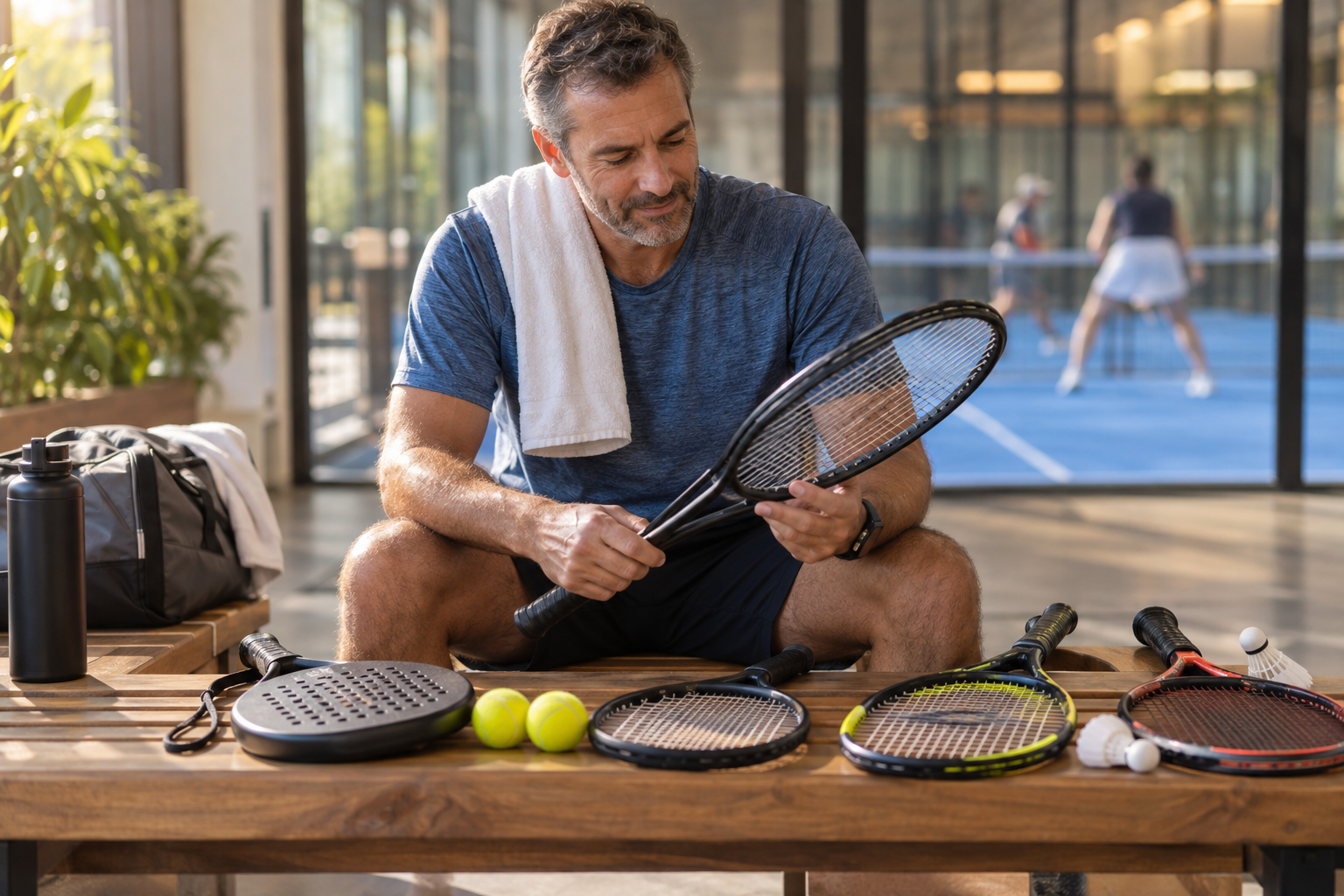
The pattern extends across RB Sports. A badminton player does not benefit from a demanding string setup merely because an elite player values a particular response. A padel player does not need the hardest or most aggressively shaped racket to learn compact preparation, placement and partnership. In both sports, grip, comfort, timing and repeatable contact deserve priority over catalog status.
Specific equipment recommendations should come from a coach or qualified fitter who can observe the player. The general editorial rule is firmer: professional use is evidence that equipment works for a professional purpose, not proof that it serves every recreational one.
Training: specific enough to help, broad enough to live well
Professional preparation becomes increasingly specific because competition rewards narrow performance gains. The athlete can devote substantial time to the exact movement, pace and recovery demands of one sport. Recreational players usually ask their bodies to do more than play: work, walk, travel, carry, climb stairs, care for family and occasionally participate in another activity.
Sport-specific training still matters. Squash players need controlled braking and repeated movement from the T. Tennis players need preparation for serving and lateral court coverage. Table-tennis players need tolerance for sustained flexed posture and frequent short adjustments. Badminton players need overhead capacity and movement into and out of lunges.
The difference lies in proportion. A recreational program should preserve a general base of strength, balance, mobility and aerobic capacity, then add the sport-specific work the player can absorb. Copying a professional’s narrow routine without the base, progression or recovery reverses the logic of professional training.
The International Olympic Committee’s consensus on load and injury emphasizes that poor load management—including rapid changes in training and competition load—can raise injury risk. That evidence does not produce one safe weekly formula. It does support a conservative lesson: adapt gradually, monitor how the body responds and avoid importing someone else’s volume because one session looked impressive.
What deserves copying
The professional model becomes most useful when stripped of theater.
| Professional habit | Why it matters | Recreational version |
|---|---|---|
| Arrive with a session purpose | Attention improves when the task is defined | Choose one shot, movement or tactical question |
| Warm up progressively | The body and skill demands rise in stages | Begin with easy movement and controllable rallies |
| Prepare before the ball becomes urgent | Early organization creates time | Watch the opponent and use a compact ready position |
| Recover as part of the shot | The next ball begins immediately | Finish balanced enough to move again |
| Select shots for a reason | Tactics connect one contact to the next | Use a simple pattern instead of searching for winners |
| Review evidence | Memory favors dramatic points | Examine a short video or one session measure |
| Change equipment deliberately | Stable setups make feedback meaningful | Test one difference at a time |
| Schedule recovery | Adaptation requires time between loads | Preserve enough capacity for the next planned session |
These habits do not require professional speed. They require professional clarity.
The amateur advantage
Recreational players have freedoms that professionals cannot always use. They can select a ball that creates a better rally, shorten a session, stop keeping score, play a conditioned game, try another RB Sport or choose equipment for comfort over maximum performance. They can train for a useful body rather than a single ranking.
That freedom should not become aimlessness. It should support a more relevant definition of success:
- Did the equipment help the player contact and place the ball more consistently?
- Did the movement remain controlled as fatigue rose?
- Did the task create enough successful repetitions to teach something?
- Did the session challenge the player without spoiling the next planned activity?
- Does the player want to return?
These questions are not soft alternatives to performance. They are performance measures for a different objective: becoming a capable, healthy and engaged recreational player.
Before copying a professional choice, ask five questions:
- What problem does this choice solve at the professional level?
- Do I face the same problem, or am I attracted to the appearance of the solution?
- What supporting skill, strength, mobility or training volume does the choice assume?
- What simpler version can I test without changing everything at once?
- What result will tell me that the change improved my play?
The best lesson from professional sport is not to own what professionals own or move exactly as they move. It is to connect every choice with a purpose, test the result and retain only what helps.