Article · PM04
More Spin Can Mean Less Control
Fast table-tennis blades and highly responsive rubbers expand what precise players can create, while developing players often learn faster from equipment that keeps cause and effect visible
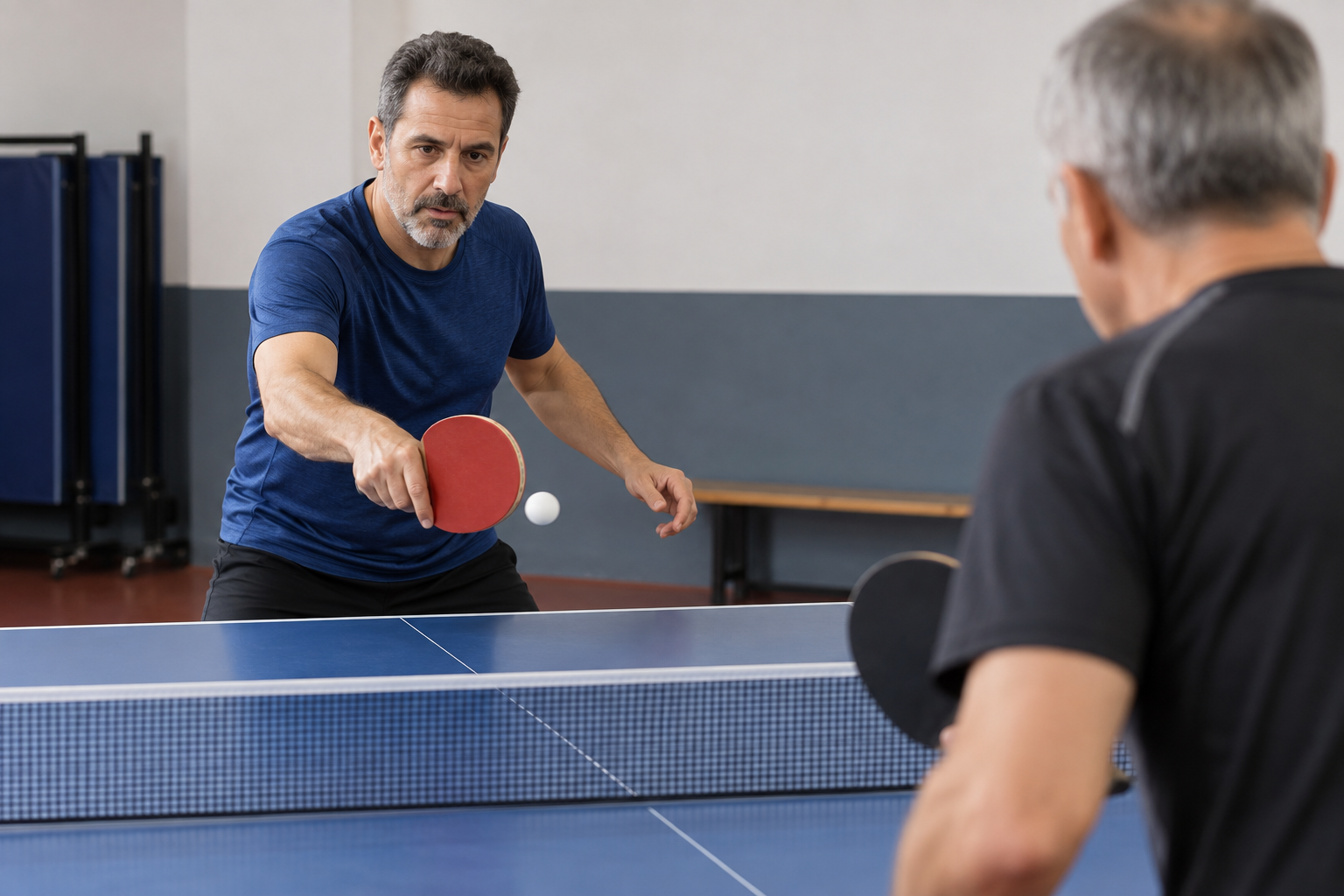
Three points
- **ITTF authorization establishes competition legality, not suitability.** The approved list contains many responses, speeds and sponge characteristics for different players.
- **Responsive equipment amplifies both good and poor inputs.** A developing player must control incoming spin and racket angle before extra rebound becomes useful.
- **The right test begins with return and rally stability.** One spectacular attack should not outweigh short touch, placement and control of varied serves.
Table-tennis equipment promises a purchasable version of elite play. A fast blade and spin-sensitive rubber can create pace and rotation in trained hands. The same sensitivity can send a recreational player’s serve return high, long or into the net after a tiny error in angle.
Professional equipment does not contain professional control. It magnifies the contact the player supplies.
Legality is not a recommendation
The International Table Tennis Federation authorizes racket coverings for competition and controls racket properties for fairness. Appearance on that list means a covering meets regulatory requirements. It does not mean the product suits a beginner, a defensive player or someone returning after ten years.
Blade construction, stiffness, speed, sponge thickness and hardness, topsheet grip and handle fit interact. Marketing categories help comparison but do not predict one player’s result precisely.
| Equipment change | What a skilled player may gain | What a developing player should test |
|---|---|---|
| Faster blade | Pace from compact action | Whether passive blocks and short returns stay controlled |
| Grippier topsheet | Greater spin production | Whether incoming spin becomes harder to manage |
| Thicker sponge | Speed and spin potential | Length control at ordinary swing speed |
| Harder sponge | Direct response under strong impact | Whether modest contact engages the rubber consistently |
| Softer sponge | Easier rebound at lower force | Stability during harder strokes |
| Stiffer blade | Predictable direct response | Touch and feedback during slower play |
| New handle shape | Better personal fit | Grip tension during backhand-forehand transitions |
Test control in the order a point develops
Equipment trials often begin with attacking a predictable ball. Real points begin with serve and return, then require a stable exchange before an attacking opportunity appears. The test should follow that order.
Use the same partner and balls. Compare two setups without changing technique deliberately. Record outcomes, not speed impressions.
| Task | Ten-ball measure | Why it matters |
|---|---|---|
| Short serve | Double-bounce or target success | Tests touch and spin production |
| Varied serve return | Low, playable returns | Tests reaction to incoming spin |
| Cooperative diagonal rally | Longest and average stable exchange | Tests repeatability |
| Direction change | Successful placement to two large targets | Tests angle control |
| Passive block | Balls controlled against moderate attack | Tests rebound under incoming pace |
| Controlled opening attack | Usable attacks at 60–70% effort | Tests whether offense remains available |
If the setup improves the final task while damaging the first five, it may solve the wrong problem. A coach who observes contact can distinguish an equipment mismatch from a technical error more reliably than an online equipment chart.
Preserve feedback
Learning requires the player to connect an action with the ball’s result. When equipment reacts strongly to tiny changes, several causes may feel identical. The player grips harder, guides the stroke and becomes afraid to accelerate. A more controllable setup can make the correction clearer: close the angle, contact earlier, brush more finely or move into position.
| Symptom | Possible equipment contribution | Technique or task to examine |
|---|---|---|
| Returns repeatedly fly long | Excess response for current touch | Racket angle and reading of spin |
| Blocks rebound unpredictably | Blade/rubber sensitivity | Contact stability and relaxed grip |
| Attacks lack depth | Setup may not respond at current force | Body position and acceleration sequence |
| Player avoids full stroke | Fear of overshooting | Larger targets and moderate-speed equipment |
| Wrist or forearm tightens | Handle or response encourages squeezing | Fit, grip pressure and practice volume |
The recreational player does not need deliberately poor equipment. The player needs a quality setup whose speed and sensitivity leave enough margin to practice complete points. Control is not the absence of ambition. It is the platform from which useful speed and spin grow.