Article · IN04
Small Court, High Repetition
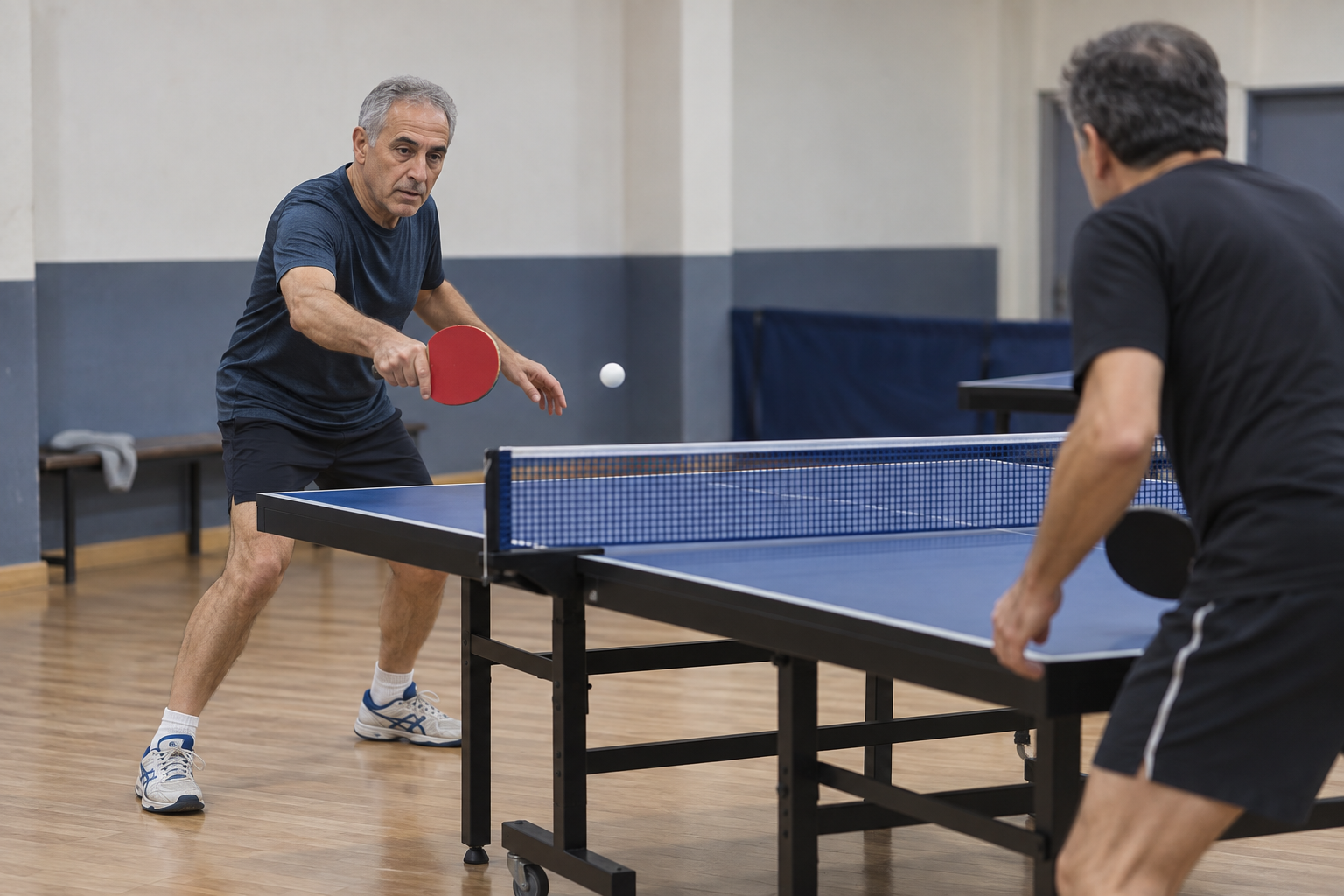
Table tennis limits travel distance but repeats a low ready position, rapid foot adjustments, trunk rotation and upper-limb contact often enough to make technique, variation and load visible
Three points
- **A small playing area does not create a negligible physical demand.** High repetition and sustained posture can load the knee, back, shoulder, elbow and wrist.
- **Practice design determines whether repetition teaches or degrades skill.** Quality stop rules, posture variation and task changes matter more than completing an arbitrary ball count.
- **The injury evidence remains limited and heterogeneous.** Recreational guidance should improve observation and referral, not promise that one warm-up or stroke prevents injury.
Table tennis compresses movement without eliminating it. The player flexes at the ankles, knees and hips, adjusts laterally, rotates the trunk and repeats short upper-limb actions at a pace that can make hundreds of contacts feel like one continuous task.
An individual stroke carries little mass. Repetition, fixed posture, late positioning and excess grip pressure can still accumulate demand. Injury reviews identify several affected regions but use varied definitions and heavily competitive samples. The responsible conclusion is practical: observe what repeats, what changes under fatigue and what symptoms persist.
Map the repeated task
| Demand | Where quality may decline | Observable sign |
|---|---|---|
| Low ready position | Back, hip, thigh or knee tolerance | Player rises, twists or shifts weight asymmetrically |
| Rapid lateral adjustment | Foot and knee control | Feet cross unnecessarily or knee collapses inward |
| Forehand rotation | Trunk and shoulder sequence | Arm swings alone from a late position |
| Backhand repetition | Wrist, forearm and elbow | Grip tightens and contact becomes rigid |
| Serve practice | Same fine movement repeated | Placement falls while repetition continues |
| Multiball | High density with limited natural pause | Technique deteriorates faster than the feeder notices |
| New rubber or blade | Changed rebound and spin response | Player guides, squeezes or makes abrupt corrections |
Stop when the drill stops teaching
Define the quality condition before beginning. A drill changes or ends after rising pain, three consecutive uncontrolled contacts, persistent loss of ready position or failure to recover between balls. The number three is an example for a particular practice, not a medical rule.
| Practice block | Useful condition | Reason to change |
|---|---|---|
| Cooperative drive | Stable rhythm to a large target | Player reaches instead of moving |
| Direction change | Feet organize before contact | Crossed or hurried steps dominate |
| Serve set | Each serve has a tactical target | Placement disappears and motion tightens |
| Multiball | Technique survives agreed feed rate | Feeder speed forces repeated late contact |
| Match play | Player returns to a usable base | Fatigue fixes posture or changes movement |
Short upright recovery between blocks can vary posture without cooling the session. Alternating forehand, backhand, serve, receive and footwork tasks changes the repeated demand. Variation should serve learning rather than become random activity.
Warm up toward the task
A warm-up can progress from general movement to controlled strokes and then to the spin, speed and positions expected in the session. It does not need a professional duration or ritual. The player needs readiness for today’s work.
| Phase | Example | Check before progressing |
|---|---|---|
| General movement | Walk, side step and gentle trunk turn | Movement feels normal |
| Table position | Easy shadow adjustments and posture changes | Base moves in both directions without rocking |
| Controlled contact | Cooperative forehand and backhand | Grip and contact remain relaxed |
| Specific response | Moderate serve return or direction change | Player reads and organizes before pace increases |
| Session demand | Planned game or multiball speed | Technique remains recognizable |
Pain that rises, persists, changes normal movement or reduces strength deserves qualified assessment. The coach can modify feed rate, repetition, posture and technique. The coach should not diagnose a medical condition from the location of pain.
Table tennis rewards repetition because the game depends on rapid, reliable responses. The goal is to repeat useful movement often enough to learn it and stop early enough to preserve it.