Article · CS01
From Table to Court
Table-tennis players bring sharp observation, placement and compact readiness to squash, then must rebuild spacing, movement and safety for a larger court shared with an opponent
Three points
- **The strongest transfer occurs in attention and intention.** Both sports reward early reading, purposeful placement and recovery for the next ball.
- **The physical problem changes completely.** Squash adds four-corner travel, braking, wall rebounds, a longer racket and another player moving through the same space.
- **A good introduction preserves expertise without pretending equivalence.** The newcomer should use familiar tactical questions while accepting beginner instruction in squash technique and safety.
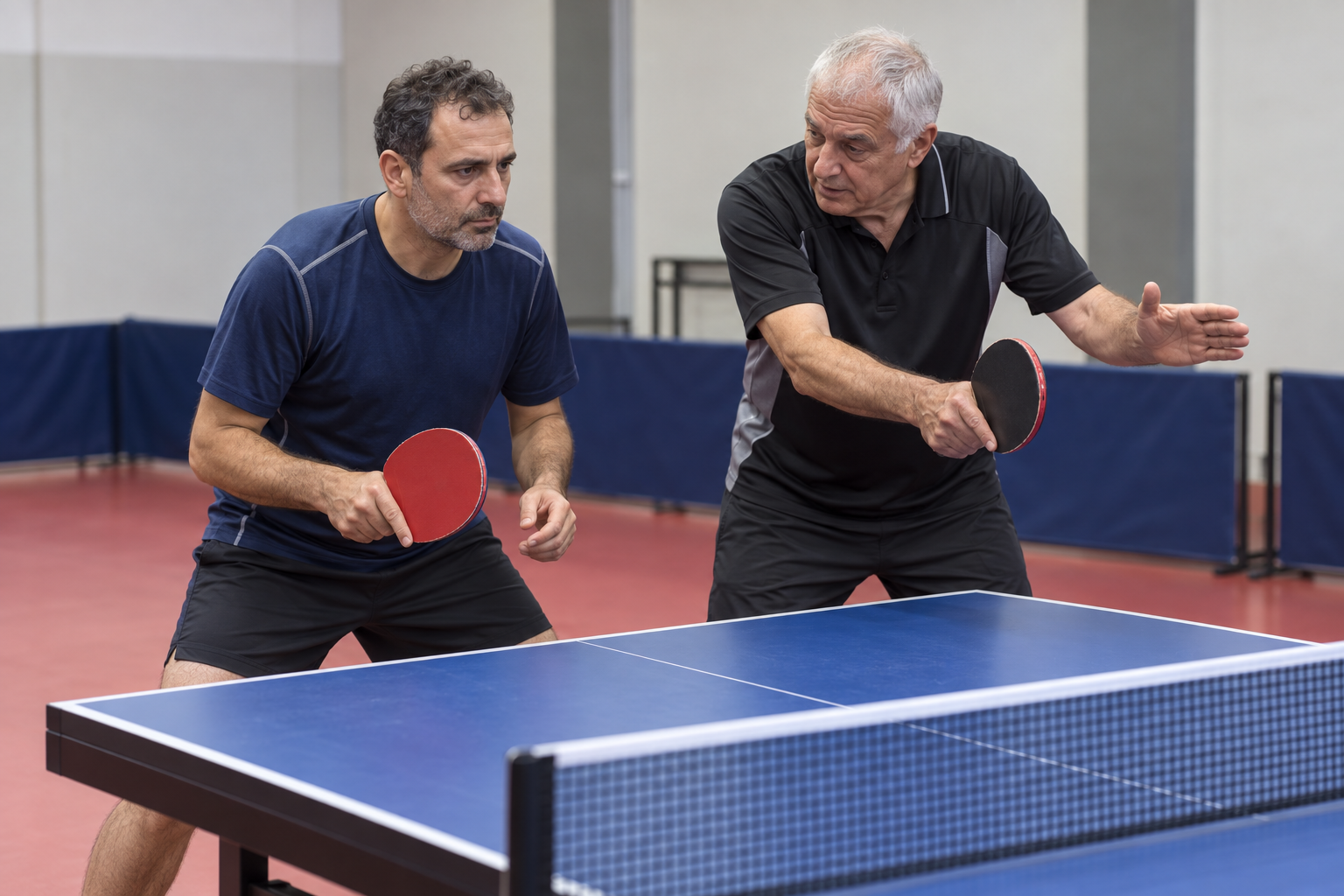
A table-tennis player rarely needs to be convinced that a small change in angle matters. The player has watched an opponent’s racket, read spin from contact, adjusted close to the table and learned that the previous ball prepares the next one. These habits make squash intellectually recognizable before it feels physically familiar.
The first mistake is therefore understandable: enlarging a table-tennis stroke and expecting the rest to follow. Squash requires a different grip, swing, ball path, contact distance and movement cycle. It also requires two people to negotiate safe access to one ball inside one court.
The bridge between the sports begins with better perception. It continues only when the player rebuilds the action.
Transfer the question, not the answer
Research in both sports shows that experienced players use advance information from an opponent’s movement more effectively than novices. That does not establish automatic cross-sport transfer. It identifies a promising learning habit: look for information before the ball completes its flight.
A table-tennis player can bring three questions to squash. What does the opponent’s preparation reveal? Which target reduces the next options? Where must I recover to read and reach the reply? The answers change because walls extend the trajectory and shared space changes movement.
| Familiar table-tennis habit | Value in squash | Necessary correction |
|---|---|---|
| Watch racket angle and contact | Encourages early reading | Add shoulder, court position and wall geometry |
| Use placement before maximum pace | Supports rally construction | Depth and wall proximity replace table zones |
| Recover immediately after contact | Protects readiness | Recover while clearing safe access for the opponent |
| Adjust the feet before striking | Supports balance | Use larger acceleration, braking and lunge patterns |
| Expect spin to change bounce | Promotes careful observation | Learn rubber-ball rebound, temperature and wall effects |
| Keep preparation economical | Reduces late improvisation | Build a squash-specific swing rather than a larger table stroke |
Change the scale of movement
Table tennis compresses the exchange around a 2.74-meter table. Squash uses a 9.75-by-6.40-meter singles court, and both players occupy it. The table-tennis player often makes quick lateral adjustments from a compact base. The squash player repeatedly leaves a central area, travels toward a corner, decelerates, strikes, clears and returns.
Stance width has no universal measurement. A practical ready position lets the player push in either direction without rocking first. The squash test adds a demanding second requirement: after a controlled corner movement, can the player stop in balance, preserve a safe swing and recover without an extra stabilizing step?
| Rally demand | Table tennis | Squash | First-session coaching priority |
|---|---|---|---|
| Playing space | Opposite sides of a table | Shared enclosed court | Explain access and interference before scoring |
| Adjustment | Small, rapid steps close to contact | Larger travel with repeated braking | Reduce speed until balance remains visible |
| Contact | Short paddle and light ball | Longer racket and rubber ball | Establish spacing and controlled front-wall contact |
| Trajectory | Net, table bounce and spin | Front wall, optional side/back walls and floor bounce | Trace simple straight paths before multiple-wall shots |
| Recovery | Reorganize near the table | Clear the shot and regain useful central access | Link every hit to a safe exit path |
| Risk | Players separated by table | Racket, ball and bodies share space | Stop whenever line or swing is uncertain |
Begin with a ball that produces a rally
The professional squash ball often provides a poor beginner experience because recreational players may not heat it enough to create the expected bounce. A coached introduction should select a ball for court temperature, hitting ability and the objective of complete rallies. Choosing a livelier ball is sound session design, not a lesser form of squash.
The newcomer also needs eye protection where required or recommended by the relevant organization and venue. Most of all, the player needs an explicit stop rule: if the opponent blocks access, the ball is too close to the opponent or the swing feels unsafe, stop and ask.
A first exchange that respects both sports
Use the first fifty minutes to compare experiences rather than test status.
| Minutes | Task | Learning test |
|---|---|---|
| 0–8 | Court, ball, eyewear and shared-space safety | Player can explain when to stop |
| 8–18 | Grip, spacing and controlled front-wall contact | Ball reaches the wall without a forced swing |
| 18–28 | Straight target hitting with recovery | Player hits, clears and regains balance |
| 28–38 | Cooperative rally with a suitable ball | Both players complete several safe exchanges |
| 38–46 | Conditioned placement game at moderate pace | Placement changes the reply without harder hitting |
| 46–50 | Compare and choose the next session | Player names one transfer, one rebuild and one question |
The table-tennis player should leave with expertise acknowledged and beginner status intact. Squash offers a larger movement problem, a different ball and a new community. The pleasure of reading one shot ahead provides the bridge.