Article · PM02
Choose the Rally, Not the Status Symbol
Professional squash equipment works inside professional pace, precision and preparation; recreational players should select the ball, racket, strings and protection that produce safe, contested rallies on their actual court
Three points
- **The double-yellow-dot ball is a playing condition, not a certificate of seriousness.** If players cannot keep it warm, a livelier ball produces more movement, decisions and useful rallies.
- **Visible professional practice needs context.** Recreational players generally control racket and ball less precisely and have strong reasons to use approved eye protection.
- **Equipment should pass a repeatable court test.** Comfort, timing, control and rally quality after normal fatigue matter more than price, endorsement or a single impressive shot.
Professional squash creates a seductive equipment list: double-yellow-dot ball, premium racket, a favored string tension and no visible eye protection. A recreational player can buy the list in an afternoon. The player cannot buy the ball speed, early preparation, precise contact or physical capacity that makes the professional setup perform as seen.
Copying the object without its operating conditions often makes squash worse. The ball dies. The player swings harder, grips tighter and retrieves more balls than rallies. Expensive equipment turns into an obstacle carrying the prestige of authenticity.
The right setup produces squash worth playing.
Let the ball create the game
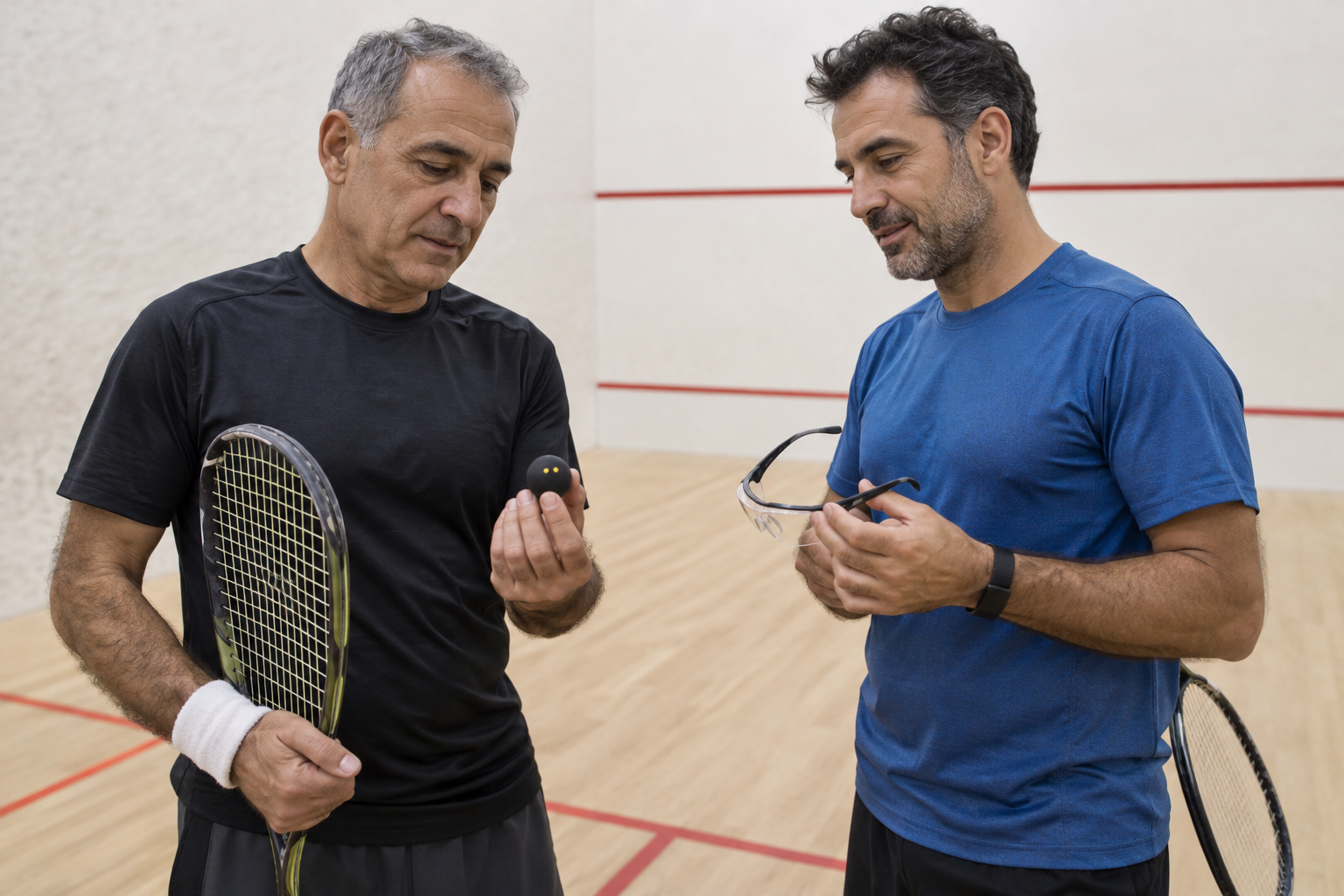
A squash ball warms through repeated impact. As it warms, it rebounds more. The slow double-yellow-dot ball suits high-level players who strike hard and sustain enough contact to keep it responsive. Beginners and many recreational pairs cannot do that consistently, particularly on a cold court.
Squash Canada describes a progression from blue for beginners through red and single yellow to double yellow for advanced play. The colors do not rank the character of the player. They alter the conditions under which a rally develops.
| What happens in play | Likely ball problem | Better experiment |
|---|---|---|
| Returns die before players can reach them | Ball remains too cold or slow | Try one grade livelier for eight minutes |
| Players hit unusually hard only to create bounce | Equipment dictates effort | Select for complete rallies at controlled pace |
| Rallies improve briefly, then collapse during discussion | Ball cools faster than the session rest pattern | Rewarm or use a livelier ball |
| Experienced players overwhelm a beginner | Pace, not only bounce, is mismatched | Combine a suitable ball with a conditioned game |
| Ball flies beyond comfortable control | Ball may be too lively for current pace and temperature | Compare one slower option after a full warm-up |
Run a simple comparison. Warm two candidate balls. Play two eight-minute blocks with the same cooperative objective. Record how many rallies reach six shots, how often a player must force pace merely to keep the ball alive and whether both players reach more than one area of the court. Choose the ball that creates observation, movement and decisions.
Treat protection as personal equipment
Televised professionals may compete without eyewear. That image says nothing about a recreational player’s control, partner, venue policy or willingness to accept an avoidable risk. US Squash requires approved eyewear in accredited play. Junior requirements are especially common across governing bodies.
Protective eyewear must fit, remain clear and suit racket-sport impact standards. Ordinary spectacles do not automatically provide equivalent protection. A venue or governing body can specify the applicable approved standard.
| Professional image | Missing context | Recreational decision |
|---|---|---|
| No eyewear | Exceptional control and a rule environment visible only in part | Use approved protection and follow venue rules |
| Full-speed retrieval | Years of movement training | Shorten range until braking and clearing remain controlled |
| Very tight length | Precision under pressure | Build accuracy before increasing pace |
| Long hard sessions | Conditioning, recovery and support | Progress volume from present capacity |
Test the racket as a system
Racket mass, balance, grip, string type and tension interact with the player’s timing. Lower tension may feel more powerful or forgiving; higher tension may feel firmer or more precise. Frame design and contact quality complicate every generalization. Evidence does not support promising that one tension prevents injury or creates control for everyone.
A useful trial keeps most variables stable. Compare two rackets after warming up. Hit controlled straight drives, volleys and serves; then repeat after thirty minutes. Note late preparation, off-center contact, comfortable length, grip pressure and any discomfort. A racket that feels fast for five swings may become unstable or tiring in a normal game.
| Item | Buy or adjust when | Do not use as the decision rule |
|---|---|---|
| Ball | It produces appropriate rallies in current conditions | Professional tournament use |
| Racket | Balance and response remain comfortable through a session | Highest price or favorite player’s endorsement |
| Strings | Current strings lose response or a controlled test supports change | A universal tension claim |
| Grip | Surface slips, size feels wrong or excess squeezing appears | Cosmetic wear alone |
| Shoes | Fit, traction and court rules suit actual movement | Lifestyle appearance |
| Eyewear | Approved model fits securely and stays usable | Whether professionals wear it on television |
Professional practice remains valuable when the principle survives translation: predictable equipment, careful preparation and consistent conditions. Recreational players should copy that discipline. They should choose their own conditions.