Article · IN02
Squash Starts With Braking
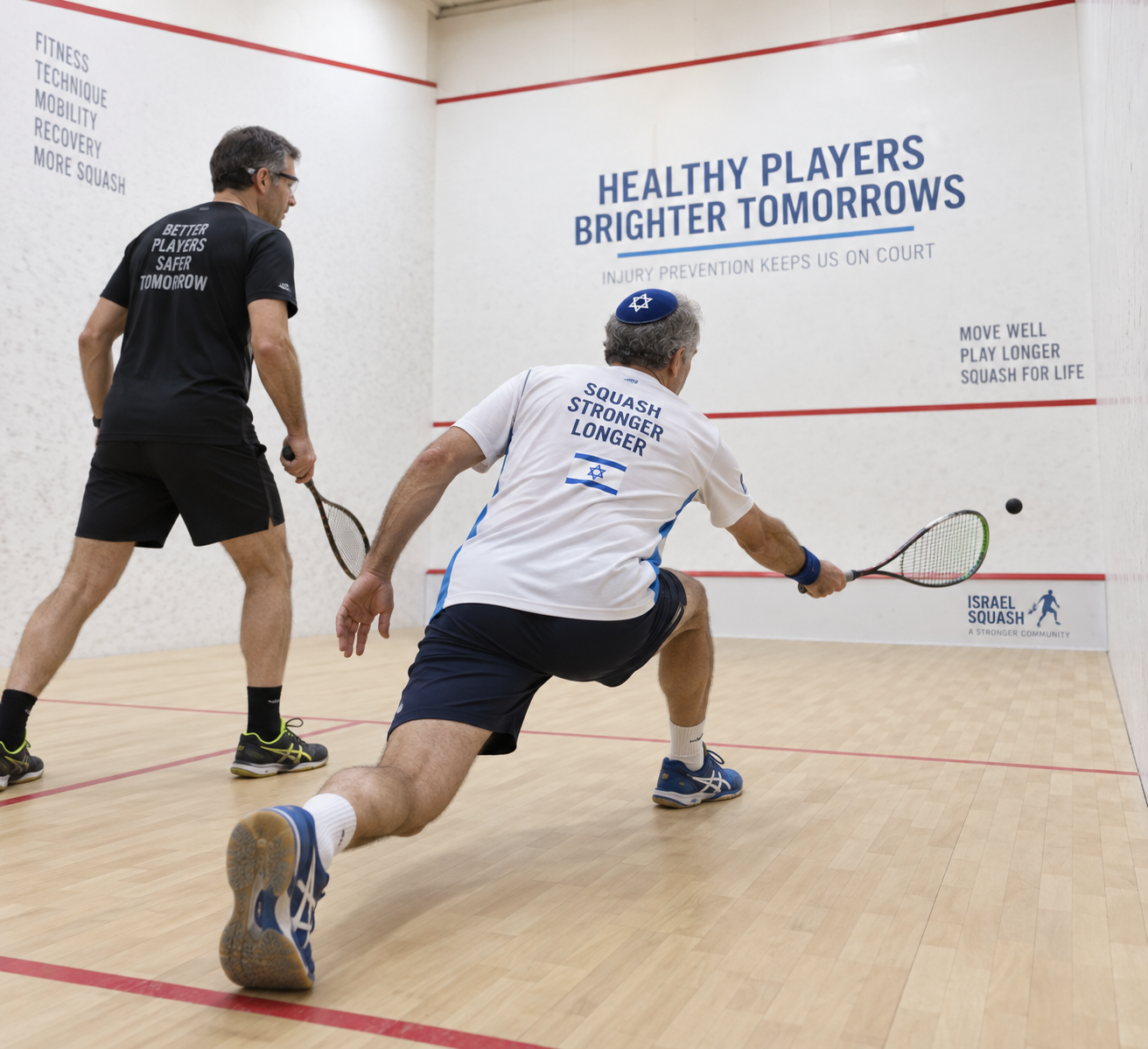
Squash rewards speed, but recreational safety depends on arriving under control, managing repeated lunges, selecting a ball that creates complete rallies and protecting shared space before chasing another point.
Three points
- The demanding movement is not reaching a corner; it is accelerating, braking, striking and leaving space repeatedly. Extra speed without a controlled final step makes both technique and court sharing worse.
- Ball choice changes the physical problem. A ball that remains too cold produces short rallies and desperate hitting, while a livelier ball gives recreational players more movement, decisions and recovery practice.
- Strength and conditioning cannot remove impact risk. Certified eyewear, controlled swings, awareness of the opponent and correct interference decisions remain essential.
Squash places two moving players, two rackets and a small ball inside one enclosed court. It asks them to change speed, use walls, lunge into corners and clear space for one another. Fitness and safety therefore meet in the same skill: control momentum early enough to make the next action possible.
What the injury evidence can—and cannot—say
A 2026 systematic review found only 12 eligible studies of squash injuries and illnesses. Eight contributed to a pooled analysis. The authors reported lower-limb soft-tissue injuries most often, but the studies differed sharply in population, injury definition, design and exposure unit. Statistical heterogeneity reached 99.65%.
That number is the main practical finding: published rates should not be treated as a personal forecast. The evidence combines elite players, adolescents, club players, hospital records and retrospective surveys. It supports attention to lower-limb loading, impact, cardiovascular strain and heat; it does not tell one recreational player the probability of injury next Tuesday.
The rally is a repeated braking test
| Squash phase | Productive movement | Common recreational breakdown | Useful correction |
|---|---|---|---|
| Opponent contact | Prepare and read before committing | Upright pause followed by a rushed chase | Establish a balanced ready position before contact |
| First step | Choose an efficient route | Cross feet or lean before the direction is clear | Use a small directional start |
| Approach | Adjust distance before the final step | One oversized stride reaches the ball | Add an approach step and preserve space |
| Braking | Absorb momentum through a controllable range | Knee collapses or body continues into wall | Reduce speed and lunge depth |
| Contact | Strike with space and a controlled swing | Racket compensates for poor balance | Arrive earlier and shorten the swing |
| Clearing | Leave the opponent a safe line and swing | Watch the shot or remain in the path | Recover as part of the stroke sequence |
| Repetition | Preserve movement quality across rallies | Fatigue creates scrambling and blind turning | Shorten the game block or increase rest |
The table favors quiet control over dramatic reach. A professional may reverse from a deep split position because years of strength, mobility and technical exposure support it. A recreational player gains more from a shorter position he can leave without a second effort.
Ball choice is a training decision
The double-yellow-dot ball used in high-level competition depends on speed and repeated hard striking to reach its intended rebound. Many recreational players cannot keep it at that temperature, especially on a cold court. They then experience a ball unlike the one professionals play: low bounce, short rallies and repeated desperate acceleration.
A livelier ball is not merely easier. It can be the more demanding training tool because it creates additional contacts, movement decisions and recoveries.
| Session signal | Ball is probably too slow for the pair | More useful response |
|---|---|---|
| Rally length | Most exchanges end before either player establishes rhythm | Try a livelier ball and controlled pace |
| Heating | Players spend the warm-up striking hard only to maintain bounce | Select equipment that stays playable at their speed |
| Movement | Players sprint late toward dying balls | Create time for balanced approach and recovery |
| Technique | Contact becomes forceful and rushed | Choose rebound that permits full preparation |
| Learning | Few tactical sequences develop | Favor the ball that produces repeated decisions |
The correct ball depends on temperature, court, player level and session purpose. The logo printed on the ball is not a ranking of the people using it.
Prepare the lower body outside the rally
Squash uses ankle and calf force, knee and hip control, trunk rotation and repeated single-leg braking. Court play exposes these qualities under uncertainty, but it does not provide a measured progression.
A complementary program can include controlled split squats or lunges, calf raises through an appropriate range, step-downs, lateral step-and-stops, trunk resistance and aerobic work. The load should progress before the range or speed becomes extreme.
A simple movement check uses five forward lunges on each side, five lateral step-and-stops and five diagonal approaches without a racket. Look for quiet contact, a stable foot, knee control, balanced trunk and a smooth return. The test does not diagnose injury or establish readiness for maximal play. It shows whether the intended movement remains controlled at that dose.
Shared space changes the safety standard
Squash is not two separate running lanes. The outgoing player must provide the incoming player with access, sight and safe swing space. The incoming player must stop rather than strike through interference.
“No hard shots” does not solve this problem. A slow uncontrolled swing near another person remains unsafe. Nor does fitness justify playing a ball when the opponent occupies the path. Learn the current rules, ask for a let when appropriate and accept that stopping a rally protects the next one.
Rear-court turning deserves particular care. A player who loses sight of the ball and turns may strike toward an opponent. Beginners should receive explicit instruction on wall routes, turning and when not to play the ball.
Eyewear addresses a different risk
Movement training cannot prevent every ball or racket impact. World Squash requires protective eyewear in specified sanctioned settings, including junior and doubles events. Local club requirements may be broader. Recreational adults should consider certified racket-sport eyewear even when professionals on screen do not wear it.
Professional visual control does not eliminate impact risk, and amateur control is generally less reliable. Fashion and imitation provide weak reasons to expose vision.
Build the first 15 minutes deliberately
| Minutes | Activity | Standard |
|---|---|---|
| 0–3 | General movement and joint rehearsal | Temperature rises without unusual symptoms |
| 3–6 | Shallow lunges and controlled stops | Each position remains reversible |
| 6–9 | Ghosting through selected corners | Player faces the front wall and clears safely |
| 9–12 | Cooperative straight hitting with a suitable ball | Contact and rebound permit preparation |
| 12–15 | Controlled length rally | Both players can move, strike and recover without scrambling |
If control deteriorates before open play begins, the warm-up has produced useful information. Reduce pace, change the ball, shorten the session or stop.
The best squash preparation does not make the court risk-free. It aligns ball, pace, movement range, opponent and rules so players can enjoy repeated rallies without borrowing positions or exposure from professionals whose preparation they do not share.