Article · IN01
The Recreational Injury Map
Racket-sport injuries arise through sudden events, repeated loading and medical emergencies, so prevention begins by identifying the actual demand, increasing exposure gradually and knowing which symptoms end a session.
Three points
- Lower-limb problems often involve starts, stops, lunges and landings; upper-limb problems often reflect repeated gripping, striking and serving. The pattern changes by sport and player rather than following one universal ranking.
- Previous injury, unfamiliar movement and abrupt changes in frequency, duration or intensity deserve more attention than a generic stretching routine. Capacity must grow before exposure grows.
- Preparation reduces avoidable risk but offers no guarantee. Sudden severe pain, major swelling, inability to bear weight, neurological symptoms, chest pain, fainting, unusual breathlessness or any visual change requires stopping and appropriate assessment.
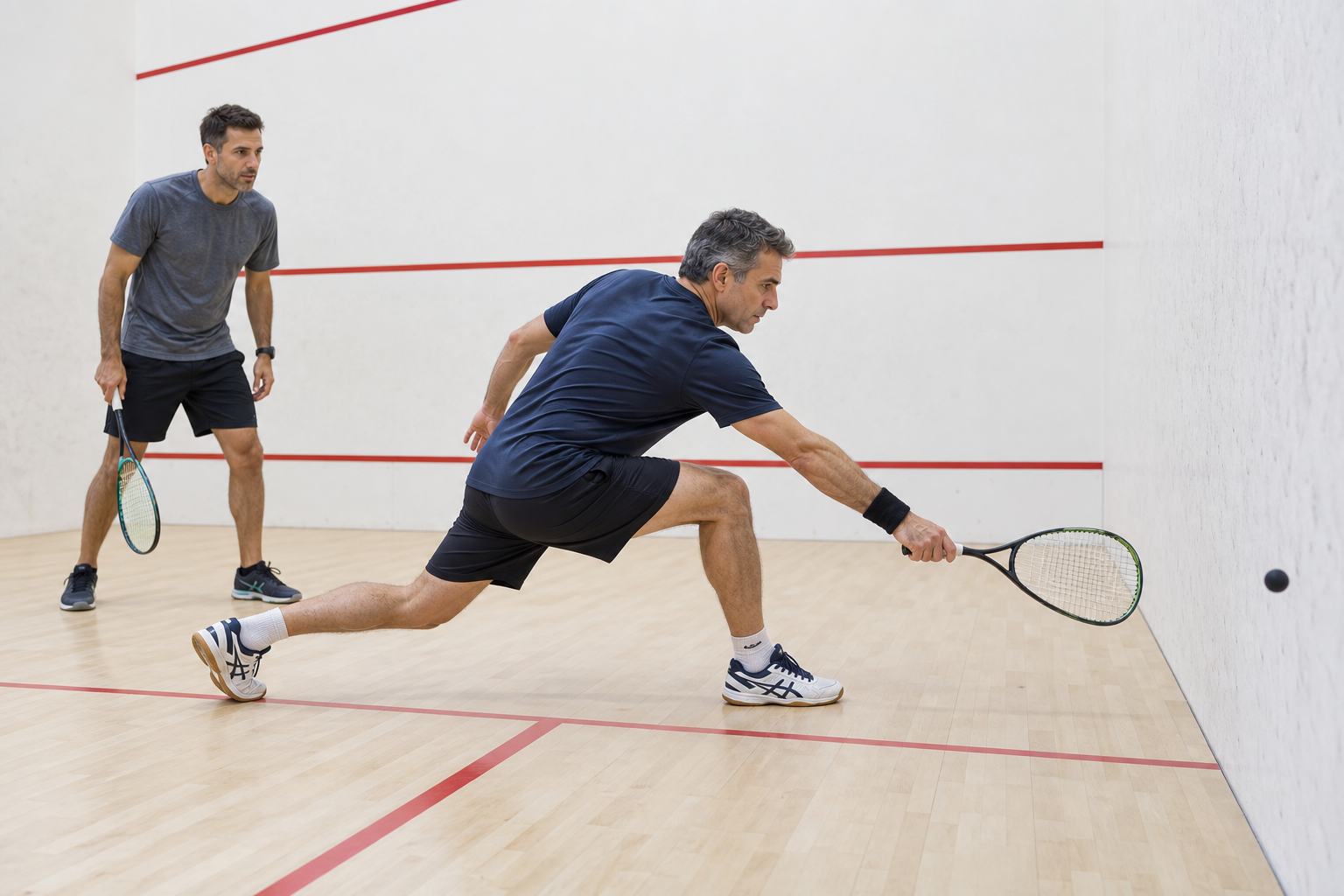
Racket sports combine fast decisions with acceleration, braking, rotation and repeated striking. That mix makes them engaging and physically useful. It also means that injury cannot be reduced to one weak muscle or one faulty shoe.
An injury map should guide decisions before, during and after play. It should not invite self-diagnosis.
Separate three kinds of problem
| Pattern | Typical presentation | Immediate question | Appropriate response |
|---|---|---|---|
| Sudden event | Twist, collision, fall, impact or sharp pull | Can the player move and function normally? | Stop when pain, instability or function changes; assess severity |
| Repeated load | Ache or stiffness grows across sessions | Has volume, intensity, equipment or technique changed? | Reduce the provoking load and seek assessment if it persists |
| Medical event | Chest pain, fainting, severe breathlessness, heat illness or neurological symptoms | Could delay create harm? | Stop play and obtain prompt medical help |
The categories can overlap. A sore Achilles after several weeks of rising volume may rupture during one push-off. A player who becomes dehydrated may also lose coordination and fall. The purpose of the categories is to improve the first decision, not provide a diagnosis.
The body reflects the game
| Area | Repeated racket-sport demand | Common warning during play | Preparation question |
|---|---|---|---|
| Ankle | Push-off, landing and direction change | Instability, swelling or protective steps | Can I balance, hop or stop at the intensity I plan to use? |
| Calf and Achilles | Repeated acceleration and forefoot loading | Increasing tightness, sharp pain or loss of push-off | Did frequency or speed rise faster than calf capacity? |
| Knee | Braking, lunging and repeated flexion | Giving way, locking or swelling | Can I control a step-down and lateral stop? |
| Groin and hip | Wide steps, rotation and recovery | Sharp pain, shortened stride or guarded turning | Have I developed range and strength progressively? |
| Lower back | Rotation, flexion and repeated reaching | Pain changes the swing or normal posture | Can hips and trunk share rotation without forcing range? |
| Shoulder | Serving and overhead striking | Painful arc, sudden weakness or reduced motion | Does volume match present shoulder capacity? |
| Elbow | Repeated force transfer and gripping | Grip tightens or pain affects contact | Are technique, grip size, string or blade speed increasing effort? |
| Wrist and hand | Racket acceleration, impact and fine control | Numbness, swelling or loss of grip | Can the racket remain secure without constant squeezing? |
| Eye and face | Ball, shuttle, racket or partner impact | Any direct impact or visual change | Is certified protection appropriate and is swing space controlled? |
The table maps demands, not diagnoses. Similar pain can arise from different structures and different problems can produce similar symptoms.
Load is more than minutes
A player who adds a second sport has changed more than weekly duration. A new court introduces unfamiliar stopping angles, stroke repetitions, surfaces and decisions. Competition adds speed even when the booking lasts no longer.
Track four variables:
- Frequency: sessions per week.
- Duration: active playing time, not merely court booking.
- Intensity: pace, rally demand and perceived effort.
- Complexity: unfamiliar movement, equipment, surface and competitive pressure.
Increase one principal variable at a time. The rule is not a validated injury formula. It is a conservative way to notice what changed when recovery deteriorates.
Research on load monitoring comes largely from organized and elite sport. Recreational players usually lack precise exposure data, medical surveillance and consistent schedules. This makes simple records—session, effort, pain that changed play and next-day function—more useful than copying professional workload ratios.
Warm-up is preparation, not insurance
A useful warm-up raises temperature, rehearses the ranges the session will use and increases decision speed gradually.
| Stage | Example | Readiness signal |
|---|---|---|
| General movement | Walk, easy jog or cycle | Breathing rises without distress |
| Joint and range rehearsal | Controlled ankle, hip, trunk and shoulder movement | Planned range feels available without forcing |
| Braking and balance | Step-and-stop, shallow lunge or gentle landing | Position remains quiet and reversible |
| Stroke preparation | Easy shadow swings and controlled contact | Grip, timing and range remain relaxed |
| Sport exposure | Cooperative rally with suitable equipment | Player can read, move, strike and recover safely |
Static stretching alone does not prepare a player for every demand. Nor does sweating prove readiness. If the warm-up reveals pain, instability or unusual symptoms, the correct response may be less play or no play.
Equipment changes demand, not destiny
Shoes should suit the surface and permit secure movement. Eyewear addresses impact exposure in squash and other relevant settings. A suitable racket, strings, blade, rubber or ball can reduce the effort required to create a playable rally.
Equipment cannot compensate for uncontrolled volume or unsafe technique. Expensive professional equipment may increase demand: a stiff or highly tensioned racket can require more force; a fast table-tennis blade and spin-sensitive rubber reduce control; a slow squash ball can produce frantic, short rallies for players unable to keep it warm.
Know the stopping signals
Stop immediately for sudden severe pain, a snap or pop with loss of function, major swelling, deformity, inability to bear weight, a joint that locks or gives way, numbness or weakness, significant head or eye impact, visual change, chest pain, fainting, severe or unusual breathlessness, confusion or signs of serious heat illness.
Persistent pain that changes normal movement or daily activity also deserves qualified assessment. “Playing through” a symptom is not evidence of toughness when compensation changes load elsewhere.
Prevention is a system
The useful system combines an appropriate medical starting point, progressive whole-body strength, sport-specific movement, gradual exposure, equipment suited to the player, sufficient recovery and a culture that permits stopping. No single component guarantees an injury-free season.
The research base also resists simple comparisons. Reviews use different injury definitions, populations and exposure units. Professional competition data cannot predict one Jerusalem recreational player’s risk. The honest conclusion is more useful: prepare for the movement you intend to repeat, notice changes in exposure and respond early when function changes.