Article · HP01
The Longevity Claim, Examined
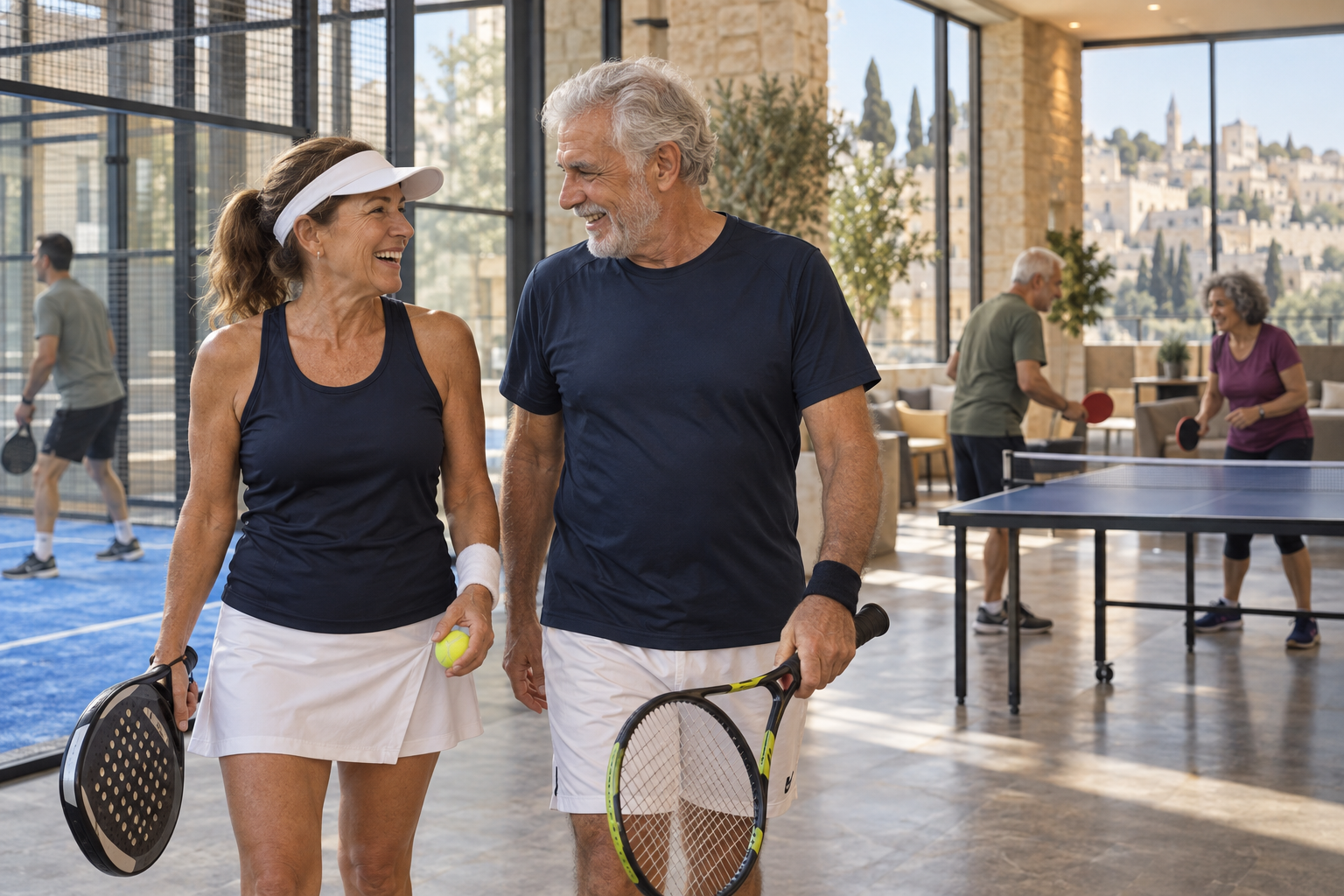
Large cohort studies associate racket sports with lower mortality, but the persuasive practical case rests on repeatable movement, social commitment and a game people still want to play years later
Three points
- **The mortality evidence is encouraging and observational.** Two large studies found lower mortality among people reporting racket-sport participation, but neither proves that the sport caused the difference.
- **Squash's “healthiest sport” reputation came from an editorial ranking.** It should invite investigation, not serve as a clinical promise.
- **Longevity depends on a sustainable activity system.** Racket play contributes aerobic work, balance, coordination and social purpose, while strength, recovery and appropriate progression remain necessary.
The strongest health claim for racket sports may be the least dramatic: they give people a reason to arrange the next active hour.
A machine supplies exercise. A racket game supplies exercise, a skill problem, another person and an unfinished story. The player returns to improve a weak return, meet a regular partner or settle a close conditioned game. Repetition turns these motives into a pattern of activity.
Research adds an intriguing association with longevity. It does not identify a miracle sport.
What the cohort studies observed
In 2017, researchers analyzed survey data from 80,306 adults in England and Scotland. They grouped badminton, tennis and squash as racket sports. Compared with people reporting no participation in that category, racket-sport participants showed a 47% lower hazard of death from any cause and a 59% lower hazard of cardiovascular death during follow-up after statistical adjustment.
A 2022 analysis included 272,550 older US adults. Among people reporting 7.5 to less than 15 metabolic-equivalent hours a week, racket sports were associated with a hazard ratio of 0.84 for all-cause mortality and 0.73 for cardiovascular mortality compared with inactivity. Only 4% of participants reported racket sports, and the study found beneficial associations across all activity categories examined.
| Study | Population and exposure | Reported association | Essential limit |
|---|---|---|---|
| British Journal of Sports Medicine, 2017 | 80,306 British adults; self-reported participation in grouped racket sports | 47% lower all-cause and 59% lower cardiovascular mortality hazard | Observational design, grouped sports and self-report |
| JAMA Network Open, 2022 | 272,550 older US adults; activity type and dose reported by questionnaire | HR 0.84 all-cause and HR 0.73 cardiovascular mortality at 7.5–<15 MET-hours weekly | Observational design; only 4% reported racket sports |
A hazard ratio describes the relative rate observed in a studied population over time. It does not tell an individual that playing squash will reduce personal risk by the headline percentage. People who play sport may differ in health, income, mobility, social support and access to facilities. Statistical adjustment reduces known differences; it cannot remove every source of selection and measurement error.
Where the famous squash claim came from
In 2003, Forbes ranked squash first in a feature on healthy sports. The scoring considered cardiorespiratory endurance, strength, muscular endurance, flexibility, calorie expenditure and injury risk with expert input. The ranking became an enduring promotional line: squash is the world’s healthiest sport.
It was an editorial comparison, not a randomized trial or long-term clinical study. The distinction does not make squash unhealthy. It means the slogan answers a different question from mortality research.
| Claim | Evidence supports | Evidence does not support |
|---|---|---|
| Racket-sport participants had lower mortality in two cohorts | An association worth studying and discussing | Guaranteed individual risk reduction |
| Squash placed first in a magazine ranking | A broad expert-informed fitness comparison | Clinical proof that squash beats every activity |
| Racket games can reach demanding intensity | Meaningful aerobic and movement work in suitable play | The same dose for every player and format |
| Social play encourages another appointment | A plausible adherence advantage | Automatic friendship or permanent participation |
Build the activity around the person
WHO guidance asks adults to combine aerobic activity with muscle-strengthening work. Older adults should also include varied multicomponent activity emphasizing functional balance and strength according to ability. Court play may contribute substantially, but no single sport supplies every requirement.
Squash asks for acceleration, braking, reaching and repeated recovery. Tennis adds larger-space movement and serving. Table tennis provides rapid perception and compact adjustment with less court travel. Badminton adds overhead action and repeated changes in shuttle trajectory. Padel organizes movement around a partner, net and walls. Session intensity changes with singles or doubles, skill, ball choice, rally design, rest and individual capacity.
| Longevity ingredient | Contribution from RB Sports | Complement that may still be needed |
|---|---|---|
| Aerobic activity | Repeated rallies and court movement | Walking, cycling or other volume at suitable intensity |
| Strength | Braking, pushing, rotation and overhead action | Progressive resistance for capacity beyond play |
| Balance | Reaching, recovering and changing direction | Specific balance work where needed |
| Coordination | Reading flight, timing contact and organizing feet | Individual technical instruction |
| Social connection | Partner, group and recurring appointment | A welcoming system that supports return visits |
| Adherence | Skill progression and enjoyable uncertainty | Schedule, access, recovery and realistic expectations |
Choose the game you can repeat
The most demanding sport on paper may be the wrong activity for a person who dislikes it, cannot reach it or repeatedly overplays. The gentler sport may provide greater long-term value because it occurs three times a week with friends. A player can also change the mix over time: singles today, doubles later; squash in winter, tennis in mild weather; table tennis during a period when large-court movement needs adjustment.
People returning after inactivity or managing symptoms should choose an appropriate starting point and seek qualified medical advice when necessary. A coach can change a ball, rule, pace or session. A coach cannot diagnose unexplained chest pain, fainting, acute injury or persistent symptoms.
Racket sports deserve attention because they combine several valuable ingredients inside one appointment. The responsible promise is powerful enough: a suitable game helps people move, think, connect and want to return.