Article · FF05
The Fitness You Repeat
A workout creates value only when it recurs. Racket sports can make repetition easier by combining a scheduled partner, visible skill and enjoyable uncertainty—but clubs must design the second visit rather than assume enthusiasm becomes a habit.
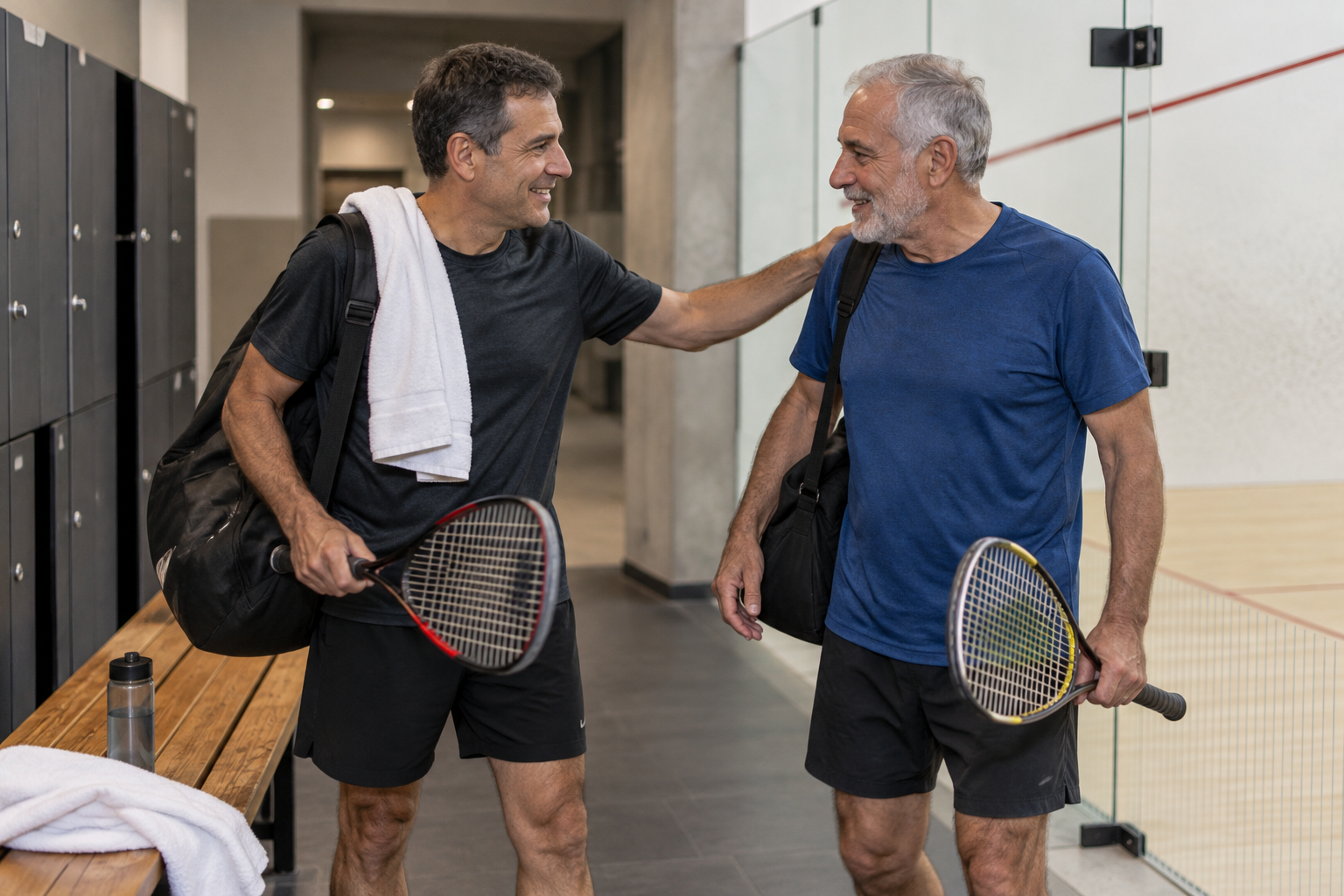
Three points
- The best exercise on paper fails when access, scheduling, confidence or enjoyment keeps it out of the calendar. Adherence is a design problem as well as a question of motivation.
- Racket sports offer three powerful reasons to return: another person expects the game, the player can see a skill developing and each rally remains uncertain. Those advantages disappear when finding the next suitable session becomes difficult.
- RacketBridge should measure continuation—second visits, repeat bookings and sustainable participation—before it celebrates registrations, strenuous first sessions or one successful event.
Exercise advice often assumes that information produces behavior. People learn that activity supports health, select a program and then repeat it through discipline. The first two steps are easier than the third.
A scientifically sound workout that happens twice has less practical value than an appropriate activity a person sustains for years. That does not make enjoyment more important than safety or proper loading. It makes repeatability one of the conditions through which good programming becomes useful.
Racket sports have an advantage: they can turn exercise from a private obligation into an anticipated appointment. They do not do this automatically. A poor level match, an awkward introduction or no clear path to a second booking can erase the advantage in one evening.
Adherence has several points of failure
“Lack of motivation” compresses different problems into one label. A person may want to play but lack a partner, a suitable level, an available court, confidence about etiquette or a session that fits work and family. Each barrier needs a different response.
| Point of friction | What the player experiences | What a useful system provides |
|---|---|---|
| Access | “I do not know where or when I can play” | Current places, times, prices and booking instructions |
| Level | “I will waste a stronger player’s time” | Honest level descriptions and a forgiving introductory format |
| Social entry | “Everyone already knows one another” | A named host, clear welcome and small-group introduction |
| Scheduling | “We keep discussing a game but never book it” | Specific invitations with date, place and expected duration |
| Equipment | “I do not own the right racket or ball” | Loan equipment and a short, sport-specific explanation |
| Physical uncertainty | “I may not keep up or recover well” | An appropriate pace, rest options and permission to stop |
| First-session quality | “The game was too difficult to enjoy” | Modified equipment, coaching or a conditioned game that creates rallies |
| Continuation | “It was enjoyable, but I do not know what comes next” | A second option offered before the participant leaves |
This table changes the management question. Instead of asking why adults lack willpower, a club can identify where participation breaks and remove that particular friction.
Someone is waiting—but dependence has a cost
A solitary exercise session can be postponed without inconveniencing anyone else. A court booking with a friend creates a commitment. The player arrives partly for the activity and partly because another person expects the game to happen.
The relationship also gives the effort meaning. Conversation does not have to carry the meeting. The game supplies a shared subject, repeated moments of cooperation and rivalry, and a natural reason to set another date.
Evidence supports a restrained version of this case. A one-year study followed 250 novice members at 25 fitness clubs. Regular attendance was associated with higher enjoyment, confidence in the ability to keep exercising and support from friends and family. The design shows association, not proof that any one factor caused attendance. A 2024 systematic review of 91 studies likewise found that adult sports participation reflects constraints and facilitators at several levels rather than one personal trait.
One partner can also become a single point of failure. Travel, injury or a busy week then cancels the entire routine. A durable social system needs a small circle: a preferred partner, a compatible substitute, a recurring group and a host who can reconnect someone after an absence. RacketBridge should help create that redundancy without making the relationships impersonal.
Skill turns effort into a continuing story
Skill creates a second reason to return. A player reads the ball earlier, controls a target, recovers with one fewer step or sustains a rally that previously ended after two shots. Progress can appear in one decision before it changes a match result.
That development changes the meaning of effort. Movement is no longer an abstract payment toward future health. It solves a present problem the player understands and wants to solve better.
Results alone are a poor progress measure. Opponents change; handicaps hide differences; a technically better performance can still lose. Recreational players need process markers they can recognize:
- squash: return to the T in balance after a straight length;
- tennis: recover outside the ball’s path instead of watching the shot;
- table tennis: contact three balls from a stable base before increasing speed;
- badminton: arrive under an overhead rather than reaching behind the body;
- padel: move forward with a partner rather than as two separate players.
Conditioned games can make these improvements visible across different levels. A score can reward the selected behavior or require a cooperative opening before the point becomes open. The condition gives both people a credible problem without pretending their overall abilities are equal.
Enjoyment is useful, but it is not the same as ease
Fun is sometimes treated as a reward added after serious training. For recreational players, enjoyment is part of the mechanism that keeps training alive. Uncertainty, friendly rivalry, humor and clean contact all contribute.
This does not require every minute to feel easy. Learning can frustrate, rallies can demand effort and a close game can create pressure. Enjoyment often comes from a challenge that feels possible and significant. Too little challenge becomes dull; too much becomes discouraging or unsafe.
The host therefore adjusts the experience rather than merely making it softer. A faster player may receive a precision target. A beginner may use a livelier squash ball, a slower tennis ball or a controlled feed. Both players should have something real to attempt.
Design the second visit before the first begins
Many introductions end with “We should do this again.” That is a compliment, not a plan. A repeatable experience needs a concrete next action.
| Moment | Decision that supports return | Weak substitute |
|---|---|---|
| Before arrival | Explain level, equipment, clothing, duration and cost | “Just come and see” |
| At welcome | Introduce one host who knows the participant’s name and aim | Point toward an unfamiliar group |
| During play | Adjust ball, court, scoring or pace to produce meaningful rallies | Preserve official conditions at the cost of participation |
| Before departure | Offer a specific second session with a suitable level | Promise to send information later |
| Within 48 hours | Confirm the next booking and one useful observation | Send a generic promotional message |
| After an absence | Make a low-pressure invitation back | Treat silence as loss of interest |
The second visit is the critical handoff from novelty to pattern. The tenth visit tests whether the pattern survived scheduling problems, plateaus and ordinary life.
RacketBridge should judge an introduction by what follows. Did the player return? Was the next session suitable? Did the intensity permit recovery? Did the participant gain more than a booking—a person to contact, a skill to develop and a reason to continue?
Measure continuation before transformation
An eight-week record needs only a few fields: planned sessions, completed sessions, partner or group, perceived effort, enjoyment, pain that changed play and whether the next session is booked. The purpose is not to quantify friendship. It is to separate a scheduling problem from a physical, social or playing-format problem.
| Pattern | Likely question | Reasonable response |
|---|---|---|
| Enjoyment is high but attendance is low | Is time, distance, cost or partner availability blocking play? | Change the appointment structure before changing the sport |
| Attendance is high but pain rises | Has load increased faster than recovery or technique? | Reduce exposure and seek appropriate assessment |
| Effort is suitable but enjoyment is low | Is the level, group or format a poor fit? | Try a different partner, condition or RB Sport |
| Results stall but process improves | Is the player measuring the wrong outcome? | Track one controllable skill for several sessions |
| Bookings recur and recovery remains stable | Is the pattern ready for gradual progression? | Increase one variable while protecting the schedule |
This record cannot prove that RacketBridge caused a habit. It can show whether the participation model produces the behavior it promises. Registration is an acquisition metric. A suitable second visit is the beginning of a fitness outcome.