Article · FF03
The Movement They Share
Every RB Sport asks players to read, prepare, move, arrive, strike and recover, but the scale and timing of that cycle change enough to make careless transfer inefficient and sometimes unsafe.
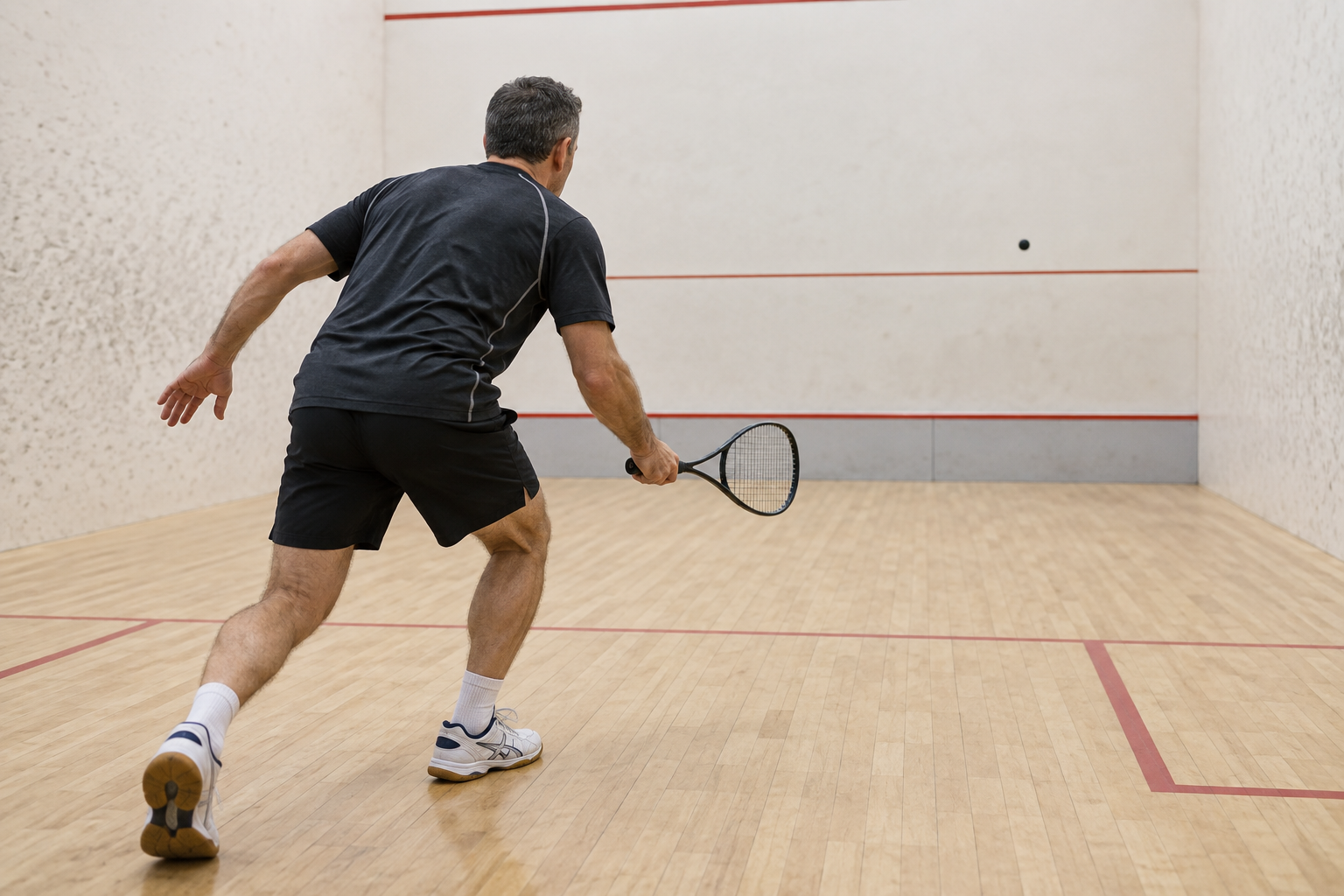
Three points
- The shared unit is a rally cycle rather than a stroke. Perception, footwork, contact and recovery form one continuous problem.
- Transfer helps when players carry principles such as balance, spacing and early preparation. It fails when they copy the old sport's step size, swing length or recovery destination.
- A useful cross-sport lesson names what remains familiar and what must change. That approach respects prior skill without allowing confidence to outrun control.
Rackets encourage superficial comparisons. A table-tennis forehand resembles a shortened tennis forehand; a squash volley resembles a compact net shot; a badminton split step looks familiar to a tennis player.
The deeper connection lies before and after contact. Players gather information, prepare a base, move into useful space, manage momentum, control the implement and recover for a reply. The ball, shuttle, walls, court and opponent determine how each stage works.
The rally begins before the ball travels
Reaction time sounds like a fixed personal quality. In play, early information matters just as much. The opponent’s position, racket preparation, contact point and available space allow an experienced player to begin organizing a response before the ball crosses the court.
Experts do not merely react faster. They often look in more useful places and recognize patterns earlier. A newcomer from another sport brings experience in directing attention, but must learn which cues carry meaning in the new game.
| Rally stage | Shared question | How the answer changes |
|---|---|---|
| Observe | What can the opponent plausibly play? | Walls matter in squash and padel; shuttle height matters in badminton; spin cues dominate table tennis |
| Prepare | Can I move in more than one direction? | Base width, body height and racket position reflect available time |
| Start | Which first step creates the best route? | A table-tennis adjustment is smaller than a tennis court-coverage step |
| Approach | How much space do I need from the ball? | Bounce, rebound and swing path set different distances |
| Brake | Can I arrive without losing the next action? | Squash and badminton use deeper lunges; table tennis often brakes within a compact base |
| Strike | Can I control contact while preserving balance? | Implement length, ball weight, spin and overhead demands change coordination |
| Recover | Which replies remain credible? | T position, baseline geometry, table distance and doubles formation differ |
This sequence also explains why isolated stroke imitation transfers poorly. A swing can look correct while the player reads late, crowds the ball and recovers to the wrong place.
Ready position is a set of options
“Stay low” is incomplete advice. A ready position should place the center of mass where the player can move in the directions the game requires. Too upright may delay a first step. Too low may fatigue the legs, restrict movement or imitate a professional position the recreational player cannot sustain.
Table tennis generally uses a compact base near the table and repeated small changes. Squash needs access to front and rear corners while preserving shared space. Tennis prepares for larger lateral and forward movement. Badminton must support rapid front-back travel and overhead preparation. Padel adds a partner whose position changes the correct space.
The appropriate test is functional: can the player start without first standing up, crossing the feet unnecessarily or shifting weight in the wrong direction?
Footwork manages distance and time
Fast players still become trapped when their steps do not manage distance. Arriving too close removes swing space. One giant final step may reach the ball but create no controlled exit. A useful pattern combines larger travel steps with smaller adjustment steps as contact approaches.
| Transfer from another sport | What helps | What needs revision |
|---|---|---|
| Tennis to squash | Split-step awareness, tracking and rotational control | Shorter approach, walls, safe clearing and less space for a large swing |
| Table tennis to squash | Early racket preparation, compact contact and reading spin | Larger travel, lunging, rebound routes and recovery around the T |
| Squash to table tennis | Anticipation, low posture and repeated recovery | Smaller steps, shorter swing and much earlier contact timing |
| Tennis to badminton | Overhead familiarity and court coverage | Shuttle deceleration, backward movement and landing demands |
| Squash to padel | Wall awareness and patience through rebounds | Partner spacing, net transitions and open-court lobs |
| Badminton to tennis | Split-step timing and overhead coordination | Heavier ball, bounce spacing and lateral load over a larger court |
The third column is not a list of faults. It is the syllabus for the first lesson.
Braking connects fitness with technique
The player must reduce speed before accurate contact and a useful recovery. Poor braking appears as a noisy final step, a collapsing joint position, a swing used for balance or several extra steps after the shot.
Training should progress from a planned step-and-stop to a directional choice, then to a predictable ball and finally to an open rally. Each stage keeps the same standard: arrive with enough control to strike and leave.
Maximum depth is unnecessary. A shorter lunge the player can reverse has more functional value than an extreme reach that ends the point and strains the return.
Recovery is a tactical decision
Coaches often teach a home position, but recovery is not a race to a painted spot. The previous shot, opponent’s options, partner position and court geometry determine where the player should finish.
Returning mechanically to the middle can waste time. A strong deep squash length changes the likely reply; a short tennis ball may pull the player forward; padel partners should move as a pair. Physical capacity enables recovery, while tactical judgment selects its distance and direction.
A cross-sport lesson needs contrast
A 40-minute introduction can organize transfer deliberately:
| Segment | Task | Teaching question |
|---|---|---|
| 5 minutes | Compare equipment, court and safety | What changes the available time and space? |
| 8 minutes | Shadow one familiar and one unfamiliar movement | Which part feels transferable, and which part needs a new scale? |
| 10 minutes | Predictable feeds with recovery | Can the player arrive, strike and leave in balance? |
| 10 minutes | Variable feeds or cooperative rally | Which cue should start movement? |
| 5 minutes | Short conditioned game | Does the movement survive uncertainty and score? |
| 2 minutes | Review and next booking | What one adjustment deserves repetition? |
The instructor should avoid saying, “It is just like tennis” or “Forget everything you know.” Both claims waste information. The useful message is more precise: this principle transfers; this execution changes.
RacketBridge can make that translation part of matching. A profile that identifies the player’s present sport gives a coach or host a starting vocabulary. The second sport then becomes an expansion of movement intelligence and social opportunity rather than a test of whether prior experience counts.