Article · CS02
Training Across Two Speeds
Table tennis compresses perception and movement into the space around a table; squash expands the same decision cycle across a room. Comparing them reveals which habits transfer, which techniques do not and how recreational players can train both games more intelligently.
Three points
- **Ready positions solve different movement problems.** Table tennis uses a low, compact base for rapid adjustments near the table; squash uses a mobile central position that supports a longer first move, controlled braking and safe clearance.
- **The transferable skill is the decision cycle, not the stroke.** Both players read the opponent, move, strike and recover, but differences in spin, walls, equipment and distance make direct technical imitation unreliable.
- **Useful cross-training changes one demand at a time.** Recreational players learn more from short, decision-based exercises than from professional statistics or exhausting drills that hide poor movement.
Table tennis and squash appear to occupy opposite ends of racket sport. One keeps the players close to a table and separates them with a net. The other sends two players through the same enclosed court and turns three walls into playable surfaces. Table-tennis strokes often look compact; squash movement can fill the room.
The contrast is real. The familiar labels are less helpful. Calling table tennis a reflex sport suggests that the player waits for the ball and reacts. Calling squash an endurance sport suggests that fitness explains success. Skilled players in both games begin earlier. They read preparation, narrow the opponent’s likely choices, move before the ball completes its path and finish one action in a position that supports the next.
The shared unit is not a stroke. It is a continuous cycle: observe → decide → move → strike → recover. Table tennis compresses the cycle. Squash expands it.
Start with the base, not the racket
A ready stance has no universally correct measurement. Body proportions, mobility, distance from the ball and tactical position all change it. “Shoulder width” is a useful starting cue in table tennis, not a law. The ITTF Foundation’s introductory coaching material asks beginners to place the feet shoulder-width apart and hold the racket in front of the chest. Many players then widen or stagger the base enough to push in either direction without first rocking or bringing the feet together.
For a recreational table-tennis player, the practical checkpoints are straightforward. The feet should feel wide enough to resist a gentle sideways push. The ankles, knees and hips should carry some flexion rather than leaving the player upright. Weight should remain available to both feet. The racket should begin in front of the body, where a forehand or backhand response does not require a long return from the previous stroke.
The player should not hold a deep squat. Excessive tension slows the first adjustment and becomes tiring before it becomes useful. The test is movement: can the player respond left or right without rising first, crossing unnecessarily or reaching beyond a stable base?
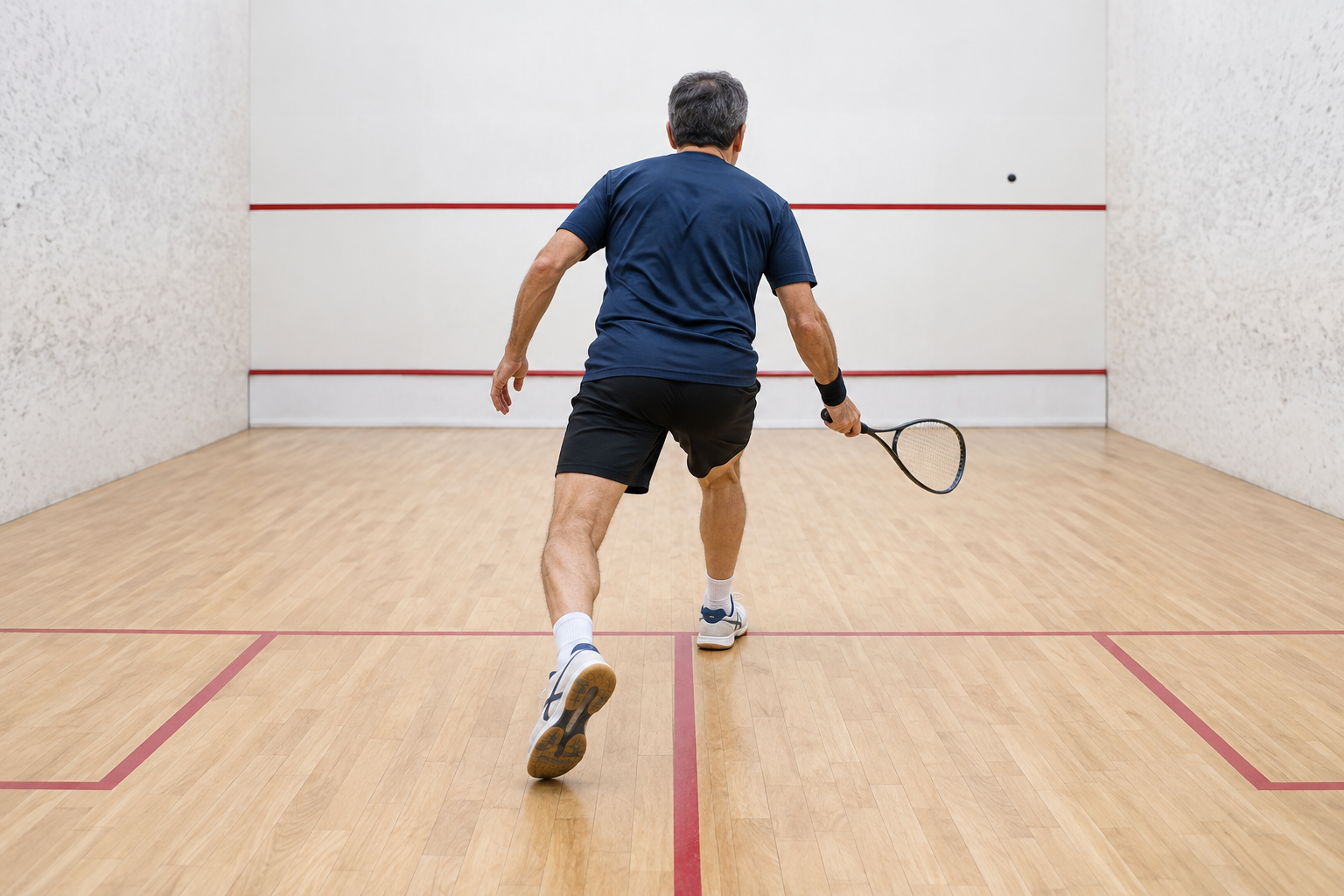
Squash asks a different question. Near the T, the player needs a neutral position from which to move toward any corner while watching the opponent and leaving safe access to the ball. The stance can remain more upright than a table-tennis receiving position because the next action may require a longer acceleration. As the player approaches the ball, the base changes. A short ball may require a deep but controlled lunge; a ball behind the body may require a turning approach; a loose ball may call for adjustment steps rather than one long reach.
The squash player’s lowest position therefore occurs near the shot, not as a permanent crouch at the T. Depth without control is not an achievement. If the front knee collapses inward, the trunk falls beyond the base or the player cannot push away without an extra hand or step, the arrival has exceeded current capacity.
A comparison for recreational players
| Movement question | Table tennis | Squash | What success looks like |
|---|---|---|---|
| Starting base | Around shoulder width or slightly wider; often mildly staggered | Comfortable and neutral near the T; width changes with the route and shot | Movement begins without rocking, gathering the feet or standing up first |
| Body height | Flexion through ankles, knees and hips keeps the player near the expected contact zone | Mobile near the T, then lower during braking and arrival | The chest remains organized over the base rather than folding at the waist |
| First movement | Small push, shuffle, step or crossover depending on distance | Split step or adjustment followed by a longer step pattern toward a corner | The first move follows useful information rather than a memorized direction |
| Typical working space | Compact adjustments around the table | Repeated travel between a central area and four corners | The player uses only the distance the ball requires |
| Main braking task | Stop lateral drift before a precise contact | Absorb forward, lateral or turning momentum before striking | Contact occurs without sliding, collapsing or reaching desperately |
| Racket preparation | Compact and early because the next ball returns quickly | Larger preparation coordinated with travel and shared-court awareness | Preparation does not block vision, balance or the next recovery |
| Visual priority | Opponent’s trunk and racket, early flight, bounce and spin | Opponent’s preparation, front-wall contact, angles, bounce and open court | The player identifies a cue before the ball becomes urgent |
| Contact and spacing | Fine foot adjustments place the body around a small contact zone | Approach path and final steps create room for the swing and opponent | The player strikes from balance rather than compensating with the arm |
| Recovery | Re-center enough to cover the likely angles; often a small distance | Clear the shot safely and recover toward a useful T position | The next move remains available before the opponent strikes |
| Common recreational error | Standing upright, reaching, taking a large backswing or watching the completed shot | Overstriding, collapsing into a lunge, crowding the ball or blocking the opponent | One correction improves both the shot and the position that follows |
The table compares functions, not fixed poses. Coaches may use different terminology, and individual technique requires direct observation. The useful standard remains repeatability: the player reaches the ball in balance, makes a controlled contact and leaves the shot ready to continue.
Two kinds of early information
In table tennis, useful information appears before the ball crosses the net. The opponent’s trunk, racket path and contact can indicate direction, speed and spin. The first bounce then refines the judgment. Waiting until the ball reaches one’s own side turns an anticipation problem into an emergency.
In squash, the player also watches the opponent before contact, but the environment adds another calculation. The ball may reach the front wall directly, touch a side wall first, rebound into the back court or die near the front. The player must interpret the opponent’s preparation while protecting safe space around the swing.
Video-occlusion studies help explain the distinction. Experienced table-tennis players have anticipated direction from body kinematics more accurately than novices. Earlier squash research likewise found expert-novice differences in the use of advance cues. These studies show sport-specific perceptual expertise. They do not establish that a good table-tennis reader automatically reads squash well.
What may transfer is the habit of looking upstream. Instead of following only the ball, the player asks: What did the opponent’s position and preparation make likely? The answer differs by sport; the question remains valuable.
Recovery is a tactical act
Beginners often treat recovery as housekeeping performed after the important action. It is part of the shot.
A table-tennis player who finishes a forehand with the racket far outside the body may have produced one strong ball while surrendering the next. A squash player who hits an accurate length and remains beside the wall may have improved the shot but lost access to the center. In both cases, the stroke ended in a position that reduced future choices.
Recovery does not mean returning mechanically to one marked spot. The useful position depends on the reply just invited. A wide table-tennis angle may require a different recovery than a ball directed into the opponent’s body. A tight squash length usually justifies movement toward the T, but a loose crosscourt may require the striker to respect the opponent’s direct route and swing.
The better question is not “Did I get back?” It is “How many credible next moves did my finish preserve?”
What transfers—and what must be rebuilt
| Habit from either sport | Transfer value | Limit |
|---|---|---|
| Watch the opponent before tracking the ball | High | The useful cues and timing remain sport-specific |
| Prepare early | High | The size and shape of preparation differ greatly |
| Use the legs to organize contact | High | Footwork patterns and contact distances differ |
| Recover before admiring the shot | High | The destination depends on court geometry and likely reply |
| Construct the rally rather than chase winners | High | Spin, walls, bounce and scoring change the available tactics |
| Copy the familiar stroke into the new sport | Low | Different rackets, balls, surfaces and contact points punish imitation |
| Assume the existing fitness level is sufficient | Low | Squash braking and table-tennis posture may expose different limitations |
A table-tennis player entering squash may recognize placement yet stand too close to the ball, use an abbreviated wrist-led swing or forget that both players share the path to the front wall. A squash player entering table tennis may prepare too largely, expect more time after the bounce or move the upper body instead of making a small foot adjustment. Existing skill accelerates understanding only when the player accepts beginner status in the new technique.
A 35-minute two-sport exchange
Cross-training works best when the session has one purpose. The following exchange trains observation and recovery without pretending that the strokes are interchangeable.
| Time | Table-tennis task | Squash task | Coaching question |
|---|---|---|---|
| 5 minutes | Cooperative rally at controllable pace | Straight hitting with a bouncier ball if needed | Can both players sustain the task without rushing? |
| 6 minutes | Partner directs to one of two zones after a visible cue | Partner feeds to one of two front-court targets | What information appeared before the ball arrived? |
| 6 minutes | Freeze after contact, then check racket and base | Freeze after contact, then check balance and clearance | Could the next movement begin immediately? |
| 6 minutes | Score only after recovering to a useful ready position | Score only after clearing and recovering toward the T | Did the condition improve the rally or distract from it? |
| 8 minutes | Open play with one observation goal | Open play with one observation goal | Which cue remained useful under pressure? |
| 4 minutes | Compare one success and one difficulty | Compare one success and one difficulty | What transferred as a habit, and what needs new instruction? |
The pace should preserve movement quality. A bouncier squash ball, slower table-tennis feed or cooperative scoring condition can produce more decisions per minute than a difficult ball or unrestricted game that repeatedly ends after one or two contacts.
Use video to answer one question
A phone can help if it records a specific question rather than becoming a performance theater. Place it where it does not create a hazard or capture other players without consent. Review four moments: just before the opponent’s contact, the first movement, one’s own contact and the first recovery step.
Look for one pattern only. Did the feet narrow before movement? Did the player rise before pushing? Did the squash arrival continue past the ball? Did the table-tennis stroke finish so far away that recovery became late? One visible correction provides a useful practice objective. A list of ten faults does not.
Professional rally averages add little to this diagnosis. The recreational player needs personal evidence: more balanced contacts, fewer emergency reaches, safer clearance, a higher proportion of rallies that continue and enough physical control to play again later in the week.