Article · FF02
Fitness Follows the Sport
General fitness supplies strength, endurance, mobility and balance, but each racket sport teaches the body when, where and how to use those capacities through its own court, rhythm, equipment and decisions.
Three points
- Fitness transfers as capacity, not as a completed skill. Strong legs help in every RB Sport, but a squash lunge, tennis recovery and table-tennis adjustment solve different problems.
- Sport-specific training should reproduce the game's information and decisions as well as its movements. Copying a stroke without reading a ball prepares choreography rather than play.
- Cross-sport players should lower intensity while learning the new movement scale. Previous fitness permits progress, but unfamiliar braking, landing and stroke volume still require gradual exposure.
A distance runner can become breathless in a short squash game. A strong squash player can feel permanently late at a table-tennis table. A tennis player who covers a large baseline can struggle to move backward under a badminton shuttle.
These experiences do not invalidate general fitness. They reveal the difference between possessing a capacity and expressing it in a particular task.
The body brings a foundation
Every RB Sport benefits from lower-body strength, aerobic capacity, mobility, balance, trunk control and the ability to tolerate repeated effort. Those qualities expand the player’s options. They help the player arrive, remain stable and recover between sessions.
General work also covers movements the sport underuses. Racket sports repeat a dominant grip and familiar stroke patterns. Whole-body strength can train both sides, load joints progressively and develop ranges that a match reaches only under pressure.
The foundation matters most when it remains general enough to support life. A recreational player does not need to turn every squat into a simulated forehand. The exercise earns its place by developing a capacity the player needs, not by looking like the sport.
The sport decides how the capacity appears
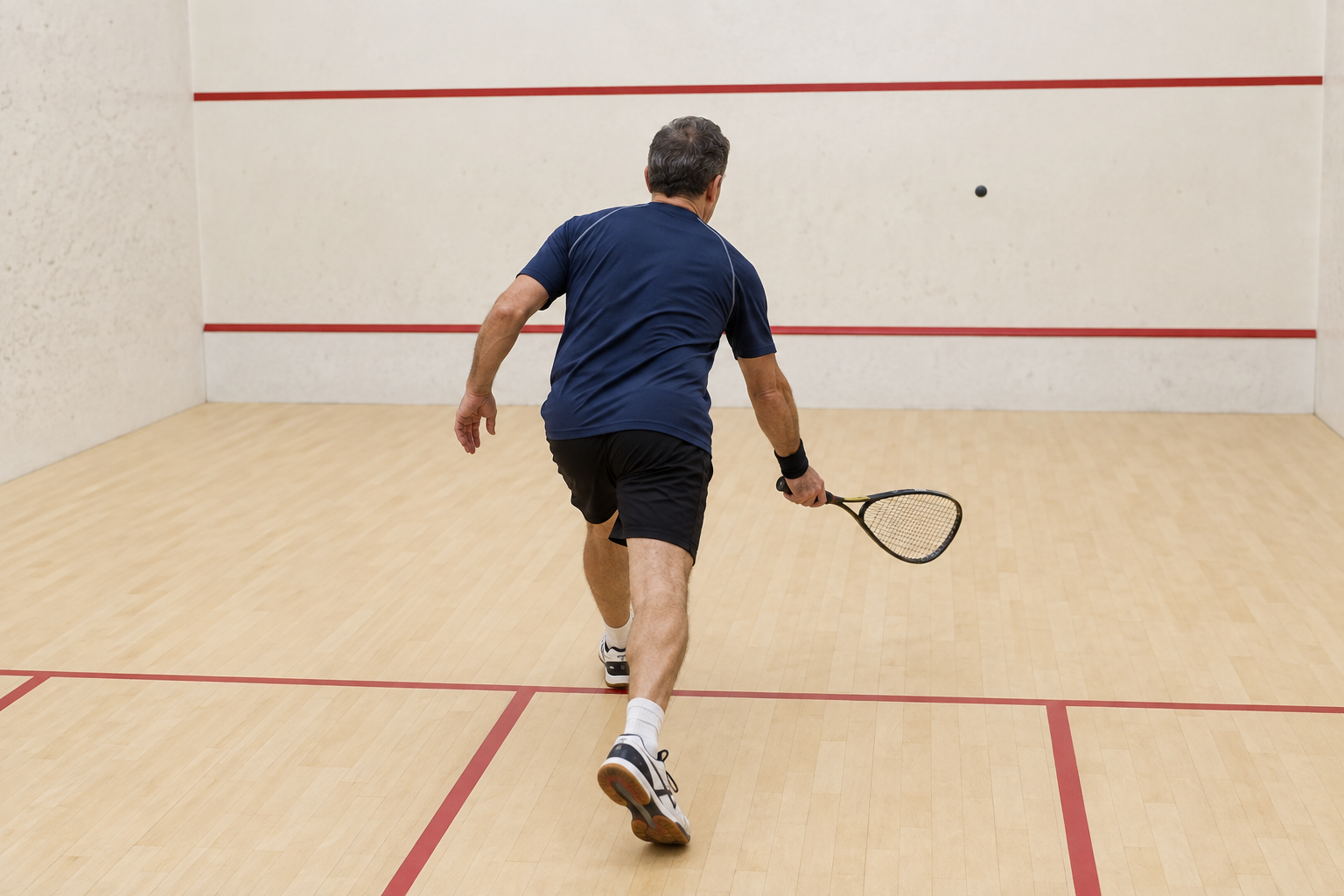
The same physical quality changes meaning across courts. “Fast feet” in table tennis means small, early adjustments that preserve time for the next ball. In tennis it may mean a powerful first step followed by several running strides. In squash it includes braking near a corner while leaving a safe path for the other player.
| Shared capacity | Squash | Tennis | Table tennis | Badminton | Padel |
|---|---|---|---|---|---|
| First movement | Short start toward a rebound route | Split step into larger court coverage | Immediate compact adjustment | Split step into front-back or lateral travel | Read ball and partner before moving |
| Braking | Control a lunge near walls and shared space | Stop after wide or forward running | Stop within a small base | Absorb lunges and landings | Brake while preserving doubles shape |
| Stroke endurance | Repeat forehand and backhand under whole-body fatigue | Manage groundstroke and serving volume | Sustain rapid compact rotation | Repeat overhead actions | Sustain volleys, overheads and rebounds |
| Recovery | Rebuild position around the T | Recover according to opponent and court geometry | Return to a neutral distance from the table | Re-center for front and rear replies | Recover with a partner rather than alone |
| Aerobic demand | Repeated work with short point recovery | Alternating points, rests and changeovers | Brief exchanges across many repetitions | Explosive rallies with variable rest | Intermittent doubles movement |
| Perceptual demand | Read opponent, ball and walls | Read stroke, spin, height and open court | Read serve and racket angle very early | Read deception and shuttle flight | Read opponents, partner and wall rebound |
The table describes problems, not fixed measurements. Level, rally style, singles or doubles, ball choice, coaching format and temperature all change the dose.
Specificity has a ladder
Training becomes more sport-specific in stages. Skipping stages often creates speed without control.
| Stage | Example | What it develops | What it cannot prove |
|---|---|---|---|
| General capacity | Squat, row, calf raise, carry or cycling | Force, tissue tolerance and aerobic base | Correct court movement |
| Movement pattern | Controlled lunge and recovery | Alignment, braking and range | Timing against a ball |
| Pattern with choice | Move left or right after a visual cue | Perception joined to movement | Stroke control under a rally |
| Predictable ball | Coach feeds to known areas | Spacing and contact | Reading an opponent |
| Variable ball | Feeds vary in direction, speed or spin | Adaptation and decision | Match pressure |
| Conditioned game | One rule rewards the selected behavior | Skill inside opposition and scoring | Complete match ability |
| Open game | Regulation play | Integration under ordinary rules | Whether one weakness caused the result |
A player who loses balance in a lunge may need strength or movement practice before more feeds. A player who moves well in rehearsal but arrives late in games may need better information, not harder conditioning. The stage identifies the problem more accurately than the word “fitness.”
Energy systems do not play the point
Racket-sport research often reports heart rate, oxygen consumption, rally time and work-to-rest ratio. Those measures help researchers describe groups of players. They do not prescribe one recreational session.
Two bookings of equal length can impose very different demands. One contains long rallies and short rests; another contains brief points, conversation and extended retrieval of balls. A watch may show effort, but it does not show whether the player moved efficiently or repeatedly reached beyond present control.
Use simple session information instead: total playing time, perceived effort from 1 to 10, the hardest movement repeated, recovery by the next morning and any pain that changed technique. Those observations guide the next session without pretending that amateur play reproduces professional data.
A new sport requires a temporary step down
Experienced players dislike feeling like beginners. Their hand-eye coordination and tactical language may let them create speed before their tissues or movement patterns are ready for it.
The first four introductions should therefore control different variables:
- Orientation: learn court boundaries, safety, equipment and a neutral ready position.
- Rally creation: use suitable balls, feeds or reduced pace to produce repeatable contact.
- Movement connection: add controlled starts, stops and recovery without maximal reach.
- Open decisions: introduce short games while keeping volume below the player’s established sport.
Previous fitness makes these sessions more productive. It does not remove them.
Build a week around demands, not sport labels
| Weekly element | Purpose | Recreational control |
|---|---|---|
| Primary RB Sport | Maintain familiar skill and social routine | Keep normal volume stable while adding a new sport |
| Second RB Sport | Learn a new movement and decision scale | Begin with short coached or hosted sessions |
| Whole-body strength | Develop force and tissue capacity outside match pressure | Use controlled repetitions and balanced movement patterns |
| Aerobic work | Support recovery and general health | Include easy sustained work when court play is highly intermittent |
| Balance and mobility | Address individual restrictions | Train the range the player can control, not the professional extreme |
| Recovery | Permit adaptation | Track sleep, soreness, enthusiasm and next-day function |
Increase one major variable at a time: frequency, duration, intensity or complexity. The new sport already raises complexity even when the session feels easy.
Fitness follows the sport because the game organizes capacity into action. A thoughtful program preserves a broad foundation, teaches the specific action in stages and leaves enough recovery for the player to want another game.