Article · CS03
Tennis Meets the Walls
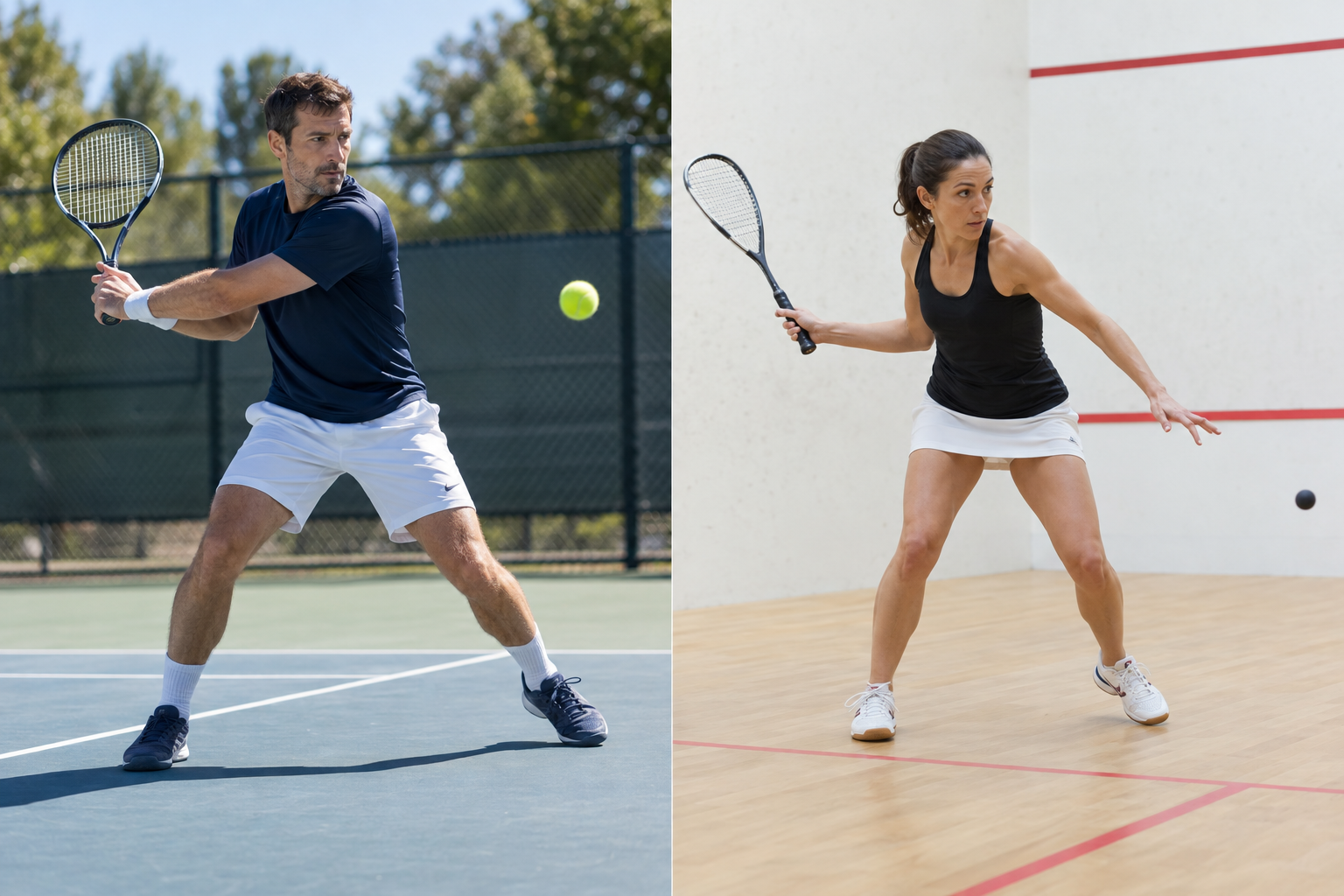
Tennis players can carry rally construction, preparation and respect for court position into squash, but the walls and shared court demand new spacing, recovery and safety from the first swing
Three points
- **Tactical experience travels better than stroke shape.** Depth, preparation and planning the next ball remain valuable, while grip, swing path, contact and targets require squash instruction.
- **The court reverses familiar assumptions.** Walls keep the ball alive, both players share the same space and recovery moves toward central access instead of a baseline home.
- **The first lesson should reward control and a complete movement cycle.** A balanced hit, safe clearance and useful recovery matter more than pace or an early match score.
Tennis and squash look close enough to invite overconfidence. Both use a strung racket, a ball, lateral movement and alternating shots. An experienced tennis player understands preparation, balance and the discipline of constructing a point.
Then the first squash ball passes the player, strikes the back wall and returns. The opponent crosses toward the same corner. A large tennis backswing occupies space another person may need. Familiar competence meets a court with different geometry.
The tennis player does not begin from zero. The player begins with valuable ideas and several habits that now need translation.
Keep the tactical grammar
Tennis players understand that depth can reduce an opponent’s options, direction opens space and recovery depends on the shot just played. Squash preserves this cause-and-effect structure. It changes the available surfaces and positions.
A strong first lesson uses familiar tactical language: Where did your shot send the opponent? What reply did it invite? Where should you stand to cover the likely response? It does not ask the newcomer to reproduce a tennis forehand against a side wall.
| Tennis habit | Keep | Rebuild for squash |
|---|---|---|
| Prepare before the bounce | Early organization | Shorter, squash-specific spacing and swing path |
| Use depth to move the opponent | Tactical purpose | Straight length close to the side wall |
| Recover after every shot | Continuous point construction | Movement toward useful T access while clearing |
| Read body and racket cues | Anticipation | Add wall angles and opponent access |
| Split as the opponent acts | Readiness rather than stillness | Timing and base appropriate to shared space |
| Accelerate for an attacking ball | Selective pressure | Control before pace on an enclosed court |
Understand what the walls change
The tennis net divides the players. Once a ball passes, the receiver knows the opponent will remain on the far side. Squash players move through the same central area and may pursue the same corner in sequence. The striker must provide the opponent a fair view, direct access and room for a reasonable swing under the rules.
Walls also turn apparent winners into continuing balls. A deep shot may rebound from the back wall. A boast reaches the front wall through a side wall. Court position therefore depends on the complete path, not only the direction at contact.
| Court problem | Tennis expectation | Squash requirement |
|---|---|---|
| Division | Net separates opponents | Both players share all floor space |
| Boundary | Ball outside lines ends the point | Side and back walls remain playable within markings |
| Deep ball | Often pushes play behind the baseline | May rebound and become playable after the back wall |
| Recovery home | Position relates to baseline and shot geometry | T access changes with ball and opponent |
| Swing safety | Opponent remains across the net | Player must stop when line, access or swing is unsafe |
| Attack | Pace and open court can finish | Tightness, length, deception and position may matter more |
Rebuild the stroke without discarding athletic skill
The tennis player’s unit turn and early preparation can help. The larger tennis swing, different grip and instinct to meet the ball farther from the body can create late contact or unsafe racket space in squash. A coach should establish grip, racket preparation, distance from the ball and a compact controlled follow-through before adding pace.
The player may also arrive with a heavier tennis racket and assume a premium squash racket will solve the adjustment. Equipment cannot replace spacing. A suitable club racket, eye protection and a ball that produces complete rallies give the newcomer enough information to choose later.
Score the complete action
The first practice target should include four events: arrive in balance, contact toward the intended lane, clear the hitting area and recover under control. A shot that reaches the target but leaves the player falling across the opponent’s path does not count.
| Progression | Condition | Advance when |
|---|---|---|
| Solo contact | Controlled front-wall target | Contact and racket path remain repeatable |
| Straight feed | Side-wall lane at moderate pace | Player finishes balanced and clears |
| Cooperative drive | Partner keeps the rally playable | Both complete several safe cycles |
| Movement pattern | Feed alternates two simple locations | Braking remains controlled |
| Conditioned game | Score after a deep controlled shot | Decisions remain safe under attention pressure |
| Open play | Short games with frequent review | Player recognizes interference and stops independently |
The tennis player’s first success is not defeating a squash player. It is discovering that existing strategic intelligence works inside a new physical grammar. That discovery provides a serious reason to book the second lesson.