Article · CG02
Change the Rules, Improve the Game
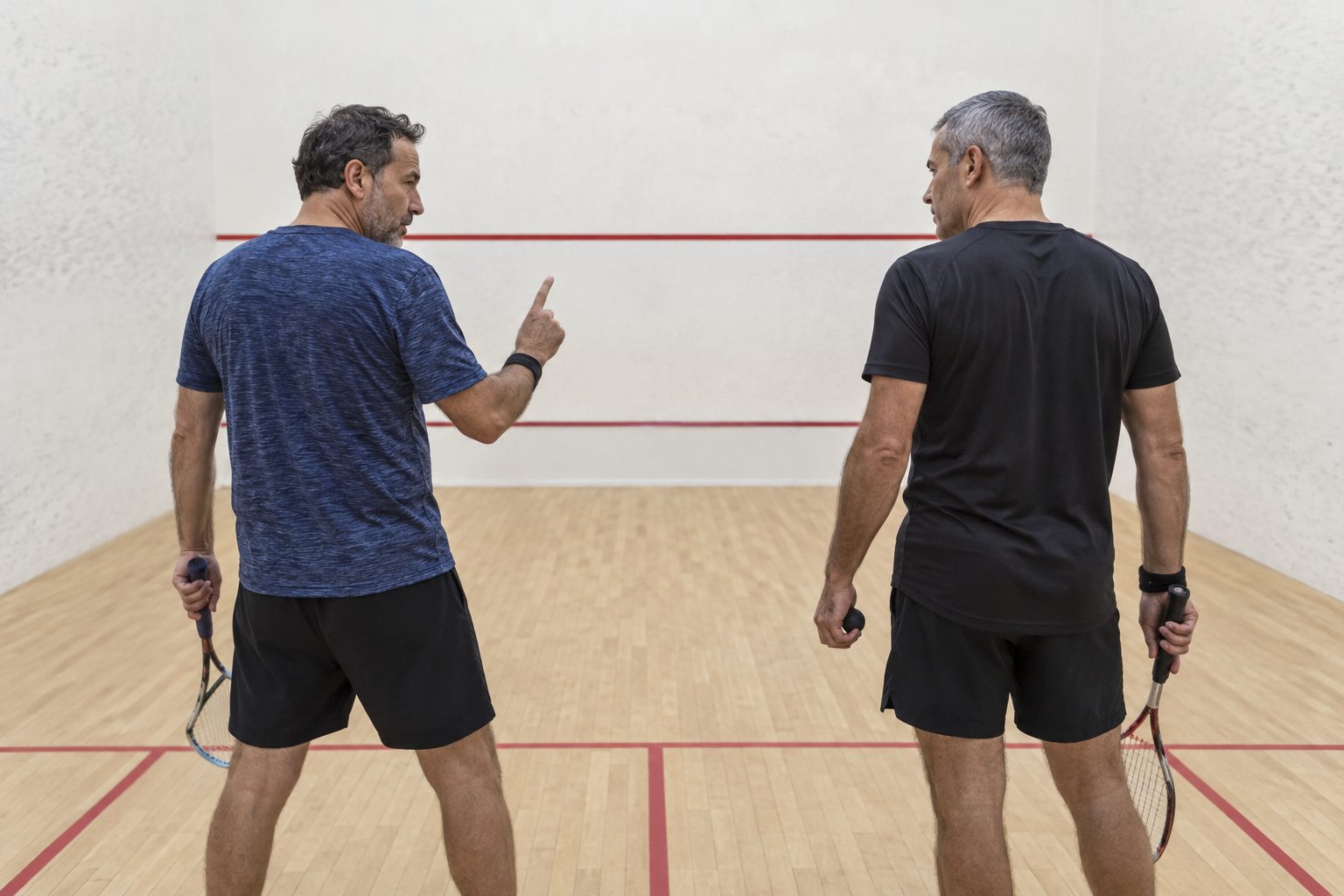
A conditioned game changes one observable feature of play so that opponents face more of the decision they want to improve, while scoring, uncertainty and the essential character of the sport remain.
Three points
- Begin with a behavior, not an inventive rule. The condition succeeds only when it makes the desired decision occur more often.
- Change one main lever—space, scoring, shot choice, pace or opening sequence—and keep official safety rules intact. Complexity consumes the attention the game should train.
- Test the condition in a short block, count the target behavior and ask both players what changed. Keep, revise or discard it according to evidence from the session.
A drill prescribes much of what happens. A regulation match leaves most choices open. A conditioned game sits between them: opposition and uncertainty remain, while one rule makes a selected problem more frequent or more important.
This is not a RacketBridge invention. Coaches in many sports manipulate task constraints to shape practice. RacketBridge turns the idea into a recreational format that players can understand, agree to and review without pretending to replace coaching.
Write the purpose before the rule
Players often begin with a novelty—“no backhands”—and search afterward for a reason to use it. Reverse the order.
Suppose a squash player attacks too early. The desired behavior is to construct the rally with depth before taking the ball short. A useful condition might allow a winning attacking point only after a rear-court target has been reached. “No backhands” would restrict the game without addressing the problem.
| Purpose | Observable behavior | Possible condition | Evidence during play |
|---|---|---|---|
| Improve depth before attack | Ball reaches an agreed deep target | Attacking winner counts only after the target | More rallies contain a deliberate setup |
| Improve recovery | Player returns to a useful base after contact | Bonus point for winning after three balanced recoveries | Fewer shots end with the player stranded |
| Improve serve return | Return reaches a playable target | Receiver receives a bonus for the declared zone | More points begin with a controlled third ball |
| Reduce unproductive pace | Players construct before accelerating | First three shots use controlled pace | Rally decisions remain clear before attack |
| Coordinate doubles movement | Partners change position together | Winning phase counts after a joint transition | Fewer large gaps open between partners |
| Balance unequal standards | Strong player solves a narrower problem | Strong player scores through a designated pattern | Both players retain a credible path to success |
The evidence column prevents a close score from becoming the only test.
Five levers change a game
- Space: make a target larger, smaller or strategically important.
- Scoring: add a point or require a condition before a point can be won.
- Shot choice: require or prohibit one option for a short block.
- Pace: use controlled speed, a livelier squash ball or a slower tennis ball.
- Opening sequence: begin cooperatively, from a specified serve or with a feed.
Use one main lever. A second may support clarity, but several simultaneous exceptions turn play into rule administration.
Replace vague intentions with calls players can make
“Do not hit hard” expresses an intention but invites argument. Pace has no shared line. “The first three shots remain below the service line” may be observable in squash, while “the point opens after three cooperative cross-court balls” is clearer in tennis.
| Vague condition | Why it fails | More usable version |
|---|---|---|
| Take it easy | No visible standard | Play cooperatively to four contacts, then open the point |
| Use your weak shot | Labels the person and lacks a target | Earn a bonus when the declared shot reaches the target zone |
| No hard shots | Pace calls become personal | Use a ball, court area or opening sequence that controls pace |
| Move better | No specified behavior | Count balanced recoveries after a straight shot |
| Make the game fair | “Fair” remains undefined | Give each player a different, stated route to score |
The rule should fit on one sentence and survive a noisy court.
Preserve representation
A useful conditioned game still asks players to perceive an opponent, choose among meaningful options and execute in relation to the developing rally. If the rule removes all choice, the activity has become a drill. That may be useful, but it should be named honestly.
The condition should also occur often enough to learn from. A target attempted once in ten minutes provides little repetition. Adjust the feed, opening or target so the relevant decision becomes available without dictating its solution.
Safety rules do not become variables
No condition overrides official safety and interference rules. Squash players must retain safe swing space and access decisions. A badminton landing task should not reward desperate retrieval. A tennis target should not require a recreational player to repeat painful serves. A padel rule should not draw partners into collisions.
Stop the block if movement becomes less controlled, disputed calls dominate, fatigue changes technique or either person feels the restriction is disrespectful.
Use a short design loop
| Step | Question | Practical action |
|---|---|---|
| Purpose | What decision should occur more often? | Name one behavior |
| Condition | Which single lever changes its value or frequency? | Write one observable sentence |
| Consent | Does each player understand the different challenge? | Explain before scoring |
| Dose | How long can we test without committing the session? | Use five points or six minutes |
| Observe | Did the behavior actually appear? | Count occurrences or successful sequences |
| Review | Was it useful, respectful and enjoyable? | Keep, modify or discard |
RacketBridge should store the purpose, rule, level difference and player ratings separately. “Worked well” is too vague to help another pair. A reusable condition records who used it, what it tried to change and what happened.
The design standard is simple: the altered rule should make the desired game problem clearer. If players remember only the restriction, the condition has failed.