Article · RB03
Buy the Lesson You Need
A useful coaching listing tells players who the session serves, what problem it addresses, how learning will occur and what a sensible next step costs
Three points
- **“Lesson” describes a purchase, not a learning objective.** An introduction, technical correction, tactical practice and physical program solve different problems.
- **Players should compare observable session design instead of credentials or star ratings alone.** Group size, active practice time, feedback, progression and the next offer shape the value received.
- **Better descriptions improve both sides of the transaction.** Coaches receive more suitable inquiries, while players make informed choices before paying for court time and instruction.
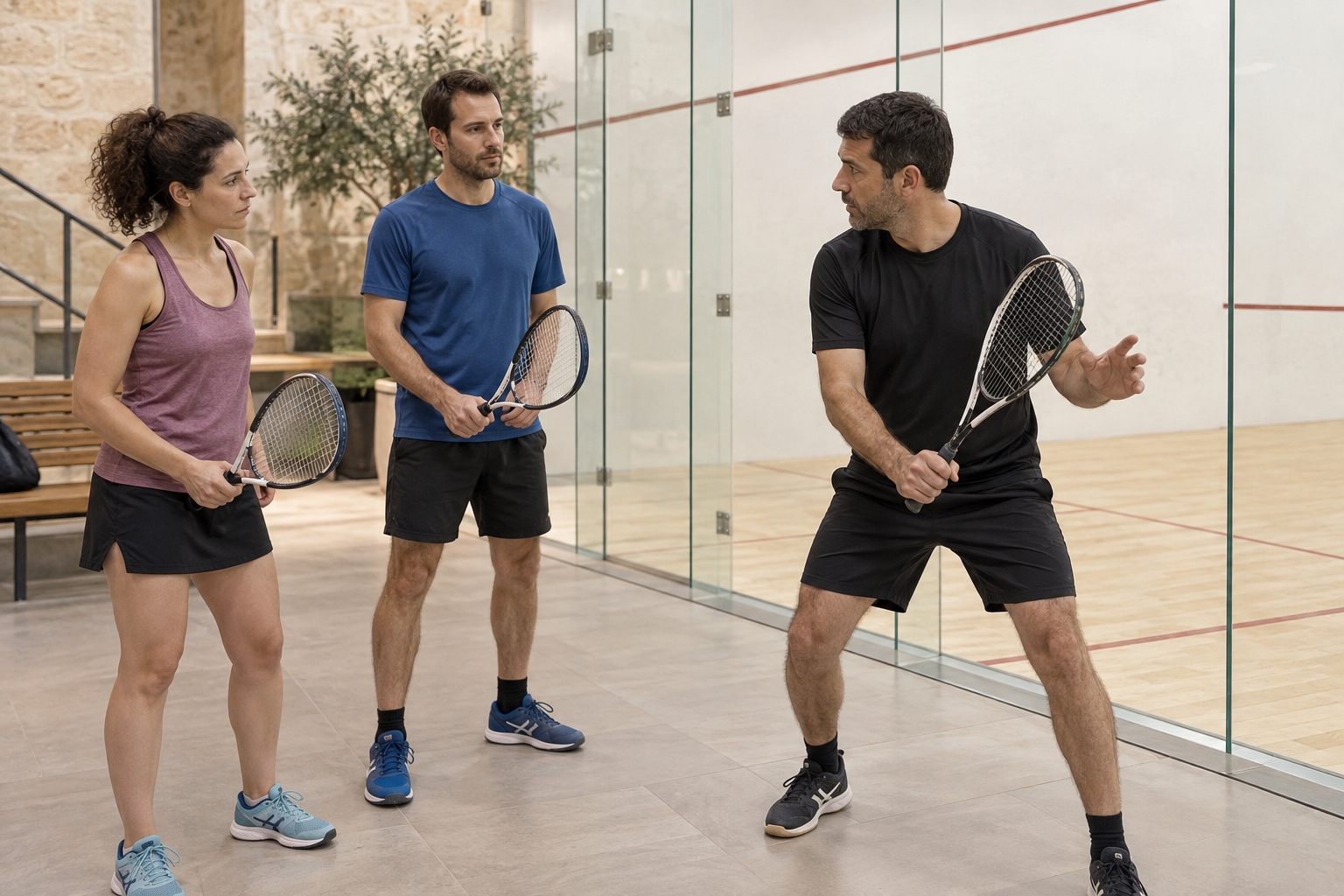
A player booking a “squash lesson” may receive forty minutes of continuous hitting, a detailed reconstruction of one stroke, a tactical game with questions, or a group rotation that provides six minutes of individual attention. Each session may be legitimate. They are not the same product.
Instruction remains unusually difficult to compare online. Credentials matter, but a certificate does not tell a customer how a specific Tuesday class operates. Testimonials reveal satisfaction, but often omit the buyer’s starting point and goal. Price per hour conceals group size, court cost and how much time a participant actually spends moving and receiving feedback.
RacketBridge should help players buy the lesson that fits the decision in front of them.
Name the problem before the format
A first-time player needs orientation: the court, safety, equipment, basic contact and a playable version of the sport. A technically established player may need diagnosis and repetition. A tactical learner needs representative decisions rather than a basket of identical balls. Someone returning after injury or illness may need a coach to work within guidance supplied by a qualified health professional.
The customer should be able to identify the lesson’s principal job before comparing providers.
| Player’s decision | Suitable session emphasis | Evidence of useful progress |
|---|---|---|
| “Do I want to play this sport?” | Safety, simple contact, court orientation and a short rally | The player understands the game and wants a second experience |
| “Why does this shot break down?” | Diagnosis, one priority and controlled repetition | The player can describe and reproduce the change at modest pace |
| “Why do I choose the wrong shot?” | Representative situations, choices and feedback | The player recognizes the situation earlier |
| “Can I join this group?” | Level observation, rotation and social introduction | The coach recommends a specific group and explains why |
| “How do I return safely?” | Adjustable volume and coordination with professional advice | A defined next session without concerning symptoms |
| “What should I train away from court?” | Qualified strength or conditioning assessment | A progressive program connected to actual demands |
Ask how the learning happens
Good instruction does not require constant talking. A coach may demonstrate, set a target, let the player explore, ask what the player noticed, then supply one short cue. Research on coaching environments supports practice that connects information with representative action and individual needs. A systematic review of attentional focus in racket sports also found that where players direct attention can affect performance and learning, although effects vary across tasks and studies.
The useful consumer questions stay concrete. How many people share the court? How does the coach divide active time? Does the session include decisions and rallies, or only isolated repetition? How will the coach check whether the player understood? What should the player practice before returning?
| Listing phrase | What it leaves unanswered | Information that helps |
|---|---|---|
| “All levels welcome” | Whether one coach can serve several levels | Grouping and adaptation method |
| “Improve your technique” | Which stroke or problem the session addresses | Stated objective and typical progression |
| “High-intensity clinic” | Whether intensity supports the intended skill | Work-rest pattern and participant prerequisites |
| “Small group” | Whether that means three people or eight | Maximum enrollment and court allocation |
| “Expert coach” | Relevance to this buyer and service | Qualifications plus experience with this population |
| “Equipment available” | Suitability and added cost | What is provided, in what range and at what price |
Calculate value beyond the posted price
A private lesson costs more per hour but may offer continuous observation. A group can supply partners, variety and a social route into the club. A clinic may offer excellent tactical play but little individual technical correction. The best value depends on the buyer’s current bottleneck.
Before booking, the player should know the total price, included court fee, session length, group maximum, equipment arrangements, cancellation terms, language and next suitable offer. A one-time bargain becomes poor value if it leads nowhere. A more expensive introduction may be worthwhile if it includes placement into a compatible recurring group.
Review the session with evidence
Star ratings compress different experiences into one number. A useful review describes what happened: the advertised group maximum was respected; the coach supplied one clear priority; active time matched expectations; or the session labeled for beginners assumed prior knowledge. Reviews should avoid diagnosing injuries, judging personality or claiming that one method works for everyone.
| After the lesson | Strong evidence | Weak evidence |
|---|---|---|
| Understanding | You can state the problem and the intended change | You received many tips |
| Execution | You reproduced the change under an agreed condition | One perfect demonstration shot |
| Transfer | You recognized when to use it in a rally | Success only in a closed drill |
| Continuity | You know what to practice and what to book next | “Come back sometime” |
| Fit | Pace, feedback and interaction suited your goal | The coach has a famous client |
RacketBridge should not declare one coach “best.” It should make services legible, connect qualifications to the advertised task and help the player begin a productive conversation. Better questions protect the player’s money and let good coaches explain the value they already create.