Article · HP04
The First Lesson Should Create a Second
A useful squash introduction teaches shared-court safety, produces controlled contact and gives the beginner enough real play to make an informed next booking
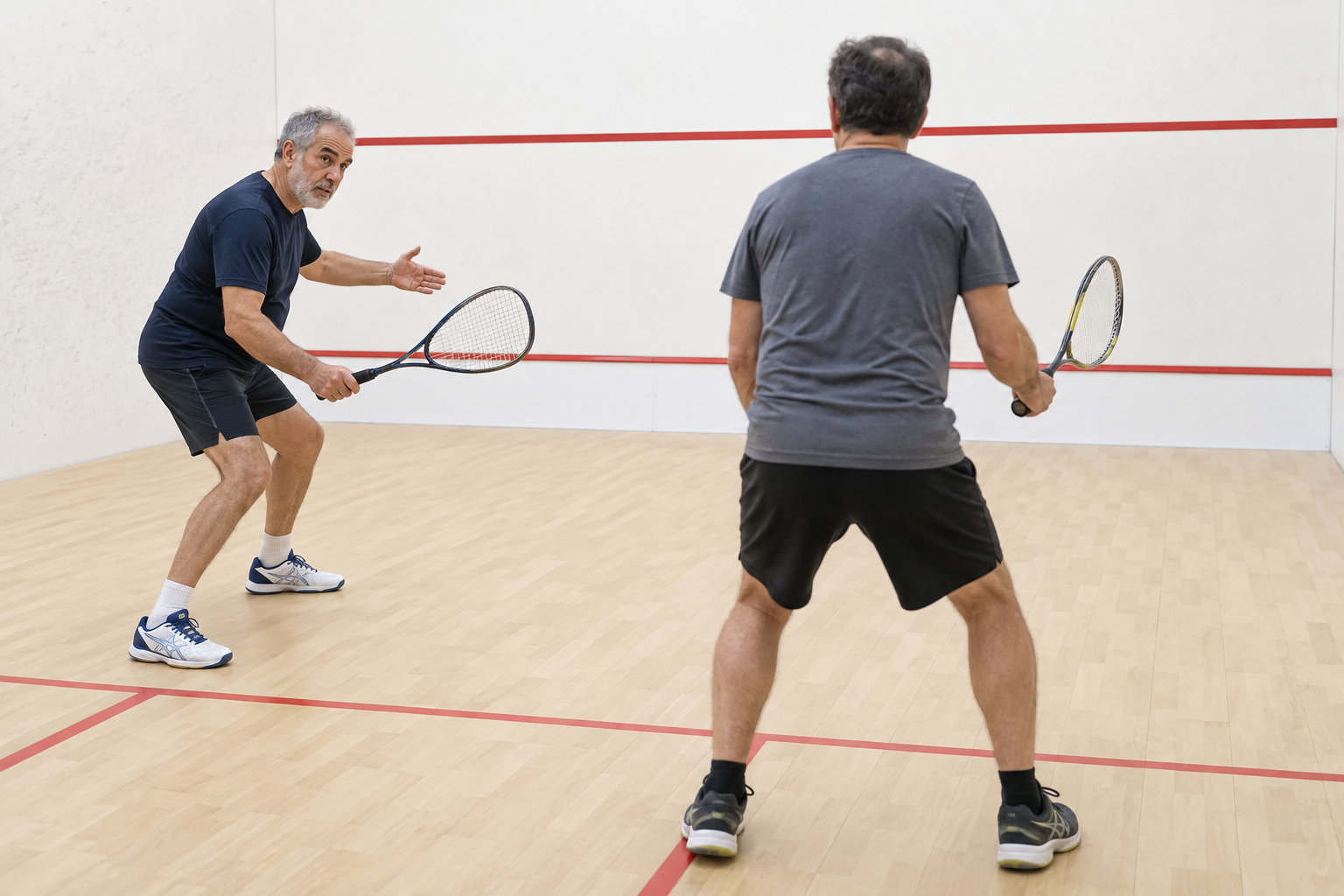
Three points
- **Safety and court understanding precede unrestricted hitting.** The beginner must know where the ball belongs, how players clear and when to stop.
- **Equipment should make learning possible.** A suitable ball, racket and approved eyewear support rallies better than copying professional conditions.
- **The lesson needs a visible destination.** Before leaving, the player should know which lesson, course or social session fits next.
A first squash lesson cannot teach the sport in an hour. It can establish the conditions under which learning becomes safe, intelligible and enjoyable. The student should experience more than instructions and less than uncontrolled competition.
Teach the shared court first
| Beginner question | Minimum answer before play |
|---|---|
| Where must the ball go? | Front wall above the tin and below out line, subject to current rules |
| Where may players move? | Both share the full court |
| What happens after I hit? | Clear the ball and recover without blocking access |
| When must I stop? | Whenever line, access or swing is uncertain |
| Who decides interference? | Apply current rules through coach, referee or agreed process |
The coach should demonstrate a safe stop and praise it as correct judgment. Beginners who believe every reachable ball must be struck learn the wrong form of courage.
Select equipment for complete rallies
| Item | First-lesson purpose | Poor shortcut |
|---|---|---|
| Ball | Rebounds enough for controlled exchanges | Default double yellow for status |
| Racket | Comfortable grip and manageable swing | Immediate premium purchase |
| Eyewear | Approved impact protection and clear vision | Copy televised professionals |
| Shoes | Clean traction and stable fit | General fashion footwear |
| Clothing | Free movement and temperature comfort | Specialized uniform requirement |
A livelier ball often lets beginners observe, move and recover without hitting excessively hard. The coach should explain that ball choice responds to temperature, ability and session purpose.
Build one complete rally cycle
| Minutes | Task | Evidence |
|---|---|---|
| 0–8 | Court, equipment and stop rule | Player explains when not to swing |
| 8–18 | Grip, spacing and front-wall contact | Several balanced contacts |
| 18–30 | Straight target and simple rebound | Player predicts basic path |
| 30–42 | Hit, clear and recover | Safe movement follows contact |
| 42–52 | Cooperative or conditioned rally | Several complete cycles |
| 52–60 | Review and next booking | One goal and one actual option |
The schedule is a design example, not a certification standard. Group size, age, language, mobility and previous sport experience change the timing.
Judge the lesson as a purchase
The provider should publish group maximum, equipment, language, total price and whether complete beginners may arrive alone. During review, the player should be able to name the central safety rule, one transferable skill, one new movement and the next suitable session.
The instructor does not need to create exhaustion to prove value. A beginner who leaves with controlled rallies, intact curiosity and a booking path has received a serious introduction.
Respect experience from another sport
A tennis or table-tennis player may understand preparation, placement and point construction. The coach should name those resources while refusing false equivalence. Squash still requires a new grip, wall reading, braking and shared-space behavior.
Ask the newcomer what felt transferable and what required conscious rebuilding. The answer gives the second lesson a starting point and shows that beginner status in squash does not erase expertise elsewhere.