Article · CS05
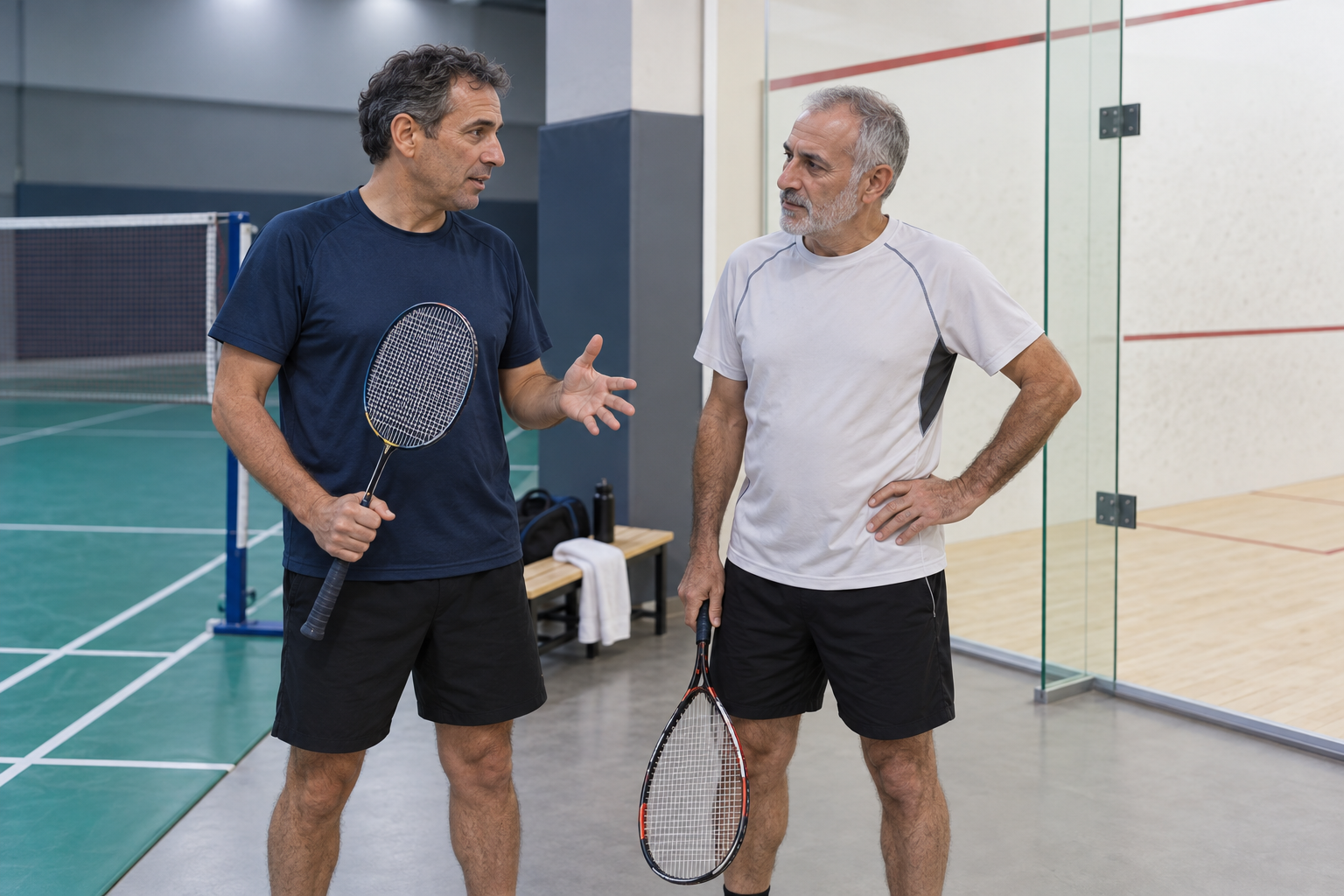
Badminton Meets Squash
Badminton players bring early preparation, deception and recovery habits to squash, then must replace shuttle timing and overhead dominance with rubber-ball rebounds, shared-space safety and controlled braking
Three points
- **Both sports reward preparation before the ball or shuttle arrives.** The useful transfer lies in reading, balance and recovery rather than copying stroke shape.
- **The flight problem changes.** A shuttle decelerates sharply; a warm squash ball rebounds from walls and may continue behind the player.
- **Shared space changes responsibility.** Squash beginners must learn access, interference and safe swing decisions before open competition.
Badminton and squash share acceleration, lunging, deception and repeated recovery, but they organize those capacities around different projectiles. A badminton player expects a shuttle to lose speed dramatically. The squash newcomer must follow a ball that retains energy and gains new paths through walls.
| Badminton habit | Value in squash | Correction |
|---|---|---|
| Early overhead preparation | Organizes action before pressure | Learn squash spacing and swing plane |
| Split-step timing | Supports first movement | Adapt timing to ball and opponent contact |
| Lunge and recover | Builds complete movement | Add braking for enclosed corners |
| Deception | Understands information control | Establish safe, repeatable contact first |
| Return to base | Protects next-ball readiness | Recover toward useful T access while clearing |
| Opposite-side safety | Respect for boundaries | Learn shared-court line, access and swing rules |
Compare complete movement
| Stage | Badminton | Squash | First lesson emphasis |
|---|---|---|---|
| Read | Racket and shuttle cues | Racket, ball and wall path | Call likely direction early |
| Travel | Front, rear and lateral court | Four corners around shared center | Moderate speed |
| Brake | Lunge or prepare for overhead | Stop before contact near walls | Stable final step |
| Strike | Shuttle contact, often overhead | Rubber ball to front wall | Controlled spacing |
| Recover | Regain base | Clear and recover toward T | Safe exit path |
Build a safe exchange
| Minutes | Task | Success condition |
|---|---|---|
| 0–8 | Court and interference orientation | Player explains when to stop |
| 8–18 | Grip and controlled front-wall contact | Balanced repeatable swing |
| 18–30 | Straight movement with recovery | Hit, clear and return under control |
| 30–42 | Cooperative rally with suitable ball | Several complete safe cycles |
| 42–50 | Conditioned placement game | Decisions survive modest pressure |
A badminton player already understands that athletic movement serves the next contact. Squash adds a new rebound system and the obligation to create space for another person. That combination makes the second sport familiar enough to invite and different enough to teach.
Do not confuse shared lunging with identical movement
Both sports display deep reaches, but court position, projectile path and recovery route determine how each lunge is organized. A badminton player often moves to contact a decelerating shuttle before it drops; a squash player may wait for a rebound, manage distance from a wall and leave the opponent a direct route afterward. Copying maximum badminton range can place the squash newcomer too close to the ball or across the shared line.
The coach should first reduce distance and pace. Feed a predictable straight ball, ask the player to brake before swinging, then score the full cycle: stable arrival, controlled contact, safe clearance and recovery. Greater range enters only when those four events remain intact.
Use deception after control becomes legible
Badminton players appreciate hold, disguise and changes of pace. Squash rewards similar tactical uncertainty, but early attempts at deception can enlarge the swing or delay the decision in shared space. Begin with two visibly different targets from the same balanced preparation. Once the player can send a straight drive or simple crosscourt without crowding the opponent, the coach can reduce the advance information.
This progression respects existing tactical intelligence. It also makes safety observable. The player learns that disguise never justifies striking when access, racket swing or the ball’s line is unsafe.