Article · TS08
Safety Is Part of Squash Skill
Because both players move and swing inside one court, judgment about access, interference and stopping belongs to competent play rather than optional etiquette
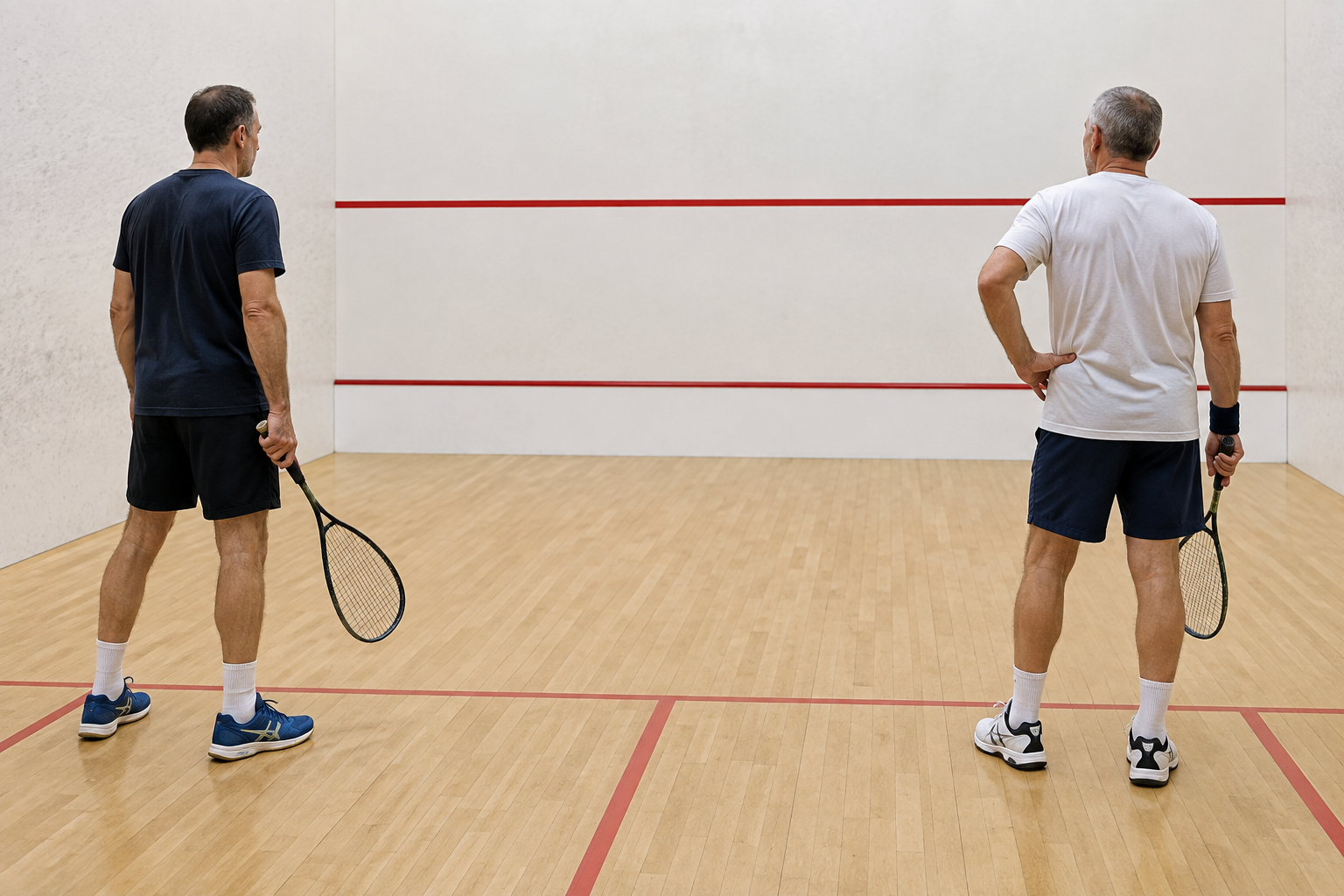
Three points
- **Every striker has a shared-space responsibility.** The opponent needs a fair view, direct access and room for a reasonable swing under the rules.
- **Stopping can show superior judgment.** No rally is worth completing through an uncertain line or dangerous swing.
- **Club conduct shapes participation.** Clear warm-up, scoring, eyewear and disagreement practices help newcomers return confidently.
Squash etiquette is sometimes described as courtesy added to competition. On a shared court it performs a more serious job. The habits surrounding clearing, interference and communication affect safety, fairness and whether both players can play freely.
Make the stop decision early
| Situation | Better response | Poor response |
|---|---|---|
| Opponent enters racket swing | Stop and request the appropriate decision | Complete the stroke to prove access |
| Ball passes close to opponent | Stop when line is uncertain | Hit harder through the gap |
| Player cannot see ball clearly | Pause and reset | Guess at full speed |
| Newcomer blocks without awareness | Teach clearing before resuming | Intimidate through pace |
Official rules determine lets, strokes and no-lets. Informal summaries should teach players to stop and seek the correct decision, not replace the rules.
Establish the court before scoring
| Before play | Information to confirm |
|---|---|
| Eyewear | Venue policy and approved protection |
| Warm-up | Shared access and duration |
| Scoring | System, game length and who serves |
| Interference | Stop signal and who decides disputed calls |
| Emergency | Venue contact and basic response process |
| Experience gap | Pace, ball and whether conditions will apply |
Resolve disagreement without degrading the game
| Event | Competent conduct |
|---|---|
| Possible double bounce | Player with best view calls honestly |
| Access disagreement | Each states what was seen; referee or rules decide |
| Repeated dangerous movement | Stop play and correct the environment |
| Accidental contact | Check the person before discussing the point |
| Uncertain newcomer | Explain the routine without embarrassment |
Etiquette also includes returning the ball safely, avoiding distraction and respecting preparation. A stronger player can reduce pace and use a suitable ball without treating the beginner dismissively.
Competence means producing shots and protecting the conditions in which another person can answer them. Clubs should teach this before unrestricted play and display the current rule source where players can find it.
Safety differs from avoiding competition
Stopping an unsafe swing does not make the game timid. It permits both players to compete harder inside trusted boundaries. A player who expects the opponent to stop can pursue the ball confidently; a player who fears an uncontrolled racket hesitates or avoids the line.
Experienced partners should practice interference decisions at moderate pace. Freeze several common positions, identify direct access and reasonable swing space, then compare the judgment with current rules or a qualified official. The goal is not rehearsing arguments. It is learning to recognize risk before urgency obscures it.
The stronger player sets the culture
When levels differ, the experienced player has more ability to control pace and explain local practice. Returning the ball safely, sharing warm-up, calling personal errors and accepting a stop without complaint teaches newcomers what the club values. These behaviors connect competitive seriousness with welcome rather than forcing a choice between them.
Clubs should make the culture explicit. A short beginner orientation can cover approved eye protection, warm-up sharing, safe return of the ball, the stop signal, basic interference language and who resolves uncertainty. Written rules remain available for detail; the orientation prepares newcomers to use them before an urgent rally becomes their first lesson.