Article · TS02
Repetition Needs a Decision
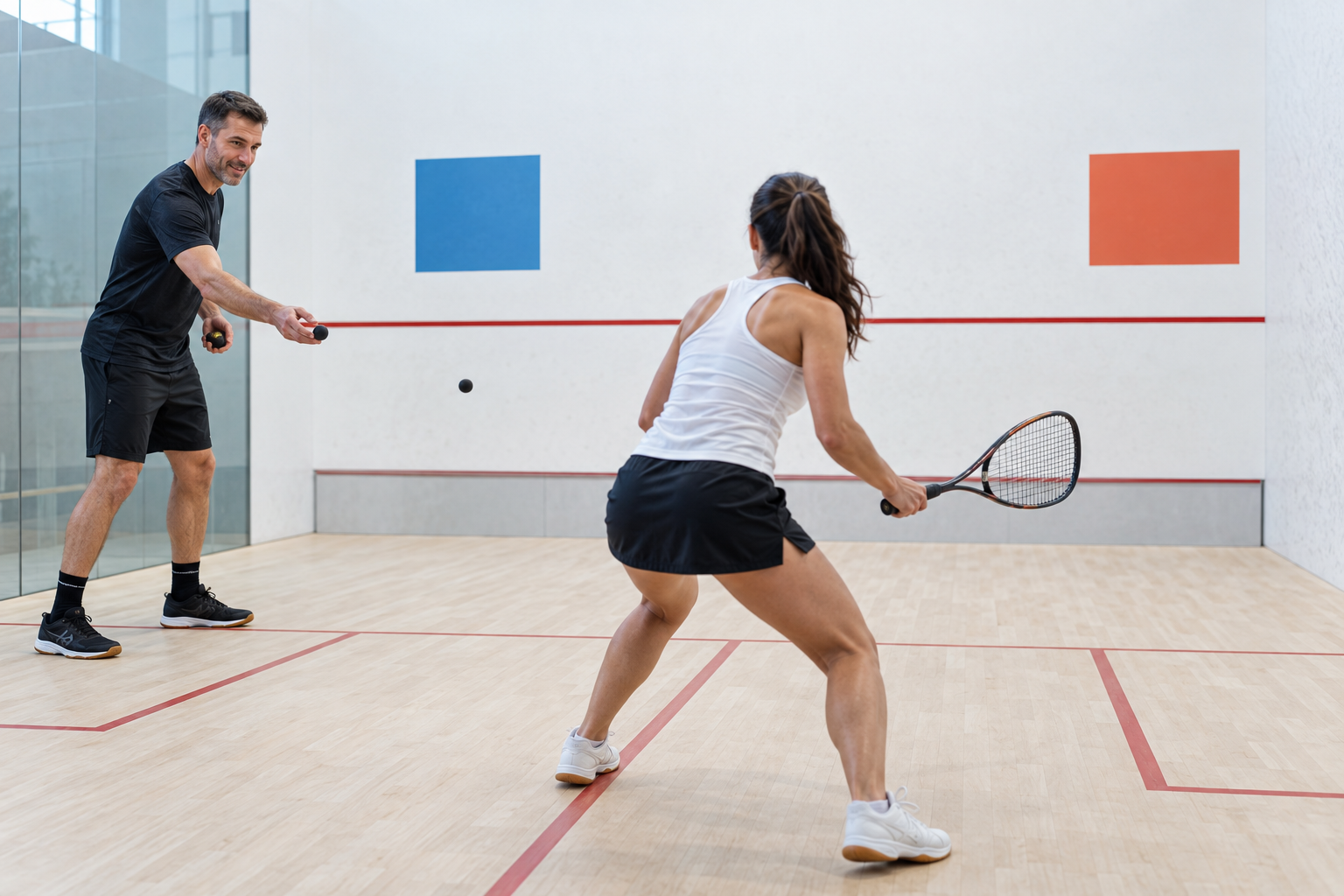
Fixed practice can stabilize contact, but squash skill becomes useful only when players recognize a changing situation and choose the action it requires
Three points
- **Predictability concentrates attention.** A fixed feed helps a player organize one movement or contact without solving the whole rally.
- **Success in a closed drill does not establish match transfer.** The player must eventually read credible alternatives and act without knowing the answer in advance.
- **Practice should progress through manageable uncertainty.** Add movement, choice and pressure only while the intended skill remains visible.
A player completes twenty excellent straight drives from the same feed, then opens a game with a loose crosscourt from the back corner. The drill worked as a contact exercise. It never asked whether straight length was the right decision or whether the player could recognize the situation under pressure.
The answer is not abandoning repetition. It is giving every form of repetition a defined job.
Match practice to the problem
| Problem observed | Practice form | What it reveals |
|---|---|---|
| New contact lacks consistency | Stable feed and target | Can the player organize the action? |
| Technique fails after movement | Feed plus approach and recovery | Does arrival preserve the stroke? |
| Player misses the right moment | Two-option cue | Can the player recognize the situation? |
| Choice disappears under score | Conditioned game | Does the decision survive pressure? |
| Match pattern remains unclear | Short open play with review | Where does the cycle first fail? |
Blocked practice provides many attempts at one answer. Variable practice changes the ball, target or starting position. Representative practice preserves information the player must use in a match. These are tools, not rival philosophies.
Add uncertainty one layer at a time
| Layer | Example | Advance when |
|---|---|---|
| Contact | Straight drive from predictable feed | Balance and path remain repeatable |
| Movement | Drive, clear and recover | Player is ready before next feed |
| Choice | Straight or crosscourt from cue | Correct option remains controlled |
| Rally | Partner supplies credible reply | Player reads instead of guessing |
| Pressure | Score after depth creates an attack | Pattern survives consequence |
If performance collapses when one choice is added, removing all uncertainty may hide the problem. Reduce the choice to two clear alternatives, slow the feed or enlarge the target.
Use a transfer test
End technical work with a short task that contains the match information the skill needs. A lob drill should include front-court arrival and opponent position. Serve practice should include the return and third shot. Recovery practice should include observation, not merely touching the T.
| Drill success | Transfer question |
|---|---|
| Ten balls reach target | Did the player choose that target appropriately? |
| Movement pattern looks smooth | Did it adapt to a different feed? |
| Conditioned game produces pattern | Did safety and technique remain intact? |
| Open game shows improvement | Can the player explain what cue changed the decision? |
A coherent 50-minute session can move from ten minutes of contact to ten of movement, twelve of two-option choice, fifteen of conditioned play and three of review. The proportions change with the diagnosis. Every block should answer the same performance question.
Keep the condition representative
A condition should exaggerate the decision without removing the sport. “You may attack only after a ball lands beyond the service box” directs attention to depth and opportunity. Requiring an unnatural sequence regardless of opponent position may create compliance without learning.
After each block, ask three questions: Did the intended situation appear? Did the player recognize it? Did the chosen action improve the next position? If the situation never appeared, change the feed or rule. If recognition failed, simplify the alternatives. If execution failed after correct recognition, return briefly to controlled work.