Article · SS07
Read the Player Across the Court
Opponent analysis becomes useful when it identifies a repeated choice under recognizable pressure and turns that observation into a plan that remains open to correction
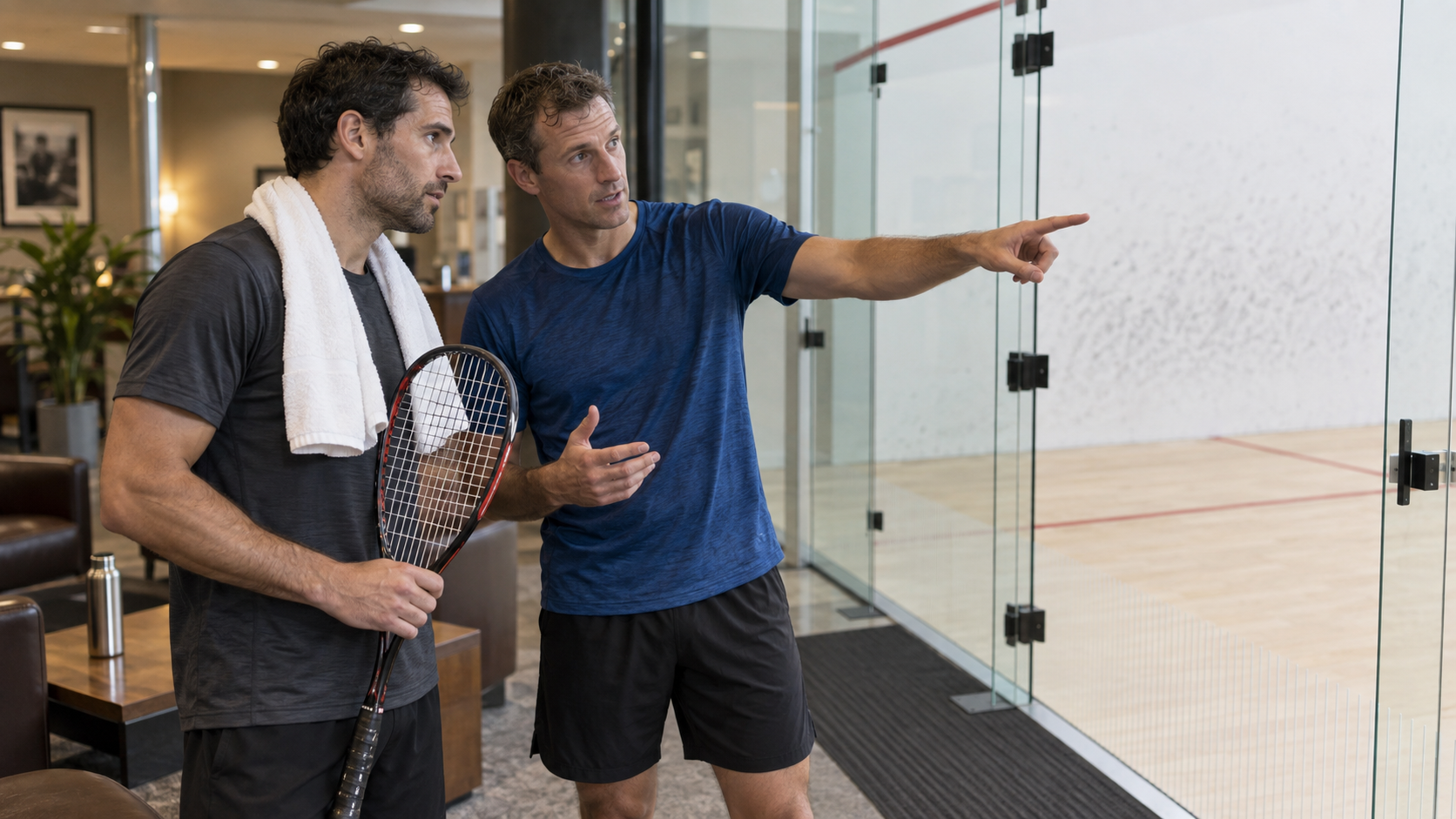
Three points
- **Describe behavior before naming a type.** “Crosscourts when late on the backhand” creates a testable prediction; “reckless shooter” encourages selective memory and vague judgment.
- **Separate preference from capacity.** A player may choose a shot because it is a strength, because the situation permits little else or because your pattern keeps producing the same problem.
- **Update the plan from live evidence.** Begin with one hypothesis, test it through a safe repeatable pattern and change it when the opponent’s actual responses contradict the label.
Player types help conversation because they compress complexity. Retriever, shooter, volleyer, hard hitter and drop–lob player all evoke recognizable club experiences. The danger appears when the label replaces observation. A “retriever” may attack every loose forehand. A “hard hitter” may possess excellent touch. A veteran may move efficiently rather than slowly.
Research offers a useful warning. A stochastic analysis of championship squash found that player behavior and outcomes varied against different opponents, limiting prediction from prior shot sequences. Later situation-awareness work also showed different performance profiles among leading players and their opponents. The strategic lesson is not that analysis fails. It is that the opponent is part of the situation producing the behavior.
Expertise research adds another qualification. Skilled squash players anticipate better than novices, but they do not simply look faster or at a magical single cue. They use available information more effectively, including advance information from an opponent’s action and early ball flight. For advanced amateurs, “watch the opponent” therefore needs a purpose: observe preparation, contact, movement and recovery in relation to a specific choice.
Build an observation, not a verdict
Use the structure condition → choice → consequence.
- Condition: What ball, position, score or movement state existed?
- Choice: What did the opponent attempt?
- Consequence: What pressure, error or recovery followed?
“He boasts” is weak. “When late in the back backhand corner, he boasts low and remains behind the T” is actionable. It suggests a forward recovery after a tight length, while preserving the possibility that he will adjust.
Tactical-diagnosis table
| Repeated observation | Possible explanation | Safe test | Evidence supporting hypothesis | Evidence against hypothesis |
|---|---|---|---|---|
| Opponent crosscourts when late in backhand rear | Straight ball feels technically restricted or crosscourt is preferred escape | Repeat tight backhand length while covering passage safely | Same choice appears from comparable pressure | Opponent varies effectively when given more time |
| Opponent volleys many balls | Early reading, forward base or your trajectory enters reach | Improve straight width and crosscourt height | Volley rate falls when passage improves | Opponent still intercepts tight outside trajectories |
| Opponent shoots short early | Confidence in touch or discomfort in patient length exchanges | Use deep margin and prepare for sudden short ball | Attacks arrive from neutral or poor positions | Opponent stops shooting when denied loose balls |
| Opponent retrieves first attack | Speed, anticipation or predictable attacking pattern | Build a second direction change and vary disguise | First attack returns but continuation creates weaker ball | Opponent recovers fully through several phases |
| Opponent hits harder under pressure | Pace is preferred escape or emotional response | Absorb pace with height and repeat movement | Accuracy declines while pace remains high | Hard ball consistently creates good passage and recovery |
| Opponent lobs after counter-drop | Prepared vertical reversal | Stop balanced after front attack | Lob recurs when you lean forward | Opponent drives when your position stays neutral |
| Opponent fades late in games | Physical strain, concentration or pacing choice | Maintain construction without speculative acceleration | Contact or recovery worsens after repeated demands | Performance returns after brief pause or tactical change |
| Opponent struggles at 8–8 | Score response or coincidence | Keep pattern stable across several close points | Preparation or selection changes repeatedly | Normal choices continue under later close scores |
Observe four moments
Before contact, read approach, space from the ball, shoulder organization and racket preparation. These cues limit some choices without determining one. Avoid committing to a single answer before reliable information appears.
At contact, read height, body balance, racket face and available swing. Contact quality helps distinguish a genuine attack from an improvised attempt.
Immediately after contact, ball flight supplies stronger information. Direction, pace and height should correct any early prediction.
During recovery, watch what the shot costs. Does the opponent clear directly, overrun, remain trapped or reclaim the T efficiently? The recovery may reveal more strategic vulnerability than the stroke.
Do this through soft attention. Staring at one body part or consciously listing cues during the rally can delay movement. Choose one question between points, then let the complete action inform the response.
Convert the observation into one adjustment
An opponent profile should change one part of your plan. If the player boasts when late, recover slightly forward after quality rear pressure. If the player volleys central crosscourts, change passage rather than merely hitting harder. If the player retrieves the first drop, prepare the second shot instead of aiming closer to the tin.
Change one variable because multiple changes destroy feedback. If you simultaneously serve differently, raise pace, attack earlier and alter recovery, you will not know which response mattered.
Opponent-response and counter-response table
| Working profile | Your initial test | Likely adjustment by skilled opponent | Your counter-response | Signal to abandon label |
|---|---|---|---|---|
| Retriever | Build depth, then two-direction pressure | Takes ball earlier or attacks before second movement | Improve passage and preserve continuation | Opponent wins by attacking, not retrieving |
| Shooter | Increase width and remove loose short invitations | Uses more patient length to draw you forward | Return to neutral construction; do not wait permanently in front | Shot selection becomes balanced |
| Volleyer | Use tighter straight lines and higher outside crosscourts | Retreats slightly and waits for length | Reintroduce pace and short hold when front opens | Interception no longer drives points |
| Hard hitter | Vary height and make pace generation occur while moving | Reduces pace and uses hold | Read position rather than racket speed | Player’s main pressure becomes touch or accuracy |
| Drop–lob player | Maintain balanced front-back base | Repeats depth or drives instead of reversing | Claim the T without guessing | Vertical alternation disappears |
| Steady player | Create visible displacement before attack | Accepts more risk and counters early | Increase margin while covering surprise | Errors and attacks rise beyond steady profile |
| Economical veteran | Test repeated direction and recovery | Shortens preparation or anticipates pattern | Change sequence and disguise | Movement remains equally strong across repeated routes |
| Unfamiliar opponent | Begin with neutral width, depth and observation | Reveals preferred choices under pressure | Form one narrow hypothesis | No tendency repeats under similar conditions |
Account for your own influence
Your shots help create the opponent you observe. A player may volley repeatedly because your crosscourt floats through the center. A “runner” may appear tireless because your attacks are predictable. A supposed backhand weakness may exist only when the ball is tight; loose balls on that side may be a strength.
Ask: Would this behavior still appear against a different quality of ball? Test it. Change width while preserving depth. Change pace while preserving direction. Repeat the same pressure from a slightly different setup. This moves analysis from personality to interaction.
Score also alters behavior. Some players become more conservative, others accelerate and others change nothing. Do not infer a pressure weakness from one point. Look for recurrence at comparable scores or across games.
Mark evidence and judgment
Research evidence: Squash expertise studies show superior anticipation and use of advance cues among experts. Performance analyses show that tactical behavior depends on court position, time, movement and opponent context, and that player behavior is not perfectly stable across opponents. These studies do not validate the player-type categories used here.
Established coaching principle: Coaches routinely scout preferences, technical strengths, movement and recovery, then adjust height, pace, direction and position. Good coaching treats a match plan as adaptable.
RacketBridge editorial judgment: Condition–choice–consequence and a one-hypothesis test provide an accessible method for advanced amateurs. The player types are working profiles, not psychological or biological classifications.
Practice observation without scripting
Conditioned games should teach the player to notice and revise. A partner adopting a tendency can make the first pattern visible, but later stages must conceal or change that tendency.
Conditioned-game progression table
| Stage | Condition | Observation task | Success criterion | Transfer test |
|---|---|---|---|---|
| 1. Declared tendency | Partner declares one repeated choice under one condition | State condition, choice and consequence | Description avoids personality labels | Repeat with a different declared tendency |
| 2. Concealed tendency | Partner selects one of three tendencies without telling | Form one hypothesis after five rallies | Hypothesis cites repeated comparable situations | Partner reveals plan and discusses false cues |
| 3. Counter-response | Observer applies one tactical adjustment | Judge whether opponent changes | Adjustment alters response without creating new weakness | Normal scoring with adjustment retained |
| 4. Tendency switch | Partner changes behavior midway without announcement | Detect contradiction | Observer updates plan within several rallies | Switch again under closer score |
| 5. Self-influence audit | Keep opponent tendency stable while observer changes one ball-quality variable | Identify how your shot produces behavior | Response changes predictably with width, pace or height | Restore open play and find natural recurrence |
| 6. Match scouting | Play to 11 with one note allowed between games | Use one hypothesis and one revision | Plan remains simple and evidence-based | Review video or notes before next meeting |
The purpose is not to make the opponent predictable. It is to replace surprise with better questions and to make your own adjustments more accountable.