Article · SS03
Make the Next Shot Easier
Rally construction improves when each shot narrows the opponent’s comfortable replies and leaves you a simpler, earlier and more balanced next decision
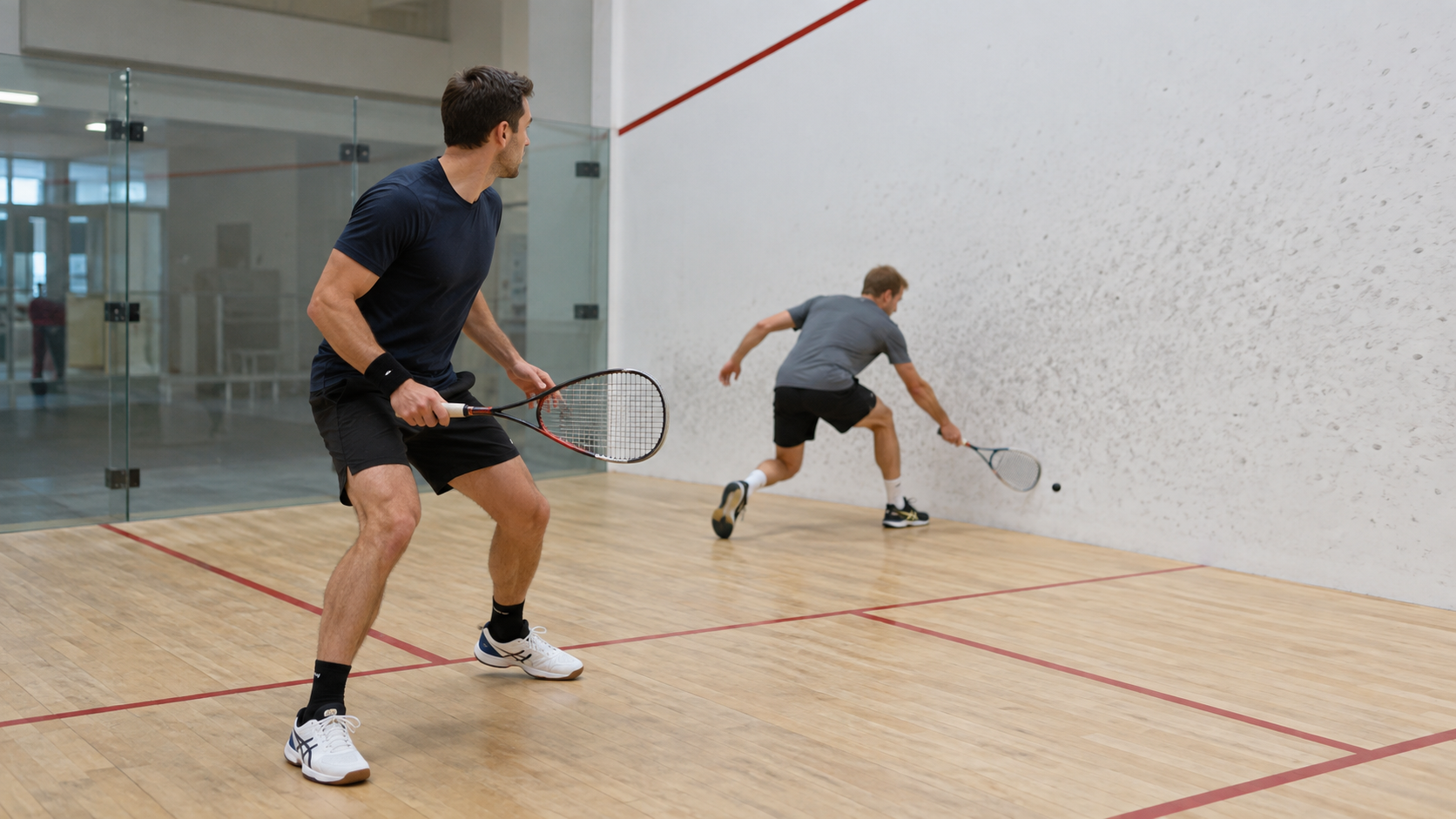
Three points
- **Construction changes probabilities rather than guaranteeing outcomes.** Width, depth, height, pace and direction influence the opponent’s contact without removing the opponent’s ability to improvise.
- **Recovery belongs to the shot.** Your next position should cover the replies your previous shot made plausible, while preserving the opponent’s direct access and safe swing.
- **The decisive mistake often occurs before the visible error.** Tracing a lost rally back one or two exchanges reveals whether poor selection created the late arrival, rushed stroke or open court that followed.
Many technical errors begin one shot earlier. The player reaches a backhand late because the previous crosscourt passed through the opponent’s volley zone. The counter-drop feels desperate because the original drop was played from behind the opponent. The boast fails because it was used to escape pressure without enough height, width or recovery time.
Advanced amateurs improve when they stop treating each contact as a separate examination. Rally construction asks two linked questions: What problem does this shot give the opponent, and what problem does it leave me if the opponent solves it?
Squash research reinforces the need for context. Court location and available time affect elite shot selection; analyses of leading players show that the same shot type can impose different movement and time demands. The research does not hand club players a universal sequence. It shows why a shot’s tactical meaning depends on the incoming ball, both players’ positions and the quality of execution.
Find the first cause
When reviewing a lost rally, begin at the end and move backward:
- What was the terminal event: error, winner, stroke, no-let or inability to reach?
- Was the final ball realistically playable from the position you occupied?
- Which previous shot placed you there?
- Did that shot fail through execution, selection or recovery?
- What lower-risk choice would have changed the next problem?
This prevents the familiar diagnosis “my backhand broke down” when the deeper problem was a sequence of loose forehand crosscourts. It also distinguishes a sound choice badly executed from a poor choice that happened to work once.
Tactical-diagnosis table
| Repeated rally outcome | Likely earlier cause | Construction objective | Practical adjustment | Evidence that it works |
|---|---|---|---|---|
| Late to opponent’s volley drop | Previous ball crossed loose or recovery followed the ball | Pass outside volley reach and stop centrally | Straighter width or higher crosscourt trajectory | Opponent contacts later and farther from the T |
| Trapped behind after your drop | Drop attempted from level with or behind opponent | Establish depth and front position first | Repeat length or hold the ball deep | Short attack begins with opponent behind you |
| Weak boast followed by losing counter-drop | Boast used from imbalance without recovery route | Restore time before changing direction | High length or safer crosscourt lift | You reach neutral position before opponent strikes |
| Good length produces no pressure | Ball reaches back wall but sits away from side wall or arrives at comfortable pace | Increase wall pressure or alter timing | Improve width; vary height; take earlier when balanced | Opponent separates from ball or plays from deeper position |
| You win only through risky winners | Neutral exchanges do not create visible advantage | Accumulate small positional gains | Target depth, then volley or hold | More attacks follow a loose ball rather than wishful selection |
| Opponent escapes front repeatedly | Drop sits up or you crowd the line | Lower second bounce and preserve counter-response position | Use larger margin, balanced finish and safe clearing | Opponent lifts under pressure and you cover the next ball |
| Straight rally suddenly becomes open | You change direction without moving opponent off the T | Earn the crosscourt through pressure or disguise | Stay straight until opponent’s recovery shifts | Crosscourt passes rather than becomes a volley |
| Errors increase late in games | Construction margin shrinks under fatigue or score | Simplify pattern and target size | Use deeper, wider targets and one planned attack trigger | Decision quality remains stable at close scores |
Use five construction levers
Width separates the ball from the opponent and often from the side wall. Tight width in the back can restrict swing space and make a straight reply difficult.
Depth moves contact behind the central area and may reduce attacking choices. Depth without width can still produce a comfortable ball off the back wall, so the two qualities must be read together.
Height changes both time and trajectory. It may buy recovery time or move the opponent’s gaze upward. If it travels through volley reach, however, height becomes an invitation.
Pace can hurry preparation, carry a ball deeper or produce a weak contact. It can also give a powerful player rhythm and return before you recover. Reducing pace may force the opponent to generate power and can make hold more credible.
Direction determines geometry. Straight play generally narrows angles and supports direct recovery. Crosscourt play may pass an opponent or move the point across the court, but it opens a central interception route and changes the likely next corner.
Construction uses these levers in combinations. “Hit deep” is incomplete. The player should know whether the goal is a tight ball that dies in the back, a high ball that creates recovery time, a firm pass outside the volley or a slower length that disrupts timing.
Recover to the answer set
The T is a reference, not a command. Your previous shot creates an answer set: the opponent’s plausible strong replies. Recover far enough to cover that set while staying outside the opponent’s direct path and swing.
A tight straight length behind the opponent reduces the quality of a straight attack but leaves the boast available. You may hold slightly forward while watching the opponent’s preparation. A loose crosscourt allows an early straight volley, crosscourt volley or drop; a deeper, more conservative base may be necessary. A strong drop from in front requires you to cover the counter-drop first without abandoning the lifted crosscourt.
Recovery also communicates pressure. Arriving early and balanced tells the opponent that the obvious reply is covered. Drifting, crossing the feet or watching your own shot gives the opponent information and space.
Opponent-response and counter-response table
| Construction shot | Strong reply available to opponent | Your recovery emphasis | Next-ball option if execution holds | Adjustment by opponent type |
|---|---|---|---|---|
| Tight straight length | Boast or another straight ball | Forward enough to see short; outside direct line | Volley repeat, counter-drop or length | Against retriever, expect another full exchange; against shooter, protect the sudden boast |
| Deep crosscourt outside reach | Straight drive from opposite rear corner | Neutral base without following ball | Volley straight or restore width | Against volleyer, raise trajectory; against slow mover, use pace only if it still passes |
| High lob | Defensive return, volley if loose | Reclaim central position before descent | Take next ball early or repeat depth | Against tall early volleyer, demand greater height and width; against deep defender, consider short court next |
| Firm straight volley to length | Scrambled length or boast | Preserve front territory | Repeat volley pressure before forcing short | Against retriever, value the second volley; against hard hitter, expect pace from imbalance |
| Working boast from balance | Counter-drop or crosscourt drive | Stop forward of normal base but clear line | Counter-drop, straight lift or volley crosscourt | Against drop–lob player, do not overcommit to the counter-drop |
| Straight drop after depth | Counter-drop or lifted crosscourt | Balanced front coverage outside access line | Counter short or volley the lift | Against fast runner, make the next shot available; against poor mover, avoid crowding and guessing |
| Slow, tight length | Early step-in or generated drive | Read whether opponent creates pace comfortably | Hold, volley or repeat tempo change | Against power player, make pace generation occur while moving |
| Body serve or wall serve | Controlled straight return or loose central return | Establish position without blocking receiver | Volley to depth or continue straight | Against strong returner, vary placement rather than chase an ace |
Change construction for the player
A pattern that simplifies your next ball against one opponent may complicate it against another.
Against a retriever, construction needs patience and a second layer. One deep ball moves the opponent; the next shot should exploit the recovery or repeat the demand. Do not interpret retrieval as proof that the construction failed.
Against an early volleyer, your first problem is passage. Straight width and crosscourt trajectory matter more than raw depth. A ball that reaches the back only after the opponent declines an easy volley was never good construction.
Against a drop–lob player, remain balanced between extremes. Deep pressure should not pull your recovery so far forward that the lob becomes decisive; a counter-drop should not become automatic simply because the opponent played short.
Against a power player, remove stable hitting platforms. Vary height and pace, make the player generate speed while moving and use direction changes after displacement rather than during neutral balance.
Against a steady player, construction should produce a visible attack trigger: late contact, loose width, poor clearing or opponent displacement. Without a trigger, increasing risk simply supplies the error the opponent is waiting for.
Against an economical veteran, test the repeat action. The first front-court retrieval may be excellent; the costly element may be the recovery and second direction change. Build the sequence without assuming a weakness from age.
State what we know
Research evidence: Observational squash studies associate shot choice and outcome with court area, available time, player movement and opponent context. They also show individual performance profiles, cautioning against a single universal pattern. The evidence mainly concerns elite competition and does not validate the exact progressions below for recreational players.
Established coaching principle: Width, depth, height, pace, straight-ball discipline and recovery are standard tools of rally construction in recognized squash instruction. Coaches commonly review the shot before the error and use target or conditioned play to connect strokes into patterns.
RacketBridge editorial judgment: The “answer set” and five-lever framework give advanced amateurs a compact way to connect shot selection with recovery. They synthesize accepted ideas; they are not proprietary scientific measures.
Practice the cause, not the finish
The conditioned game should reward the exchange that creates advantage, not only the stroke that ends the rally. Because players may disagree about causation, use observable conditions first and reflective review later.
Conditioned-game progression table
| Stage | Condition | Construction focus | What the partner records | Transfer test |
|---|---|---|---|---|
| 1. Depth gate | Short attack earns a bonus only after the ball reaches an agreed rear target | Establish depth before shortening | Whether target contact actually displaced or pressured | Ordinary game: count attacks preceded by depth |
| 2. Width gate | A loose central ball gives the opponent a bonus; normal winners still count | Keep passage outside central volley zone | Central balls created under neutral conditions | Remove penalty and compare voluntary width |
| 3. Previous-shot point | After the rally, winner may nominate the earlier shot that created the decisive advantage; partner must agree | Identify cause rather than finish | Type of setup: depth, width, pace, direction or displacement | Video-review five rallies without bonus scoring |
| 4. Recovery proof | Bonus attack point counts only if striker reaches a balanced next position and clears safely | Join shot quality with continuation | Whether the striker could respond to a good return | Ordinary scoring with recovery noted silently |
| 5. Opponent-specific construction | Choose one opponent type and one pattern intended to narrow that player’s options | Adapt pattern to observed tendencies | Whether the predicted response occurs | Change the assumed type mid-game if evidence changes |
| 6. Open-match audit | No condition; mark the first construction error in five rallies | Preserve learning under full choice | Earlier cause, not terminal shot | Compare with baseline match and select one next practice target |
Construction does not make squash predictable. It makes the uncertainty more favorable. The advanced amateur wins fewer points by demanding brilliance from every ball and more by leaving a sequence of slightly easier problems on his own side of the court.