Article · SS02
Experience Changes the Game
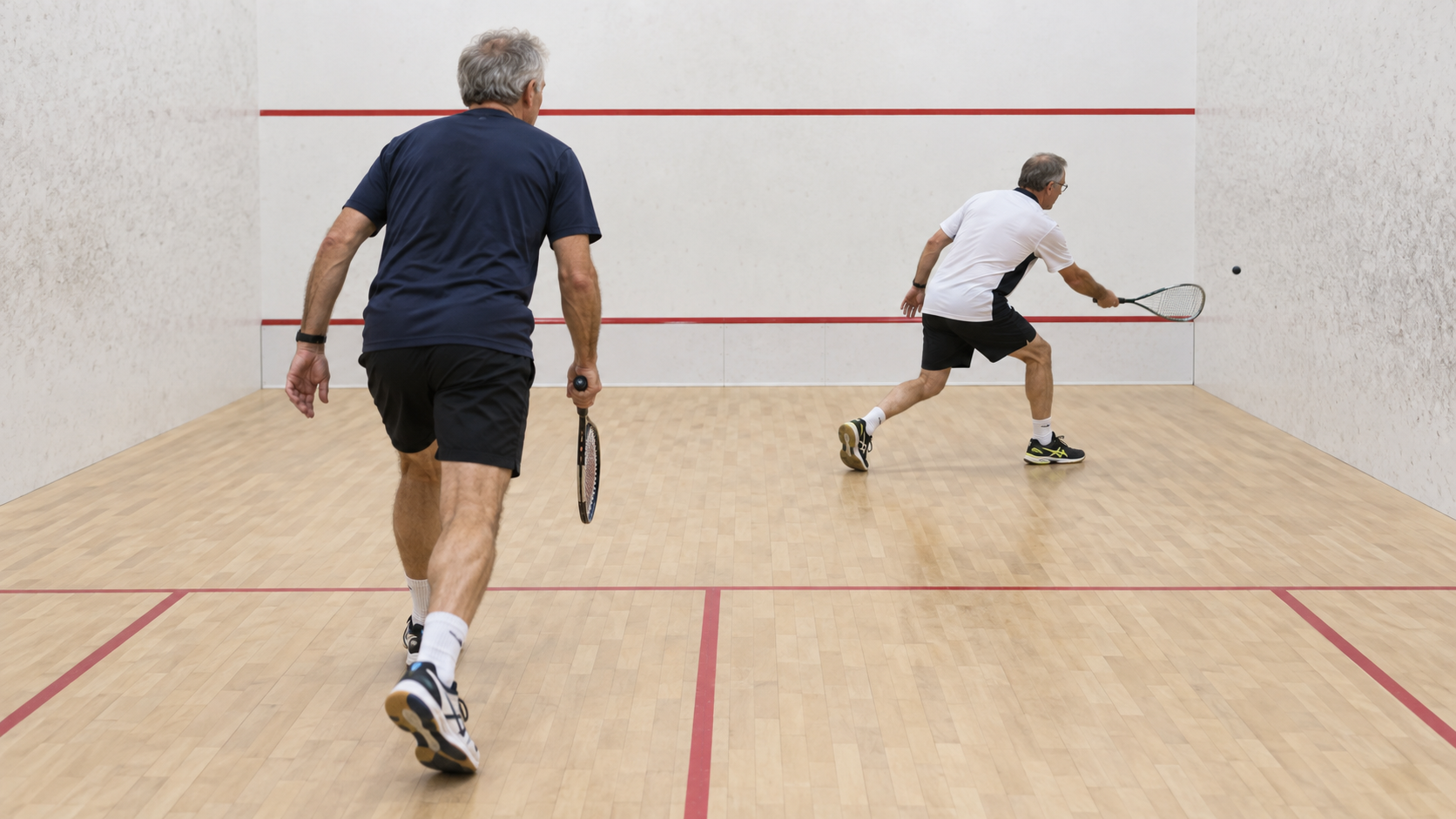
The advanced older player competes through anticipation, economical movement and selective pressure, while adapting tactics to present capacity rather than age alone
Three points
- **Economy is an active strategy.** Accurate serving, early reading, direct movement and straight-ball discipline reduce unnecessary accelerations without conceding initiative.
- **Short rallies still require construction.** Impatient shooting often increases errors and total match cost; selective volleys and attacks on genuine openings shorten work more reliably.
- **Capacity must be observed, not assumed.** Age affects recovery, power and movement differently across individuals, so the match plan should test repeatable actions instead of relying on stereotypes.
Club players recognize the veteran who seems to occupy the right place before the ball arrives. He rarely wins a footrace, rarely appears hurried and repeatedly makes a younger opponent travel twice. People sometimes describe this as “how old men play squash,” but the phrase merges age, experience, health, training history, technique and personal style into one misleading category.
The strategic subject is economy. Economy means spending acceleration, deep flexion and recovery effort where they earn tactical value. It does not mean avoiding movement, ending every rally quickly or playing passively. An economical player may accept a long exchange at moderate movement cost rather than start four violent front-to-back sprints. He may use height to recover, take an early volley to prevent a chase or repeat a straight length because it limits the next angle.
Research on master athletes shows that physical performance changes with age, while long-term training can attenuate parts of that decline. It does not support a single “older-player strategy.” Squash-specific research on elite athletes also confirms that the game demands repeated accelerations, decelerations and changes of direction, but elite workloads should not become recreational targets. The advanced amateur should use present-day evidence from his own matches: which movements remain controlled, which patterns recover by the next point and which choices create expensive emergencies.
Audit the movement bill
Every shot creates a likely movement bill for both players. A loose crosscourt may make the opponent travel laterally, but it also exposes the striker to a volley and a diagonal sprint. A tight straight length may travel less dramatically while narrowing the reply and supporting a shorter recovery. A weak drop intended to shorten the point may demand the most expensive movement of all when the opponent counters short.
Economy begins with the serve and return. A purposeful serve that pushes the receiver toward a wall may produce a narrower family of returns. A controlled return to length can prevent the server from taking immediate central command. Neither shot requires a winner to earn value.
Tactical-diagnosis table
| Match observation | Probable cost problem | Economical tactical response | What to measure | False shortcut |
|---|---|---|---|---|
| Repeated late arrivals to the front | Previous shots expose too much court or recovery starts late | Improve depth; attack short only from balance; recover while reading | Number of front sprints caused by your own loose ball | Refusing every short ball |
| Legs tire although rallies are brief | Too many maximal starts and emergency stops | Use straighter patterns, controlled height and earlier preparation | Maximal accelerations per rally | Trying to finish even faster |
| Opponent volleys crosscourts early | Ball passes through the central intercepting zone | Prefer tighter straight width or higher outside trajectory | Crosscourts intercepted versus passed | Hitting the crosscourt harder through the same space |
| Long rallies feel manageable but recovery between points does not | Match pace exceeds repeatable capacity | Insert pace variation and use the full 90 seconds between games | Quality of first three rallies after hard rally | Treating visible effort as weakness |
| Low attacking shots produce errors | Attack begins from movement or low contact | Build a looser ball; use a larger target and preserve continuation | Attacks attempted from stable contact | Eliminating attack entirely |
| Deep lunges feel slow or uncontrolled | Range exceeds current reversible strength and mobility | Shorten the approach, use earlier reads and avoid self-created emergencies | Whether the player exits the lunge in one controlled action | Copying an elite player’s depth |
| Volley opportunities arrive but feel rushed | Recognition or preparation starts late | Move the racket and feet earlier; volley only inside balance | Volleys struck in front versus reached beside the body | Reaching for every airborne ball |
| Opponent looks tired but keeps winning | You accelerate without changing the positional problem | Make the opponent repeat a costly route before raising pace | Quality of opponent’s contact after second direction change | Equating fatigue with immediate vulnerability |
Shorten work through position
The wish for shorter rallies is reasonable when repeat sprint capacity has declined or a long match threatens concentration. The tactical mistake is treating every ball as a chance to end the rally. A low-percentage shot creates three bad outcomes: an immediate error, a loose ball that forces a sprint, or a short exchange that ends in the opponent’s favor and must be followed by another rally.
Productive brevity comes from territory. A deep return prevents immediate attack. A selective volley removes the opponent’s recovery time. A tight drop after established depth makes a real front-to-back demand. An accurate serve begins the rally with pressure at low physical cost. The player shortens the exchange because the opponent receives worse problems, not because the striker accepts worse margins.
There is also a difference between rally duration and movement cost. A 20-shot straight exchange may involve controlled routes and predictable recovery. A six-shot exchange containing a loose crosscourt, counter-drop and diagonal retrieval may demand far more acceleration and braking. The player should review expensive movements, not merely count shots.
Opponent-response and counter-response table
| Opponent type | What the opponent may try against an economical player | Your response | When to change it | Cost to avoid |
|---|---|---|---|---|
| Young retriever | Extend exchanges and wait for an impatient attack | Use width and repeated direction; accept one more construction shot | Attack when movement finally weakens contact | Shooting merely because the rally feels long |
| Early volleyer | Remove the time your height was meant to create | Raise and tighten trajectory; pass outside reach; use straight width | Add pace when the volleyer begins waiting high | Loose floating balls through the middle |
| Hard hitter | Rush recovery and attack the aging backhand stereotype | Absorb pace with height and straight control; vary tempo | Counterattack after the hitter moves off balance | Matching pace from a static exchange |
| Drop–lob player | Pull you through the greatest distances | Hold a balanced base; counter-drop selectively; volley lobs that sit | Press forward only after quality depth | Guessing front and abandoning the back |
| Patient steady player | Make the match a low-error endurance contest | Use serve, volley and planned pace changes to create territory | Increase risk only from a clear positional gain | Treating patience as passivity |
| Inexperienced runner | Retrieve quickly but recover inefficiently | Repeat direction when recovery overruns; use hold | Change direction when the player begins stopping under control | Trying to outrun the runner in open patterns |
| Skilled veteran | Mirror economy and test your patience | Observe one specific limitation; vary height and sequence | Keep what produces a weaker contact twice | Assuming age reveals the weakness |
Build a personal economy profile
The advanced amateur needs a tactical inventory more useful than “I am slowing down.” Record three matches and mark:
- the shot preceding each emergency sprint;
- whether a deep lunge ended in controlled recovery;
- which volleys were struck in balance;
- which rally patterns remained accurate late in a game;
- which serves produced predictable returns;
- whether the next rally began recovered after a long exchange.
The pattern may reveal that the backhand corner is not the problem; the loose forehand crosscourt before it is. It may show that three selective volleys save more movement than ten speculative drops. It may also show that the player tolerates sustained rallies well but loses precision after repeated maximal changes of direction.
Strategy should protect strengths as well as accommodate limits. An experienced player may read early, disguise well, control height or serve accurately. The match plan should create more opportunities to use those assets. Adaptation becomes negative only when it reduces the game to avoidance.
Distinguish knowledge from prescription
Research evidence: Studies of master athletes show age-related changes in aerobic capacity, strength and neuromuscular function, with considerable variation and a moderating role for continued training. Squash performance studies identify aerobic fitness, repeated-sprint ability and change-of-direction capacity as relevant among elite players. These findings do not determine one older amateur’s safe range or match plan.
Established coaching principle: Early preparation, accurate length, height, selective volleying and recovery based on the previous shot are recognized ways to manage time and court position. Coaches commonly adapt tactics to the player’s repeatable movement and technical strengths.
RacketBridge editorial judgment: Counting expensive movements and building a personal economy profile gives advanced amateurs a practical bridge between physical capacity and tactics. It is a review method, not a medical or physiological assessment.
Health conditions, pain, dizziness or a material change in exercise tolerance belong with an appropriate health professional. Tactical economy cannot make unsafe participation safe.
Practice economy without practicing fear
The conditioned game should reward the creation and resolution of movement problems. A crude limit such as “only three accelerations” may increase awareness, but it can also make players count subjectively or avoid appropriate movement. A better progression starts with observation and gradually introduces tactical incentives.
Conditioned-game progression table
| Stage | Condition | Target behavior | Evidence of progress | Transfer test |
|---|---|---|---|---|
| 1. Movement audit | Play normal scoring; partner marks the shot before each emergency sprint | Connect shot choice with later movement cost | Player identifies recurring self-created emergencies | Repeat without observer and recall three patterns |
| 2. Straight stability | Bonus point after three controlled straight exchanges followed by a won rally | Build width, recovery and patience | Fewer central balls and diagonal chases | Ordinary scoring: track whether straight discipline remains |
| 3. Selective volley | Volley winner counts normally; bonus comes from a volley to depth that produces a weak reply | Take time without forcing the finish | Volleys are struck balanced and followed by recovery | Remove bonus and compare volley selection |
| 4. Constructed short attack | Short winner counts double only after a deep target or displaced opponent | Shorten through territory | Attacks follow visible setup rather than fatigue alone | Ordinary game: identify built versus speculative attacks |
| 5. Pace control | Each player must use one clear pace change before attacking | Prevent one-speed exchanges | Pace changes alter opponent timing without becoming loose | Play to 11 with no rule and log purposeful pace changes |
| 6. Personal match plan | Player selects one economical pattern and one situation that permits full attack | Combine adaptation with ambition | Plan produces stable decisions late in the game | Review whether the behavior survives at 8–8 and later |
The strongest older-player strategy is not “keep rallies short.” It is make the opponent pay more for each exchange than you do, while preserving shots you can repeat under score and fatigue.