Article · IN06
Padel Rewards Restraint
Padel combines repeated overheads, fast net exchanges, wall turns and doubles movement, so recreational players should control volume and pair position before adding professional pace
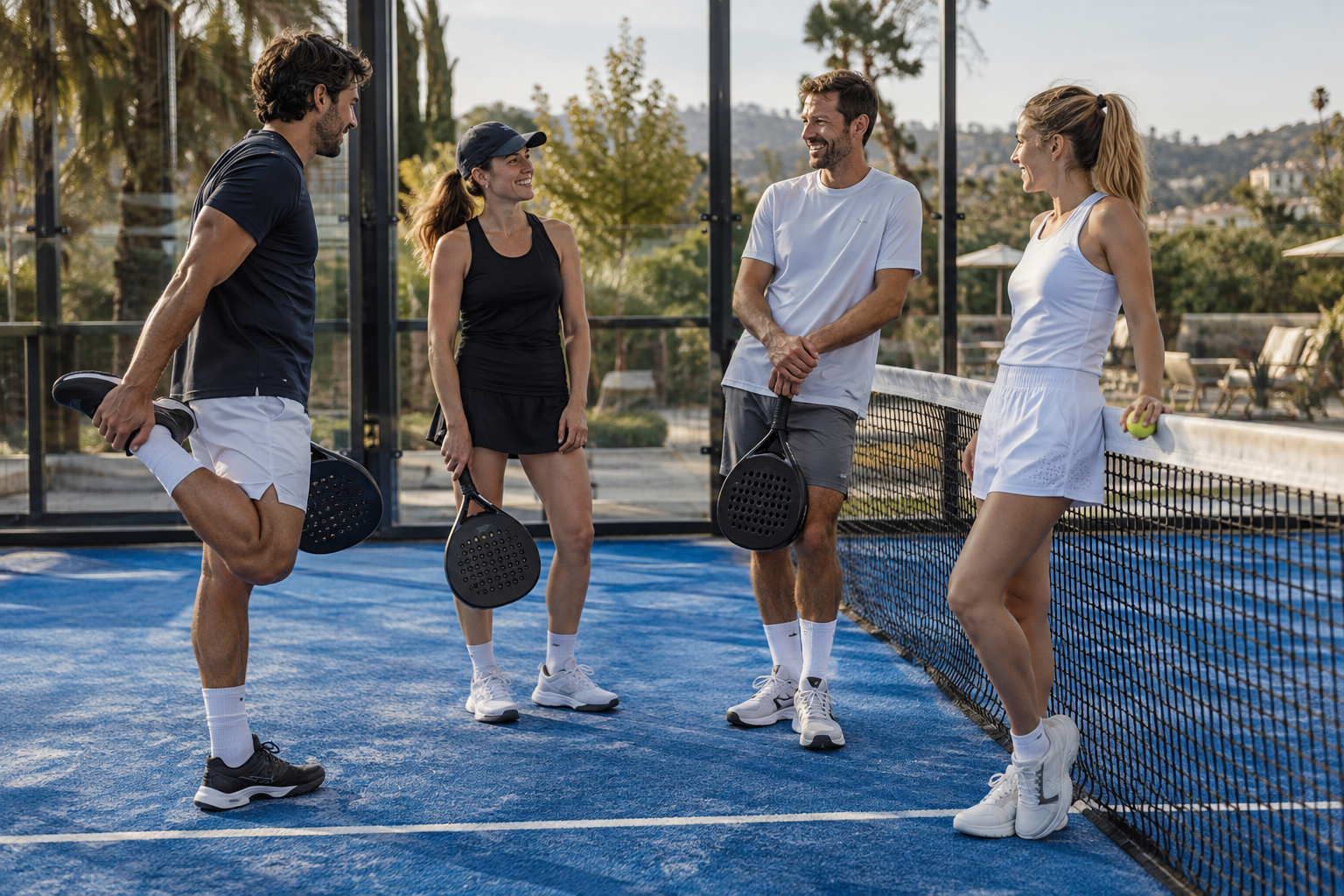
Three points
- **The shoulder and elbow experience repeated overhead and volley load.** A social format can still contain concentrated actions.
- **Lower-body demand grows through sudden starts, stops and turns.** Partner confusion may add awkward emergency movement.
- **Pair organization is part of load management.** Clear calls and coordinated movement reduce unnecessary reaches without promising injury prevention.
Padel feels accessible because the court is compact and the game is social. Compact does not mean effortless. Players repeat volleys, overheads, accelerations and turns while responding to a partner and walls.
| Demand | What to observe | Session adjustment |
|---|---|---|
| Overhead volume | Contact and shoulder comfort over time | Limit high-effort blocks |
| Rapid volley | Grip tension and late preparation | Reduce pace and enlarge target |
| Back-wall turn | Foot organization and awareness | Use predictable feeds first |
| Middle ball | Hesitation and emergency reach | Assign or call responsibility |
| Split pair | One player covers excessive space | Restore coordinated depth |
| New racket | Timing or fatigue changes | Compare after normal play |
Make the pair visible
| Pair rule | Practical effect |
|---|---|
| Move forward and back together | Reduces uncovered emergency distance |
| Call middle balls early | Removes last-second collision and reach decisions |
| Let agreed balls reach the wall | Replaces rushing with planned time |
| Recover after every overhead | Prevents attack from destroying position |
| Stop when communication fails | Restores attention before pace returns |
Progress the session
| Stage | Condition | Advance when |
|---|---|---|
| Controlled wall feed | Known direction | Turn and contact remain organized |
| Cooperative volley | Large targets | Grip and preparation stay relaxed |
| Grounded overhead | Submaximal pace | Pair recovers together |
| Direction choice | Two targets | Accuracy survives decision |
| Short game | Time or point limit | Movement quality remains recognizable |
Reviews of padel injuries report varied methods and developing evidence. They support attention to upper- and lower-limb demands but do not identify one routine that guarantees prevention. Persistent or worsening symptoms need qualified assessment.
Count actions hidden inside a social game
An hour of padel does not describe its load precisely. One player may hit twenty high-effort overheads while a partner hits five. A competitive set may create repeated emergency turns and sprints; a controlled lesson may provide more total contacts at lower intensity. Record court minutes, high-effort overhead blocks and any unusual increase in weekly frequency.
Change one major dimension at a time. Adding a third weekly session while also buying a more head-heavy racket and practicing maximal overheads makes cause and effect difficult to interpret. Hold two variables reasonably stable, observe comfort and movement quality, then progress.
Use communication as a movement tool
Early calls do more than improve tactics. They prevent both partners from accelerating toward the same middle ball, reduce last-second reaches and let a player prepare for a wall rebound. This does not prove that communication prevents injury; it removes avoidable uncertainty from the task.
After each short game, review three events: middle-ball hesitation, split forward-back positions and overheads followed by poor recovery. Choose one pair rule for the next game. The practical goal is not perfect geometry. It is a pair whose decisions remain recognizable as pace rises.
Return with a narrower game
A player returning after absence does not need to test every padel demand in one set. Begin with cooperative volleys, controlled wall feeds and grounded overheads. Then introduce short conditioned games that reward pair shape and limit high-effort overheads. Add normal scoring only when movement, contact and communication remain stable.
The partner should understand the plan. A return session fails when one player expects controlled practice and the other repeatedly creates emergency sprints. Agree on court coverage, pace, rest and the stopping signal before play. This converts caution into a shared format rather than leaving one player to negotiate it during the rally.
Padel’s social character becomes a practical advantage when the pair uses it deliberately. The same communication that makes the game enjoyable can help both players sustain appropriate movement and finish with a clear plan for the next session.