Article · FF09
Stretch for the Moment
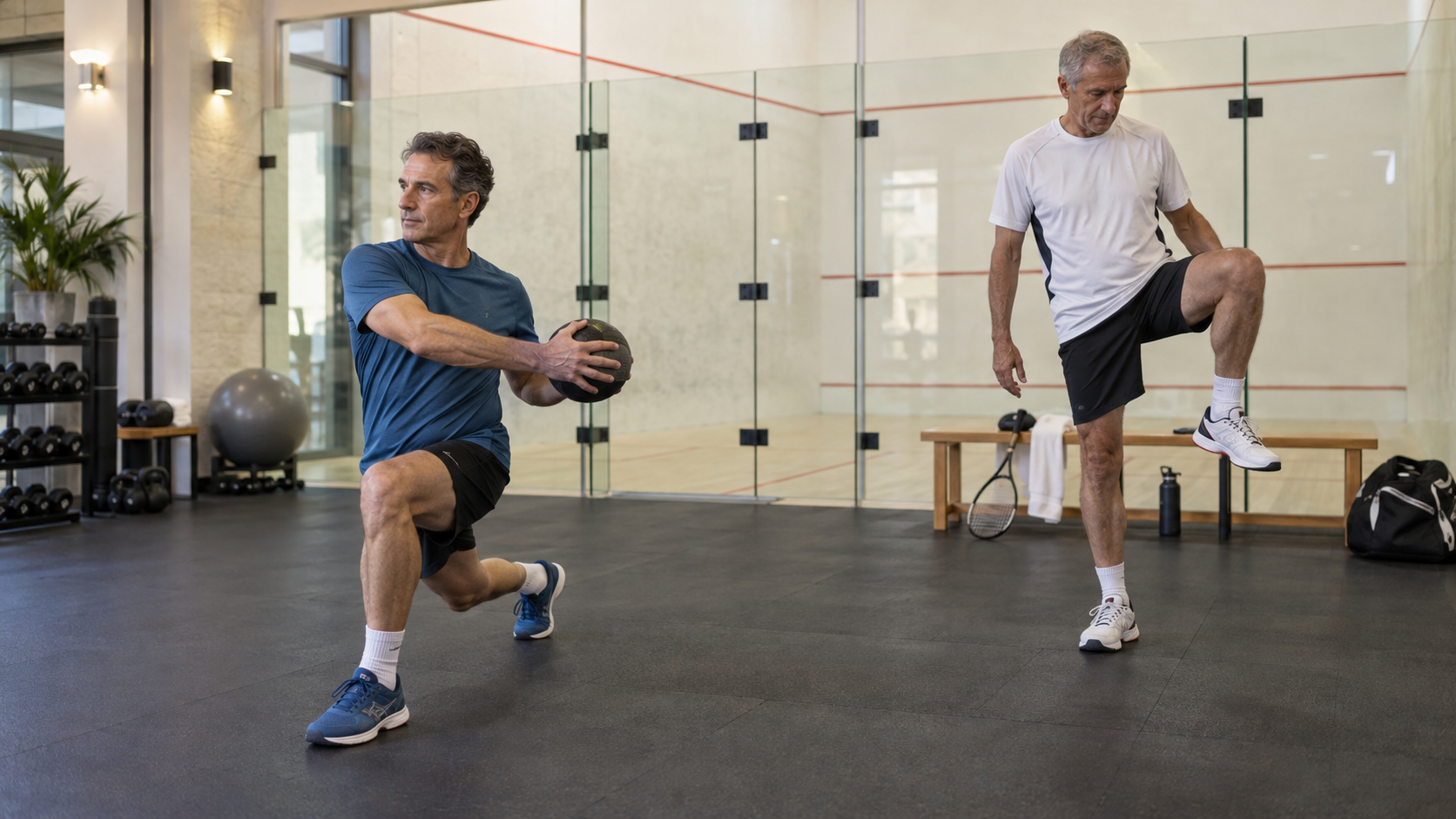
Dynamic movement prepares the body for fast racket play, while static stretching develops or restores range of motion more effectively when it is separated from the most explosive part of the warm-up
Three points
- **Dynamic and static stretching solve different problems.** Dynamic movements rehearse controlled motion while temperature and speed rise; static holds expose a muscle-tendon unit to a sustained end position and can improve range of motion.
- **Timing changes the result.** A court warm-up should progress from general movement to dynamic range and sport-specific actions; prolonged, intense static stretching immediately before explosive play may reduce performance, while brief comfortable holds followed by dynamic activity usually have smaller effects.
- **The useful range is individual and sport-specific.** Advanced amateurs need enough mobility to reach, rotate, lunge and recover without losing control, but greater range is not automatically better and stretching alone does not guarantee injury prevention or recovery.
Stretching attracts simple rules: always stretch before exercise, never stretch before power, hold for thirty seconds, bounce, do not bounce. The evidence supports a more useful question: what does this player need at this moment?
A cold player about to begin squash needs rising temperature, progressively larger movement and rehearsal of stopping, lunging and swinging. A player trying to improve chronically restricted ankle or shoulder range needs a separate flexibility dose that can be measured over weeks. A player who feels relaxed after post-match stretching may keep that ritual, but should not be told it reliably prevents next-day soreness.
Evidence. A major systematic review reported small average performance reductions immediately after static stretching and small improvements after dynamic stretching. Static holds totaling at least 60 seconds per muscle group produced larger average impairments than shorter exposure. When dynamic activity followed stretching, the performance effect was often negligible. A 2023 meta-analysis found that long-term stretch training improves range of motion, with static stretching and proprioceptive neuromuscular facilitation generally producing larger gains than dynamic stretching. A 2021 review found insufficient evidence that post-exercise stretching improves soreness or recovery compared with passive rest.
Accepted coaching principle. Warm up by moving from general to specific: raise temperature, explore controlled dynamic range, then rehearse the speeds and patterns of the sport.
RacketBridge editorial judgment. Recreational players should stop using “stretching” as a synonym for “warming up.” A good warm-up contains movement, preparation and information about how the body feels that day.
Diagnose the purpose
| Situation | Best starting choice | Why | What to avoid |
|---|---|---|---|
| Arriving cold before play | Easy locomotion followed by dynamic movements | Raises temperature and rehearses active control | Dropping immediately into maximal lunges |
| Preparing for explosive rallies | Dynamic range plus sport-specific acceleration and braking | Preserves the link between mobility and force | Long, intense static holds as the final activity |
| One area feels unusually restricted | Brief comfortable static hold, then dynamic reassessment | May improve short-term range without ending the warm-up | Forcing through pain or assuming all restriction is harmless tightness |
| Developing flexibility over weeks | Separate static-stretch sessions with measured positions | Chronic practice can improve range of motion | Chasing pain or changing several variables at once |
| Cooling down after play | Gentle movement; optional comfortable static stretching | May feel pleasant and maintain a routine | Promising that it prevents soreness or speeds recovery |
| Returning after injury | Individual plan from a qualified clinician or coach | The limitation may involve tissue healing, strength or confidence | Generic stretching based only on the location of pain |
| Already very mobile | Control and strength through available range | More passive range may not solve the performance problem | Treating flexibility as an unlimited score |
Dynamic stretching moves a joint repeatedly through a controlled range: walking lunges, leg swings, arm circles, trunk turns and ankle rocks are familiar examples. The motion should be deliberate, not a loose ballistic throw into an uncontrolled end range. Static stretching holds a position without repeated motion. The sensation should normally be tension rather than sharp pain, joint pain, numbness or tingling.
PNF stretching combines positions with muscle contractions and often needs a partner or experienced instruction. Ballistic stretching uses repeated momentum near end range. Neither is necessary for a clear introductory program.
Prepare the patterns that the sport will ask for
Squash demands ankle dorsiflexion, hip motion and trunk organization in deep lunges, but the player must also brake and leave the position. Tennis adds large serving and rotational actions, plus repeated lateral starts. Badminton combines overhead range with deep forecourt positions and rapid rear-court movement. Table tennis uses smaller court distances but maintains a flexed stance and continuous trunk and hip adjustments. Padel adds overhead strokes, turns and frequent low-ball positioning.
The warm-up should therefore reflect the session ahead. A squash player planning conditioned length games needs progressively deeper diagonal movement before full rallies. A tennis player beginning with serves needs shoulder, trunk and hip actions that grow toward the service motion without forcing its end range. A badminton player needs overhead preparation and increasingly quick changes between low and high positions. A table-tennis player needs repeated stance changes and active trunk rotation more than long passive holds. These are coaching applications of general principles, not findings from a trial comparing all five sports. The player should finish this preparation feeling more capable, not tired.
| Player type or response | First adjustment | Counter-response if the problem remains |
|---|---|---|
| Older player who feels stiff at the start | Extend the general warm-up and use gradually larger dynamic range | Add separate mobility work rather than making match-day movements aggressive |
| Hypermobile player | Emphasize strength, balance and stopping positions | Reduce end-range stretching if control deteriorates |
| Squash player who collapses in a deep lunge | Use controlled ankle and hip mobility followed by split-squat strength | Shorten the playing reach while strength and control develop |
| Tennis player with limited overhead comfort | Use pain-free shoulder and trunk preparation | Seek assessment rather than forcing the racket farther back |
| Table-tennis player whose back tightens in stance | Alternate hip motion, trunk rotation and short stance exposures | Adjust stance and training volume if the symptom returns |
| Player who feels weaker after stretching | Shorten and soften pre-play static holds, then add dynamic actions | Move flexibility work to another session |
| Player who stretches daily without change | Define one joint and one repeatable measure | Investigate technique, strength, anatomy or symptoms with qualified help |
The distinction between evidence and coaching matters here. Research can estimate average acute effects, but it cannot select the exact warm-up for every 55-year-old squash player or every 30-year-old badminton player. A coach observes the movement task and the individual. The player then tests whether the preparation improves comfort, range and court quality without producing fatigue.
Progress from range to usable movement
| Stage | Preparation task | Court connection or conditioned game | Evidence of useful transfer |
|---|---|---|---|
| 1. Raise temperature | Walk, cycle or move easily for several minutes | Cooperative hitting at low pace | Breathing rises and movement feels easier |
| 2. Explore range | Controlled ankle rocks, lunges, trunk turns and arm movements | Shadow the main court positions | Range increases without pain or loss of balance |
| 3. Add speed | Quicker dynamic actions and modest direction changes | Progressive feeds to known areas | The player brakes and recovers cleanly |
| 4. Add information | Partner calls direction during movement | Two-choice feed or return drill | The player sees the cue before committing |
| 5. Rehearse the sport | Serves, volleys, drives or overheads at rising intensity | Cooperative rally with a defined pace | Technique survives the larger range |
| 6. Test in play | Normal warm-up without new exercises | Conditioned game begins below maximum pace and opens gradually | The body is ready before the contest becomes demanding |
A conditioned game makes stretching relevant by requiring control at the range just prepared. Squash partners might play length-only rallies at moderate pace before adding the front court. Tennis partners might begin crosscourt and allow a direction change only after four balls. Badminton players can begin with half-court clears and drops. Table-tennis players can use a predictable two-point placement before free play. The condition manages speed and range; it does not reward extreme stretching.
What stretching does not promise
Stretching may improve range of motion. That does not mean it corrects every movement limitation, prevents every injury or accelerates recovery. Injury risk reflects exposure, load, previous injury, strength, fatigue, technique, equipment and many other factors. Reviews have not shown a clear all-cause injury-prevention effect from static stretching alone.
Post-exercise stretching may still serve a personal purpose: it creates a calm transition, gives partners time to talk and encourages awareness of unusually sore areas. Those are legitimate benefits when described honestly. The claim should remain modest.
A sensible advanced amateur records one or two useful observations: whether a known range changed, whether the warm-up improved the first game and whether symptoms appeared during or after play. More stretching is not the default answer. Better timing, strength through range, reduced court load or professional assessment may be the right response.
Next Steps to Consider
Choose one recurring limitation and identify whether the immediate goal is warm-up readiness or long-term range. Test one preparation sequence for several comparable sessions, then judge movement quality rather than the sensation of stretch alone.