Article · FF08
Kettlebells Build Court-Ready Capacity
Swings, squats, carries and presses can develop strength, power and work capacity in one compact program, provided racket players learn the lifts, control fatigue and preserve time for movement and actual play
Three points
- **The kettlebell’s value comes from several distinct movements.** Swings train rapid hip extension; goblet squats and split squats train leg strength; carries challenge grip and trunk control; presses and rows build upper-body capacity.
- **Conditioning and strength overlap, but they are not interchangeable.** A swing interval can drive heart rate and breathing while still loading the hips and back, yet a light, exhausting circuit is not automatically the best strength or power session.
- **Racket-sport transfer requires restraint.** Advanced amateurs should use kettlebells to build general capacity, then practice braking, lunging, rotation and stroke timing in sport-specific tasks.
A kettlebell places its mass below the handle. That shape supports ballistic movements, carries and transitions that feel different from a dumbbell. It also tempts newcomers to copy fast demonstrations before they own the hinge, rack position or safe path around the body.
Evidence. A small randomized trial in young men found that six weeks of twice-weekly kettlebell swing training improved measured maximal and explosive strength. A study of ten college-aged men found that twelve minutes of continuous two-handed swings produced a substantial metabolic demand, although heart-rate percentage was much higher than the measured percentage of maximal oxygen consumption. Another small trial in collegiate women used high-intensity kettlebell snatches and reported improved aerobic capacity. These studies show that kettlebells can supply training stress; they do not establish a superior program for recreational racket players.
A 2019 scoping review found that kettlebell research was limited, heterogeneous and often low quality. It concluded that confidence in many clinical claims remained low. That restraint matters. Kettlebells are useful equipment, not a proven shortcut to injury prevention or better match results.
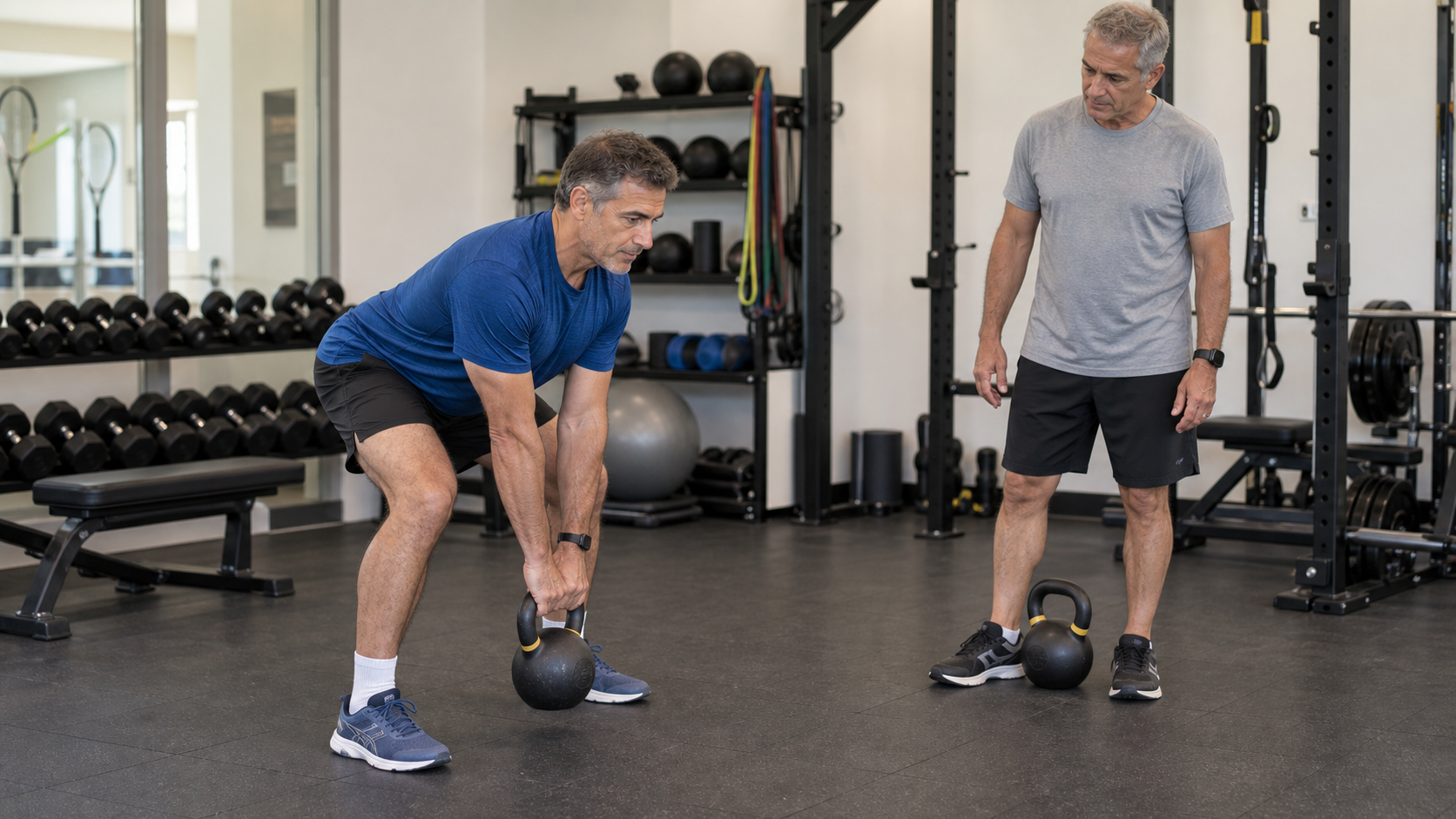
Accepted coaching principle. Learn the deadlift and hip hinge before the ballistic swing. In a hardstyle swing, the hips drive the bell to roughly chest height while the arms guide rather than lift it.
RacketBridge editorial judgment. A small menu practiced well—deadlift, two-handed swing, goblet squat, suitcase carry, row and an appropriate press—serves most advanced amateurs better than a complicated flowing routine.
Match the lift to the missing capacity
| Player need | Useful movement | Main demand | Important limit |
|---|---|---|---|
| Learn hip loading | Kettlebell deadlift | Hinge pattern and whole-body tension | Do not progress to speed until the bell path and spine position are controlled |
| Develop hip power | Two-handed swing | Rapid hip extension and repeated power | The swing is not a squat or a shoulder raise |
| Add unilateral control | One-handed swing | Anti-rotation, grip and asymmetric loading | It magnifies errors; earn it after the two-handed swing |
| Build leg strength | Goblet squat or split squat | Knee and hip strength through usable range | Depth should match control and individual mobility |
| Train trunk and grip | Suitcase or rack carry | Posture under asymmetric load | Walking slowly with control matters more than distance records |
| Build pulling capacity | Supported one-arm row | Upper-back and arm strength | Avoid twisting to finish the repetition |
| Build overhead capacity | Half-kneeling or standing press | Shoulder, trunk and grip strength | Overhead range must be comfortable and controlled |
| Combine work capacity | Simple swing intervals | Repeated power and cardiovascular demand | Fatigue can change mechanics before the athlete feels generally exhausted |
The two-handed swing begins with the bell ahead of the feet, a controlled hike back, a hinge and a forceful hip extension. At the top, the athlete stands tall rather than leaning backward. The one-handed version introduces a stronger rotational pull and greater grip demand. It can serve tennis, squash and badminton players who need to resist unwanted trunk motion, but it is not a rehearsal of a forehand.
Opponent style changes the court demand that strength must support. A squash retriever may expose inadequate repeatability; shorter swing intervals and carefully managed rest can build work capacity without duplicating a full match. An attacking volleyer exposes slow braking and recovery, which requires court drills in addition to general strength. A hard tennis server may demand rapid first movement and stable return posture; no kettlebell exercise trains the visual read. A table-tennis blocker asks for repeated compact leg actions rather than large hip extension. These distinctions prevent a general exercise from being advertised as a universal sport solution.
Programming should also respect interference. A heavy lower-body session immediately before an important match may reduce movement quality even when the exercises are appropriate. Place unfamiliar or demanding strength work far enough from competition to observe recovery. During a heavy playing week, preserve the key lifts with fewer sets rather than testing conditioning every session. During a lighter court week, the player may gradually add volume. The best schedule is the one that improves capacity without taking quality away from lessons, practice partners or matches.
The goblet squat uses the bell as a front counterweight. A suitcase carry loads one side while the athlete walks without leaning; a rack carry moves the load closer to the shoulder. Rows and presses complete a simple strength menu. Cleans and snatches are valuable skills, but they demand timing and instruction and need not appear in a first program.
Biomechanical research on seven men found substantial back-extensor and gluteal activation during a 16-kilogram swing and identified a spinal shear pattern different from traditional lifting. The authors noted that some people report benefit while others experience irritation. This is a reason for individual coaching, not fear or universal reassurance.
| Player type | Sensible emphasis | Common error | Better adjustment |
|---|---|---|---|
| Older returning player | Deadlift, goblet squat and carries before swings | Chooses weight from past strength | Use present control and recovery to select load |
| Endurance-fit but strength-limited player | Squats, rows, carries and moderate swing sets | Turns every lift into cardio | Rest enough to preserve force and technique |
| Strong gym-trained newcomer | Hinge timing and bell path | Muscles the bell upward with the arms | Use a lighter teaching load and qualified feedback |
| Squash player | Hip strength, split stance control and repeatable swing intervals | Adds high-volume swings beside heavy court weeks | Reduce volume when match load rises |
| Tennis or badminton player | Unilateral carries, leg strength and overhead capacity | Assumes presses reproduce the serve or smash | Keep technical stroke work separate |
| Table-tennis player | Leg endurance, trunk control and compact power | Selects loads that slow all movement | Preserve speed and stance quality in sport practice |
| Player with back or shoulder symptoms | Individually assessed exercise selection | Copies generic online programming | Seek qualified clinical or coaching guidance |
Use fatigue as information
Maximum-effort swing research found that hip power declined and ground-reaction forces changed as experienced participants fatigued. The practical message is simple: a timer does not protect technique. Stop or extend rest when the hinge becomes shallow, the bell drops late, the back rounds, the arms lift or the top position turns into a backward lean.
Kettlebell conditioning can complement court play because both ask the athlete to repeat force under rising ventilation. The resemblance ends there. A rally contains perception, multidirectional braking and technical decisions. A kettlebell set is predictable.
| Stage | Strength or conditioning task | Court transfer or conditioned game | Progress marker |
|---|---|---|---|
| 1. Own positions | Deadlift, bodyweight split squat, light carry | Controlled ghosting or shadow movement | Stable posture and no next-day symptom increase |
| 2. Add volume | Goblet squat, row and longer carries | Cooperative rally at moderate pace | Court movement remains fresh after strength day |
| 3. Add speed | Short two-handed swing sets with full recovery | First-step and braking drill | Swing speed and landing control remain consistent |
| 4. Add asymmetry | One-handed swing or unilateral carry | Alternating forehand/backhand movement | Trunk control is comparable on both sides |
| 5. Add density | Modest swing intervals | Conditioned game with controlled rally length | Technique survives breathing stress |
| 6. Integrate | Reduce gym volume during heavy play | Normal games with one tactical movement focus | Fitness supports decisions rather than competing with them |
Two weekly sessions can fit many recreational schedules, but frequency, weight and volume depend on training age, court load and recovery. A useful session might contain one hinge or swing, one squat, one pull, one carry and an optional press. That is a framework, not an individualized prescription.
Buying in Israel or online
Choose a flat-bottomed bell with a handle wide enough for two hands and a finish that does not cut or pinch the skin. Cast iron is durable. Competition-style bells retain the same external dimensions across weights and may suit people who value consistent handling. Adjustable models save space but require secure mechanisms. Try the handle if possible.
Current purchasing starting points, checked September 2026:
- Israel: Decathlon Israel kettlebells
- Israel: Iron Fitness kettlebells
- Israel: XPodium cast-iron kettlebells
- International: Amazon search for cast-iron kettlebells
Heavy international shipping can erase an apparent price advantage. Compare delivered cost, handle dimensions, weight increments, return terms and local instruction.