Article · FF07
The Ladder Builds an Agility Foundation
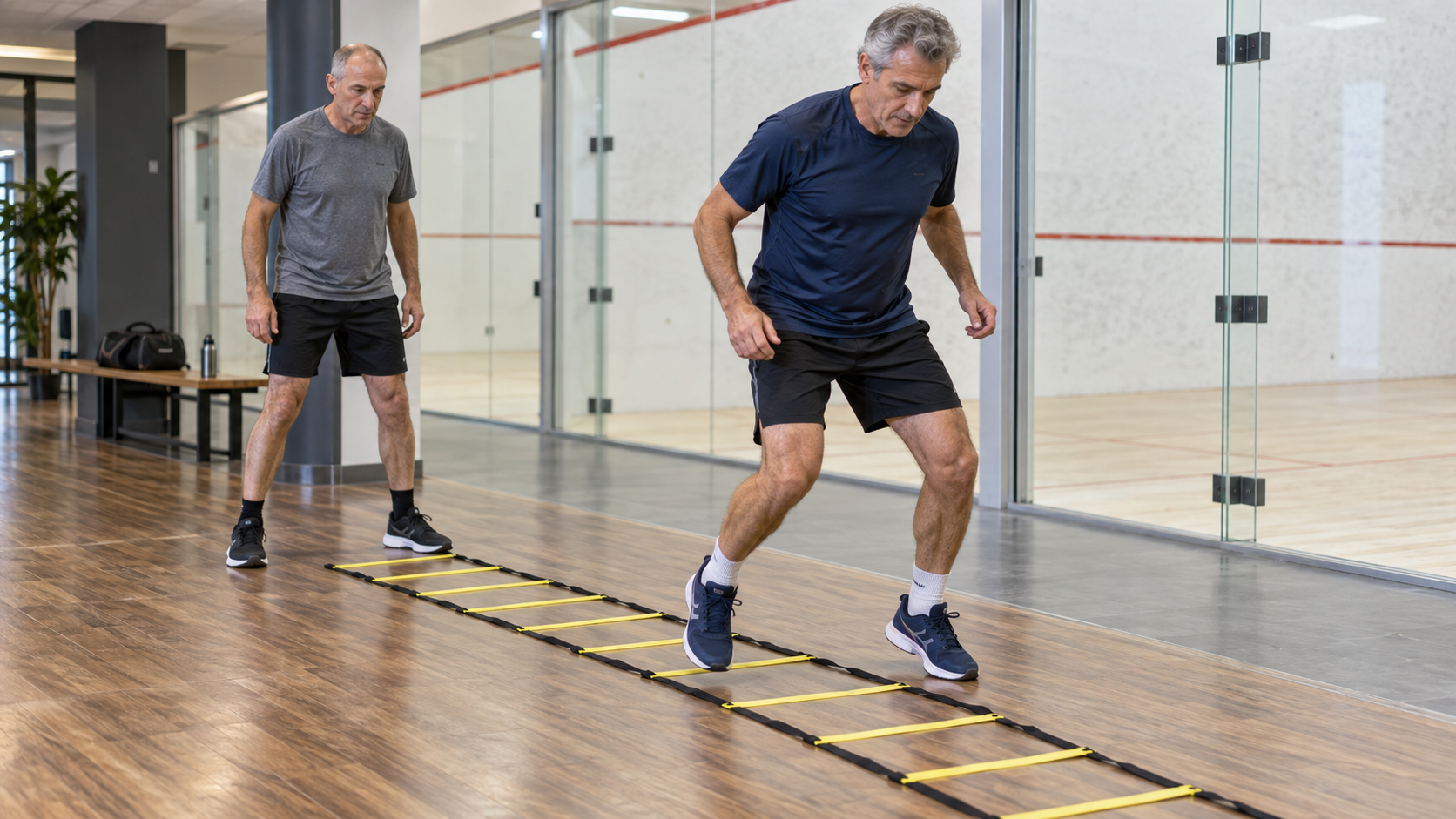
Agility-ladder training develops rapid foot contacts, multidirectional coordination, movement confidence and selected plyometric qualities that prepare racket players to learn sport-specific starting, stopping, reversing and lateral footwork on the court
Three points
- **The ladder develops general movement abilities that matter in every RB Sport.** Planned patterns challenge cadence, spatial accuracy, balance, coordination and the ability to move forward, backward and laterally while organizing the body over changing foot positions.
- **Ladder work becomes plyometric when the drill uses rapid stretch-shortening actions.** Hops, bounds and quick elastic contacts can develop low-level plyometric ability, while slower walking and stepping patterns remain coordination work; both have value when they match the player’s needs.
- **General agility becomes sport skill through progressive transfer.** Ladder exits, braking drills, external cues, ball feeds and conditioned games connect the foundation to the specific distances, postures, perceptions and decisions of squash, tennis, table tennis, badminton and padel.
Racket players rarely move in one direction at one speed. They start, stop, recover, reverse and move laterally, often while the opponent is changing the next task. A squash player leaves the T, controls a lunge and returns through shared space. A tennis player splits, accelerates toward a ball and brakes before striking. A badminton player may move from a low forecourt reach to an overhead rear-court action. A table-tennis player makes small, repeated adjustments around a stable hitting base.
An agility ladder cannot reproduce those sports, but it gives the athlete a visible framework for learning how the feet and body organize during rapid patterns. The rungs define space. The sequence defines a coordination problem. Repetition exposes hesitation, asymmetry, excess vertical movement and loss of posture. For an adult who has played for years without deliberately studying general movement, this can be a valuable learning environment.
Evidence. Systematic reviews show that change-of-direction performance can improve through sprint, strength, plyometric, specific change-of-direction and combined training. They also show that the exact task matters: acceleration, deceleration, angle and number of directional changes alter the demand. Research on speed-agility-quickness programs often includes ladder drills as one element alongside cones, sprints, plyometrics and reaction tasks, which makes it difficult to assign the full result to the ladder alone.
A 2026 randomized study in adolescent badminton players compared ladder training performed with a simultaneous visuomotor task, ladder and reaction work performed sequentially, and a control condition. Both training groups improved several measures, while the simultaneous dual-task group showed an additional reaction-time benefit. The population was young and the study does not establish an adult racket-player prescription. It does support progression from an isolated pattern toward movement coupled with information.
Accepted coaching principle. Learn the pattern at a speed that preserves posture and placement. Increase cadence only after the sequence is stable; then add direction, distance, braking and a relevant external cue.
RacketBridge editorial judgment. The ladder should be described as an agility foundation, not dismissed as choreography and not promoted as a complete agility system. Its value lies in giving a player general abilities that make sport-specific footwork easier to learn.
Diagnose the missing general ability
| Player need | Ladder method | Primary quality | Necessary extension |
|---|---|---|---|
| Hesitates with unfamiliar foot patterns | Slow in-in-out-out and two-feet-in sequences | Coordination and spatial accuracy | Progress to eyes-up movement |
| Starts slowly | Short pattern followed by an immediate exit | Foot organization before acceleration | Extend the exit far enough to accelerate |
| Stops without control | Fast entry followed by a deliberate stick beyond the ladder | Transition from cadence to braking | Add realistic court distance and direction |
| Struggles to reverse | Forward entry, controlled stop and backward return | Reorganization and confidence moving backward | Keep the area clear and add vision before speed |
| Moves poorly laterally | Lateral two-in, lateral Ickey and crossover patterns | Side-to-side rhythm and placement | Transfer to the stance width and distance of the sport |
| Needs elastic contacts | Low hops, hopscotch and quick alternating contacts | Low-level stretch-shortening ability | Manage volume and progress toward multiplanar plyometrics |
| Reacts late | Familiar pattern with a late color, number or direction cue | Perception-action coupling | Use opponent or ball information on court |
| Looks fast in the ladder but slow in rallies | Reduce isolated pattern time | Identifies a transfer failure | Prioritize feeding and conditioned games |
The forward Ickey shuffle uses a repeating three-contact rhythm: two feet enter the square in sequence and the lead foot exits laterally as the body advances. The backward Ickey reverses travel and demands greater orientation because the player cannot depend on forward vision in the same way. Lateral patterns emphasize repeated entry and exit from the side. Hopscotch and single-leg variations add elastic loading and landing control.
These descriptions outline movement; they do not replace demonstration or coaching. A player should first walk the sequence, then perform it smoothly, then increase cadence. Backward and hopping drills require a nonslip surface, a clear area beyond the ladder and enough control to stop safely.
Separate coordination, plyometrics and agility
The terms overlap, but they are not synonyms. Coordination is the organization of body segments toward a task. Plyometric action uses a rapid eccentric-to-concentric stretch-shortening cycle. Change-of-direction ability describes a planned alteration of velocity or direction. Reactive agility adds a response to external information.
Many ladder sessions include all four in sequence. A walk-through is coordination. Quick hops are low-level plyometric contacts. A lateral exit and return introduce change of direction. A partner’s late signal introduces reaction. The ladder becomes more valuable as these layers are added deliberately.
The short spaces between rungs limit the force and distance of the task. Quick contacts inside the ladder cannot fully train the braking demands of a long tennis run, a deep squash lunge or a badminton change from rear court to net. The answer is not to abandon the ladder. It is to use an exit: finish the pattern, accelerate several steps, decelerate under control and organize for the next action.
| Movement problem | Initial ladder response | Counter-response when transfer is incomplete |
|---|---|---|
| Slow first two steps | Short known pattern plus explosive exit | Remove the ladder and react to a ball or opponent cue |
| Poor lateral coordination | Lateral Ickey at controlled speed | Add sport-width movement and a hitting stance |
| Weak reversal confidence | Forward-backward pattern with a stable turn | Increase travel distance and practice seeing the playing area |
| Loud, heavy contacts | Reduce speed and use low elastic steps | Add strength and landing work if control remains poor |
| Feet cross unintentionally | Practice shuffle and crossover as separate choices | Let a coach select which pattern fits the court situation |
| Player watches the ladder continuously | Add an eye-level target or verbal task | Use late directional information after the pattern is automatic |
| Pattern collapses under fatigue | Shorten the repetition and extend rest | Build work capacity separately before increasing complexity |
| Skill disappears in play | Choose one court behavior to transfer | Use a conditioned game that makes that behavior observable |
Adapt the foundation to the player and opponent
An older player may gain most from accurate stepping, controlled backward movement and modest elastic contacts. A quick junior may need less pattern rehearsal and more reactive exits. A powerful player with poor braking needs strength and deceleration work beyond the ladder. A table-tennis player should keep movements compact. Tennis and badminton players must expand into larger accelerations. Squash players need diagonal exits, lunge control and safe recovery toward the T.
Opponent type changes the transfer task. Against a squash retriever, repeated recovery rhythm matters; against an early volleyer, the first step and compact organization matter more. A tennis baseliner may demand sustained lateral movement, while a net player compresses reaction time and changes the direction of the first movement. A table-tennis blocker produces repeated compact placements; an attacker creates less predictable speed and depth. The ladder builds the movement alphabet. The opponent determines the sentence.
Jump rope overlaps with much of this foundation. It can develop rapid contacts, rhythm, bilateral and unilateral patterns, side-to-side motion, conditioning and whole-body coordination while adding continuous upper-body rope control. The ladder offers advantages that rope work does not fully reproduce: visible spatial targets, deliberate stepping into and out of defined spaces, clearer backward sequences, crossing patterns, and exits that lead naturally into acceleration and braking. The tools are complementary rather than interchangeable.
Progress toward sport-specific footwork
| Stage | Ladder task | Court or conditioned-game transfer | Standard for advancement |
|---|---|---|---|
| 1. Learn the pattern | Walk through a forward or lateral sequence | Reproduce the same rhythm without the ladder | Accurate placement and stable posture |
| 2. Add elastic contact | Quick low contacts or controlled hops | Split step and first move to a known target | Quiet contacts and balanced landing |
| 3. Add start and stop | Pattern, short acceleration and controlled stick | Move to a known ball position and recover | No uncontrolled extra steps at the stop |
| 4. Add reversal | Forward pattern, stop and backward or lateral return | Sport-specific recovery toward the base position | Eyes and trunk reorganize before speed rises |
| 5. Add information | Familiar pattern ending on a late direction cue | Two-choice feed or opponent signal | The player responds rather than guesses |
| 6. Add the racket and ball | Brief ladder primer before representative feeding | Conditioned game rewards one movement behavior | The behavior appears without looking for the ladder |
| 7. Remove the equipment | Normal dynamic warm-up | Ordinary scoring with one tactical movement focus | General ability supports spontaneous sport footwork |
Useful conditioned games keep the bridge honest. Squash partners can play length-only while a bonus rewards balanced recovery through the T. Tennis partners can rally crosscourt until the feeder changes direction, with the mover splitting on contact. Badminton players can alternate known forecourt and rear-court patterns before opening the rally. Table-tennis partners can use two predictable placements followed by a free ball. Each condition connects general coordination to perception and sport technique.
Advanced amateurs should judge improvement through court behavior: a cleaner first step, fewer balance-saving steps, a controlled stop, faster reorganization and a better decision after movement. Completing a pattern faster is useful only when placement and posture remain sound.
Buying a simple ladder
Choose flat, visible rungs, adjustable spacing and enough length to establish a pattern. The ladder should remain stable on the intended surface. Raised rungs create more trip consequence; flat floor markers may suit older players or early backward practice. A carry bag is convenient, while elaborate accessory bundles are optional.
Purchasing starting points, checked September 2026: