Article · FF06
A Rope Trains the Whole Player
Jump-rope training joins repeated lower-body force, continuous rope control, trunk stability, rhythm and cardiovascular work in one full-body task—and gives racket players a broad physical base when the rope and progression fit the purpose
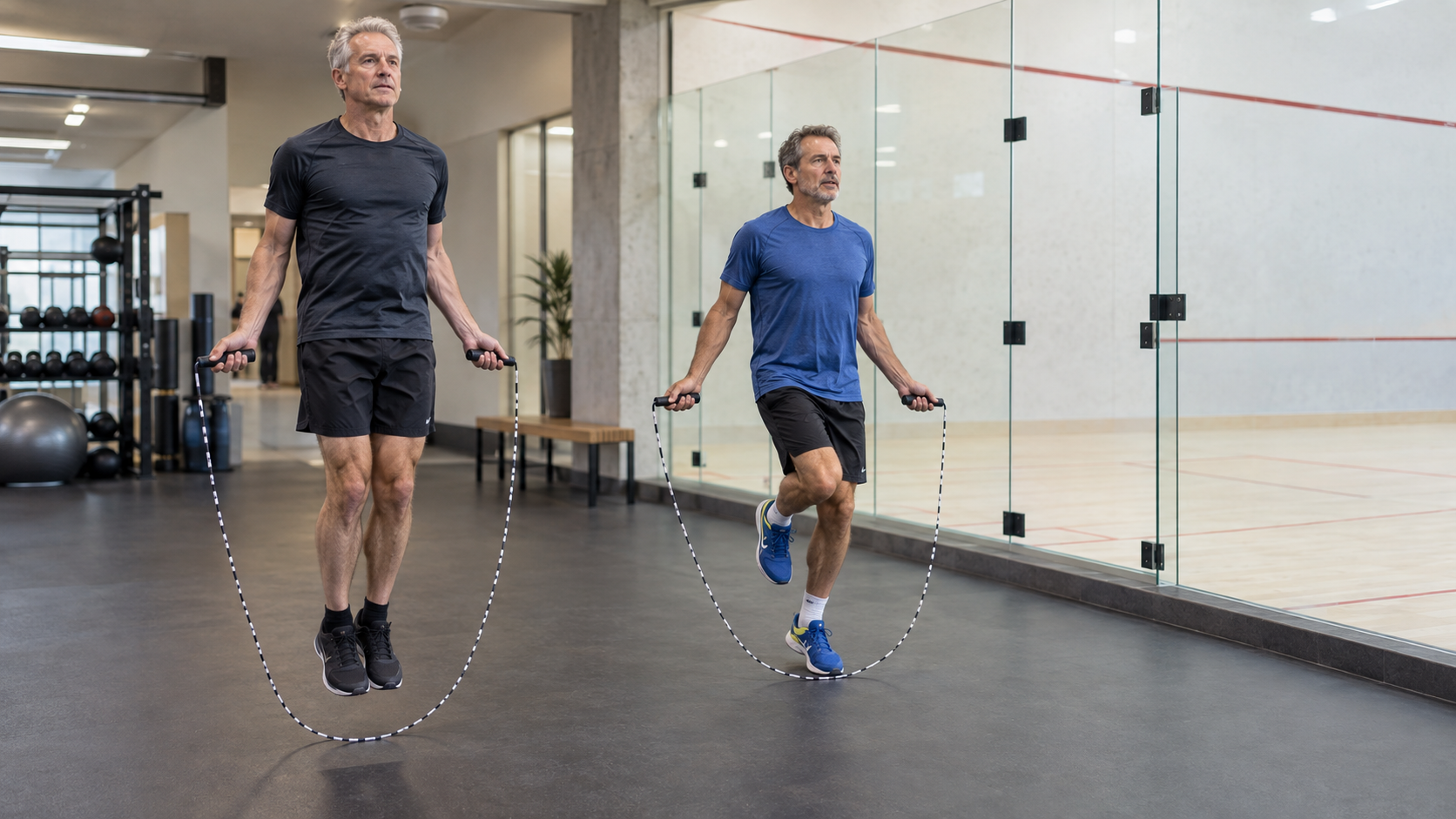
Three points
- **Jump rope is a whole-body coordination and conditioning exercise.** The feet repeatedly leave and meet the ground, while the hands, wrists, forearms, shoulders and trunk maintain the rope’s path, regulate its speed and synchronize upper- and lower-body movement.
- **The rope determines the training effect.** Beaded ropes provide strong sensory feedback and useful resistance for learning; heavier beaded ropes increase upper-body involvement; PVC ropes support advanced rhythm and footwork; thin speed ropes sacrifice feedback and resistance for maximum turnover and are a poor default for most RB Sports players.
- **Broad physical benefits still require court transfer.** Rope work can develop rhythm, coordination, elastic contacts, work capacity and movement confidence, but the player must connect those qualities to braking, lateral movement, opponent reading and sport-specific footwork through drills and conditioned games.
Jump rope is often placed in the same category as running because both can raise heart rate and involve repeated foot contacts. That description misses half the exercise. A runner does not continuously propel and control a flexible object around the body. A jumper must produce the rope’s circular path, preserve its shape, sense its position and place each jump inside a narrow period of time.
The result is a coordinated full-body task. The ankles, knees and hips absorb and return force. The hands and wrists regulate the turn. The forearms maintain the grip and transmit force to the handles. The shoulders and upper arms support the repeated cycle without allowing the hands to wander. The trunk stabilizes the body so that the upper and lower limbs can maintain a shared rhythm. Breathing must continue while all of this happens.
That combination gives jump rope a natural place in RB Sports training. Squash, tennis, table tennis, badminton and padel all require the player to organize the upper and lower body around a moving implement. The resemblance is general rather than technical: turning a rope is not the same motion as striking a ball, and a self-generated rope path is not the same visual problem as reading an opponent. Rope training develops capacities that support sport learning; it does not reproduce the sport.
Evidence. A 2022 systematic review and meta-analysis of 21 controlled jump-rope studies reported improvements across cardiorespiratory endurance, jumping, sprinting, range of motion, and lower- and upper-body strength. The studies involved 1,021 participants, and 18 studies had a mean participant age below 18, so the results cannot be converted directly into a prescription for middle-aged recreational players. A controlled study of university students also reported improvements in cardiovascular response and several strength measures, although the intervention was brief and the results do not isolate which muscles or rope characteristics produced the changes.
Research specifically testing weighted ropes adds nuance. A small study in adolescent volleyball players found that weighted-rope training improved some coordination and lower-limb endurance measures more than ordinary rope training. A recent exploratory study of weighted-rope work in CrossFit participants found no significant changes in measured shoulder rotational strength. The responsible conclusion is that rope work engages the upper body and can contribute to strength and endurance, especially as rope resistance rises, but a standard rope is not a replacement for progressive resistance training.
Accepted coaching principle. Efficient rope turning uses a stable posture, relatively quiet upper arms and economical wrist-led rotation. A heavier rope increases the force needed to preserve the arc, but useful resistance should not turn the movement into large shoulder circles.
RacketBridge editorial judgment. Jump rope deserves to be presented as a full-body functional-fitness tool. Its special value is integration: the player develops rhythm, repeated force, object control, posture and work capacity at the same time.
Choose the training effect before choosing the rope
The phrase “jump rope” conceals very different tools. A thin cable rotates quickly because it produces little drag. A beaded rope has distributed mass and gives audible and tactile information as it meets the floor. A thicker PVC rope turns smoothly and supports faster patterns once timing is stable. A deliberately weighted rope creates a larger demand on grip, arms, shoulders and trunk.
| Primary objective | Rope choice | Whole-body demand | Limitation to respect |
|---|---|---|---|
| Learn the basic rhythm | Standard beaded rope | Clear hand-foot timing, moderate turning resistance and audible feedback | Ordinary beads improve feedback more reliably than strength |
| Build upper-body endurance while learning | Heavier beaded rope | Greater grip, forearm, shoulder and trunk involvement | Added weight magnifies inefficient arm action |
| Develop advanced foot rhythms | Durable 4–6 mm PVC rope | Faster coordination with continuing full-body rhythm | Progress only after the jumper controls posture and the rope arc |
| Develop a demanding conditioning interval | Heavier beaded or purpose-built weighted rope | Larger cardiovascular and upper-body demand | Fatigue can widen the hands and change shoulder mechanics |
| Practice low, repeated elastic contacts | Beaded or PVC rope | Ankle-calf stretch-shortening work with coordinated turning | Tissue tolerance may lag behind cardiovascular fitness |
| Train maximum competitive turnover | Thin cable speed rope | High timing demand with minimal rotational resistance | Offers little feedback, punishes errors and adds limited value for most racket players |
| Prepare to play | A familiar beaded or PVC rope | Temperature, rhythm and integrated readiness | Learning a new pattern before a match wastes attention and may create fatigue |
Beaded ropes are the best first choice for the RacketBridge program because they communicate their position. The jumper can see the arc, hear contact with the floor and feel the rope travel through the handles. A heavier beaded rope increases resistance and can make the upper-body contribution more obvious. The distinction matters: “beaded” describes construction, not a guaranteed training load. Buyers should check total rope weight rather than assuming every beaded model develops strength.
PVC ropes suit players who already control the basic bounce and alternate-foot step. They support side straddles, forward-and-back patterns, boxer-style weight shifts and cadence changes. Speed ropes are designed for a different priority. Their thin cables favor double unders and maximum revolutions, but they reduce the feedback that helps a recreational player coordinate the entire movement. For RB Sports, speed is a later option rather than the standard.
Understand what the upper body contributes
The rope travels because the upper body creates and maintains its motion. Good technique does not mean the shoulders do nothing. It means the shoulders, arms and trunk provide an efficient platform while the wrists regulate the turn. As the rope becomes heavier, the player must produce more rotational force and resist greater disruption to posture.
A fatigue study of continuous double unders measured changes at the wrist, elbow and shoulder and concluded that shoulder muscular endurance may matter for preserving technique. That study involved a demanding skill rather than ordinary recreational skipping, but it confirms that the upper body is part of the performance system. Rope training also challenges the trunk to limit unnecessary rotation and bending while forces move through both handles.
The coordination is best described as hand-foot and whole-body visuomotor timing. The eyes help establish orientation and may monitor the rope, while the hands and feet operate within a repeating visual, auditory and tactile cycle. Ball tracking is different: an opponent generates the ball’s speed, spin and direction. A player should value rope coordination without claiming that it substitutes for reading a serve, volley or wall rebound.
| Player type | Productive emphasis | Likely response | Training counter-response |
|---|---|---|---|
| Older returning player | Short beaded-rope sets and quiet two-foot contacts | Calves fatigue before breathing becomes difficult | Increase contacts gradually and alternate with non-impact conditioning |
| Strong lower body, weak upper-body endurance | Heavier beaded rope at controlled cadence | Hands widen and shoulders begin circling | Shorten the set and restore wrist-led turning before adding resistance |
| Fit runner new to rope | Basic bounce and rope control | Tries to run fast while the rope follows unpredictably | Slow the cadence and make rope contact, posture and landing consistent |
| Skilled squash player | Alternate-foot rhythm, trunk stability and lateral patterns | Assumes court fitness guarantees jump tolerance | Begin below conditioning capacity and monitor next-day Achilles and calf response |
| Tennis or badminton player | Rhythm changes followed by split-step and first-step tasks | Turns rope practice into continuous vertical bouncing | Pair the final rope contacts with a purposeful lateral or diagonal exit |
| Table-tennis player | Compact contacts and rapid stance recovery | Uses movements too large for the sport | Reduce displacement and transfer the rhythm to small side-to-side adjustments |
| Advanced rope specialist | Weighted and PVC work with varied rhythms | Confuses rope mastery with reactive movement | Protect time for opponent-driven court practice |
Progress from full-body rhythm to racket movement
Jumping itself is low-level plyometric work when each landing rapidly loads the muscle-tendon system before the next takeoff. Intensity rises with jump height, unilateral contacts, speed, resistance and accumulated fatigue. Calling every rope session “plyometric training” without describing the load is unhelpful. A low basic bounce and repeated high double unders are not the same task.
Likewise, side-to-side and forward-and-back rope patterns develop general multidirectional coordination, but they do not expose the player to the distance or braking force of a court sprint. Rope work builds a base. The court supplies scale, perception and decision.
| Progression | Rope task | Court or conditioned-game transfer | What success looks like |
|---|---|---|---|
| 1. Integrate | Basic bounce with economical wrist turning | Balanced ready stance after the set | Hands remain close, trunk stays tall and contacts remain quiet |
| 2. Alternate | Alternate-foot step | Split step followed by a known first step | No extra hop appears between the rope and court movement |
| 3. Move laterally | Side straddle or skier pattern | Known forehand-backhand shadow movement | The player controls direction without excessive vertical bounce |
| 4. Respond | Stable rope rhythm ending on a late left-right cue | Partner indicates one of two movement targets | The player reads before moving |
| 5. Read the ball | Short rope interval followed by unpredictable feeding | Two-corner or two-placement drill | Coordination survives the change from self-generated to external timing |
| 6. Play | Remove the rope | Conditioned game rewards balanced recovery after the opponent changes direction | The movement behavior appears during a real rally |
Different opponents expose different capacities. A squash retriever tests whether posture and rhythm survive repeated extra shots. An early volleyer tests the first step and the ability to organize quickly. A tennis power player tests response and stability rather than rope speed. A table-tennis blocker creates a compact, repetitive lateral problem. Rope work contributes to all four situations through broad fitness, but only live or representative practice teaches the actual solution.
Advanced amateurs should begin with quality rather than volume. Stop a set when landings become loud, the jump grows unnecessarily high, the hands drift outward, the shoulders dominate, posture folds or errors multiply. Pain in the foot, Achilles tendon, knee, hip, back, wrist or shoulder changes the decision. Repeated-impact exercise and weighted-rope work deserve appropriate progression and, when health or injury questions exist, individualized professional advice.
Buying for integrated training
Look for adjustable length, a rope body appropriate to the objective, handles that turn freely without encouraging a loose grip and construction suited to the surface. A standard beaded rope is the strongest first purchase. A heavier beaded model is a useful second choice for greater rotational resistance. A PVC rope supports advanced rhythm. A speed cable should be purchased only for a specific speed goal.
Purchasing starting points, checked September 2026: