Article · FF04
Train the Capacity Once, Practice Each Sport Honestly
A multi-racket week can share strength, balance and aerobic preparation while preserving the distinct timing, footwork and decisions that make each game a separate skill
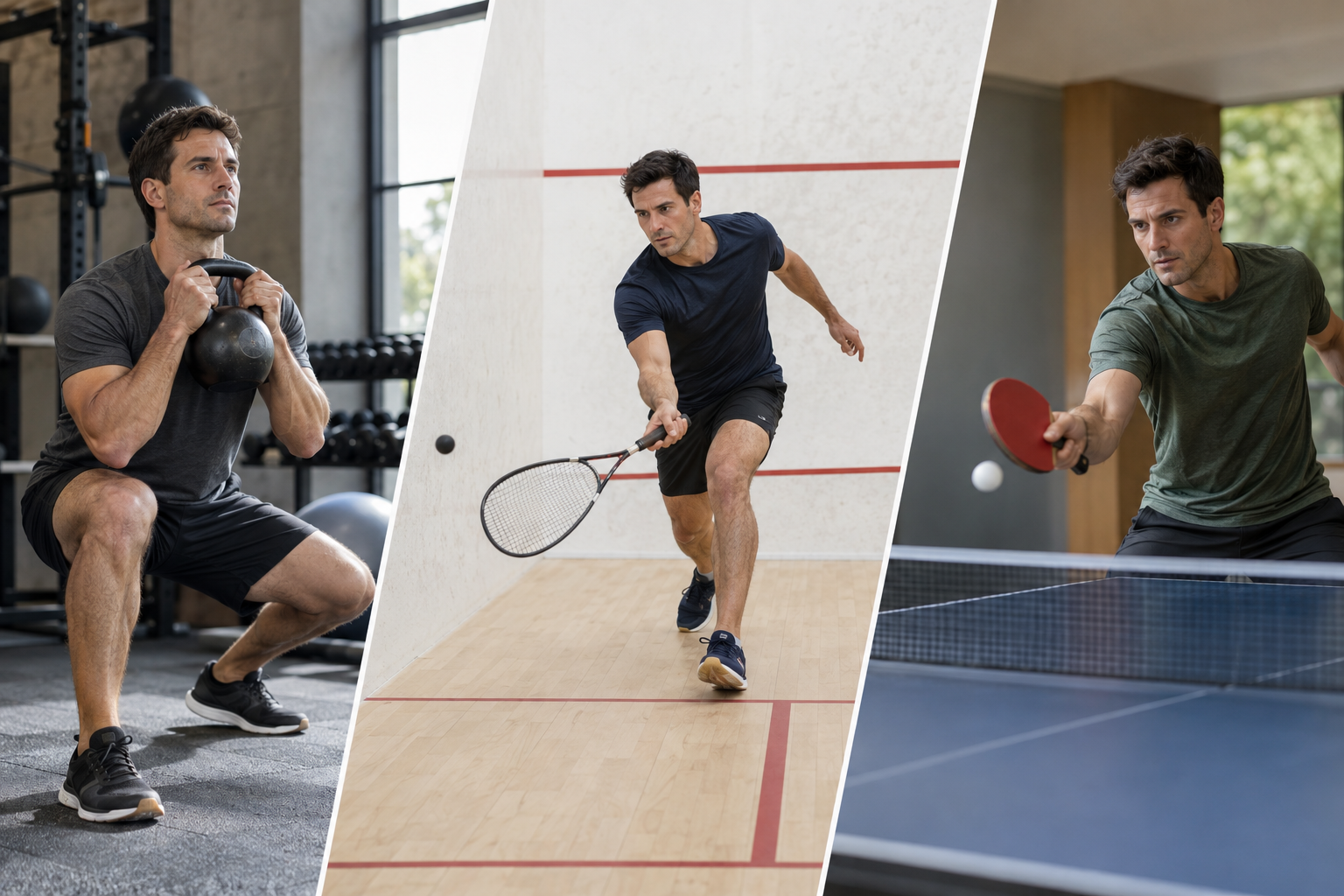
Three points
- **General capacity can serve several sports.** Strength, mobility, aerobic recovery and controlled braking provide a common physical base.
- **Transfer stops where the task changes.** Squash walls, table-tennis spin, tennis space, badminton flight and padel partnership require sport-specific practice.
- **The week should distribute demand.** Technique, social play, competition and recovery cannot all become maximum sessions.
Playing two sports can broaden movement and protect interest. It can also create a week in which every coach adds work without seeing the other sessions. The player needs one plan.
Share capacities, separate techniques
| Capacity | Shared value | Sport-specific expression |
|---|---|---|
| Lower-body strength | Push, brake and recover | Different stance, distance and timing |
| Trunk control | Transfer force and retain balance | Stroke and overhead patterns differ |
| Aerobic capacity | Recover across rallies and sessions | Rally density varies by format |
| Balance | Control reaching and direction change | Wall, net and partner geometry differ |
| Observation | Use opponent and ball information | Cues differ by racket, spin and flight |
General training builds potential. Only court practice teaches when and how to use it.
Map the demands before scheduling
| Session | Main load | Pair carefully with |
|---|---|---|
| Hard squash match | Braking and repeated court movement | Not another maximal change-of-direction day |
| Table-tennis multiball | Dense posture and stroke repetition | Variation and upper-limb recovery |
| Tennis serve practice | Concentrated overhead volume | Controlled serving elsewhere in week |
| Badminton jumps | Landing and overhead demand | Lower-intensity next session |
| Padel social match | Pair movement plus overheads | Actual action count, not “social” label |
Build a sustainable two-sport week
| Day | Emphasis | Control point |
|---|---|---|
| Monday | Primary-sport technique and moderate play | Finish with movement recognizable |
| Wednesday | Strength, balance and mobility | Address capacity gaps |
| Friday | Second sport, coached or social | Keep novelty below maximal intensity |
| Weekend | Optional easy practice, walking or rest | Review symptoms, sleep and desire to play |
This is an example, not a prescription. Change one major variable—frequency, duration, intensity or complexity—at a time. A fit tennis player remains exposed to unfamiliar squash braking; general fitness does not erase task novelty.
Let enjoyment regulate continuity
Variety should create more reasons to move, not a second obligation. If the additional sport repeatedly damages recovery, conflicts with valued play or creates pain, reduce its load or frequency. If it expands the social circle and renews attention, it may strengthen the whole playing life.
Tell each coach about the complete week. The best program connects shared preparation, honest sport-specific practice and enough recovery to keep friends, functional fitness and fun available next month.
Review transfer with evidence
After four weeks, ask what actually changed. Did table tennis improve early observation in squash, or did the player merely enjoy the contrast? Did squash movement expose a braking limitation worth training generally? Did the second sport reduce or increase discomfort and fatigue?
Transfer is a hypothesis until court behavior changes. Keep the second activity when it adds useful movement, people or motivation at an acceptable recovery cost. Change it when novelty becomes unmanaged load.
Functional fitness improves when capacity remains usable across real tasks. Cross-sport play can test that usability, but court participation does not automatically supply balanced strength or mobility. Preserve progressive off-court preparation where the player’s needs require it.