Article · CS04
Tennis Eyes, Table-Tennis Time
Tennis players understand preparation, placement and point construction, but table tennis compresses the available time and magnifies spin enough to require smaller actions and earlier information
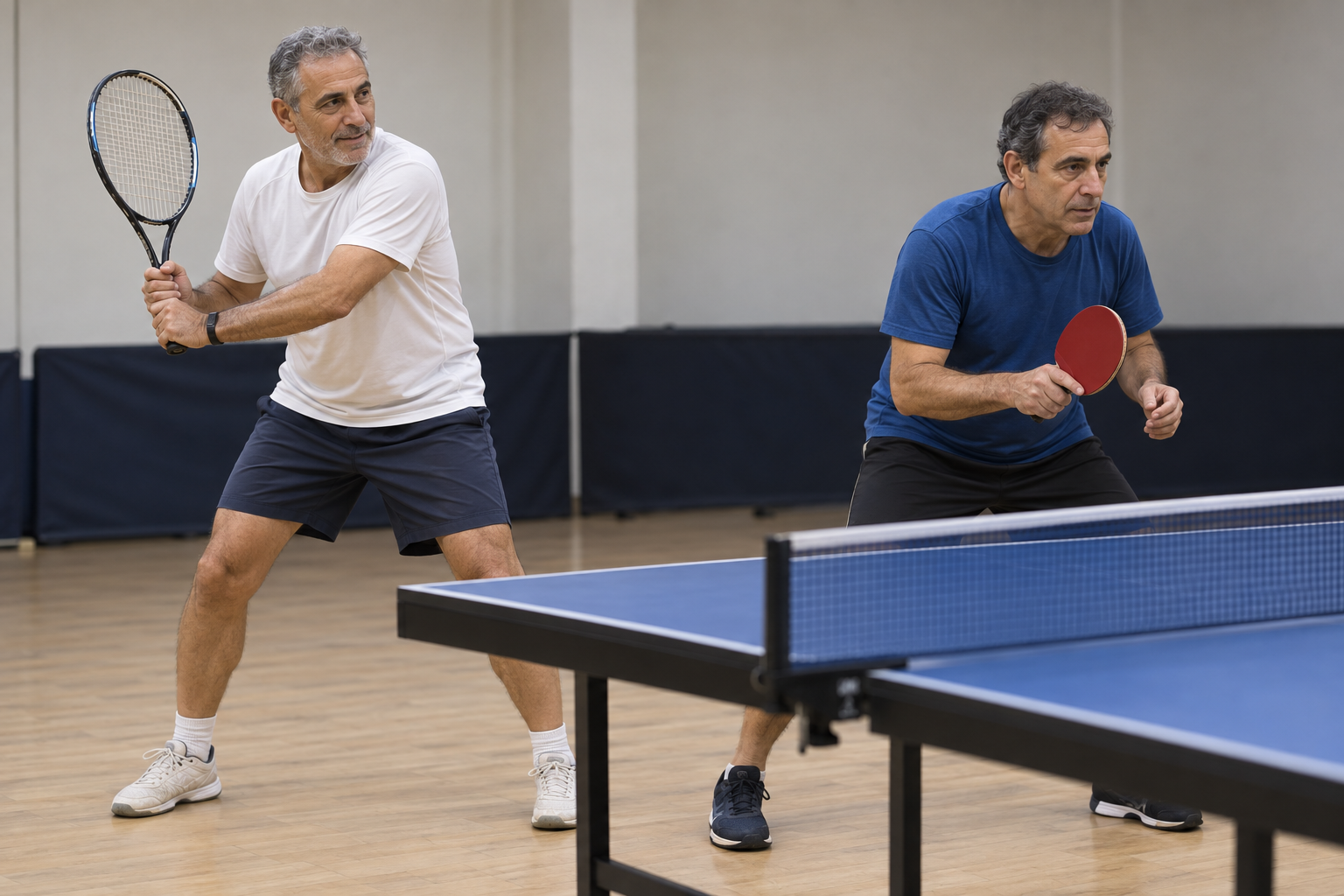
Three points
- **Tactical habits transfer more readily than stroke dimensions.** Tennis players can retain purposeful targets and recovery while rebuilding swing length and racket angle.
- **Spin becomes immediate evidence.** The receiver must read serve contact, ball flight and bounce before committing the paddle.
- **A useful introduction rewards control.** Serve return, a stable rally and two-target placement reveal more than one fast forehand.
Tennis teaches players to organize before contact and to use one ball to influence the next. Table tennis preserves those ideas on a 2.74-meter table, with a light ball and a much shorter interval between opponent contact and response. The newcomer who waits for the bounce often discovers that the decision has already passed.
| Tennis resource | Table-tennis value | Required change |
|---|---|---|
| Early unit turn | Preparation before arrival | Make the action much more compact |
| Target selection | Placement over random pace | Use table zones and opponent position |
| Recovery after contact | Readiness for the next ball | Recover within centimeters, not meters |
| Reading opponent shape | Advance information | Attend closely to paddle angle and contact |
| Topspin experience | Understand rotation changes flight | Learn the stronger rebound response to incoming spin |
| Serve strategy | Begin a planned point | Rebuild legality, toss, contact and short-table tactics |
Learn the return before the attack
A fast racket may help an attacking ball while making serve receive less predictable. Begin with varied but moderate serves. The receiver calls the likely spin, selects an open, neutral or closed angle, and aims to a large target. The coach corrects one source of information at a time.
| Task | Measure | Advance when |
|---|---|---|
| Spin recognition | Correct call before bounce | Reading exceeds guessing consistently |
| Controlled return | Low playable ball to large target | Angle remains stable across variation |
| Diagonal rally | Repeatable exchange | Feet adjust before the stroke |
| Direction change | Two target zones | Placement survives moderate pace |
| Opening attack | Attack a predictable long ball | Recovery follows contact |
Use a first-session scorecard
| Question | Useful evidence |
|---|---|
| Did preparation become smaller? | Paddle waits near the next likely contact |
| Did the player read spin earlier? | Calls rely on opponent contact, not only bounce |
| Did the feet remain active? | Player adjusts instead of reaching |
| Did equipment support learning? | Returns and rallies stay controllable |
| Is another session worthwhile? | Player names a specific skill and format |
The tennis player brings a mature understanding of point construction. Table tennis teaches that construction at a speed and scale where excess movement becomes visible immediately.
Keep equipment from hiding the lesson
A tennis player may assume that a faster blade and highly responsive rubber will reward the acceleration already developed on a larger court. The equipment may instead amplify unfamiliar incoming spin and punish a long action. Borrow a moderate setup for the first sessions. Compare equipment only after the player can return several kinds of serve and sustain a controlled rally.
The first coach should also resist correcting everything through tennis analogies. “Shorter swing” helps only when the player understands when preparation begins, where contact belongs and how the paddle angle relates to spin. One external target, such as sending the ball low over the net to a marked zone, often supplies clearer information than several body instructions at once.
Turn rapid exchange into functional training
Table tennis asks for repeated ankle, knee and hip flexion, small pushes in either direction, trunk rotation and fast visual decisions. It does not reproduce the running demand of tennis. That difference makes it a useful second activity rather than a miniature substitute. The tennis player can train compact balance and early perception on days when a full court is impractical, while still managing the repeated posture and upper-limb load described in the table-tennis injury literature.
A successful second session should add varied serve receive and a short conditioned game, such as scoring only after changing direction under control. The condition connects familiar tactical purpose with the smaller technical action the new sport requires.